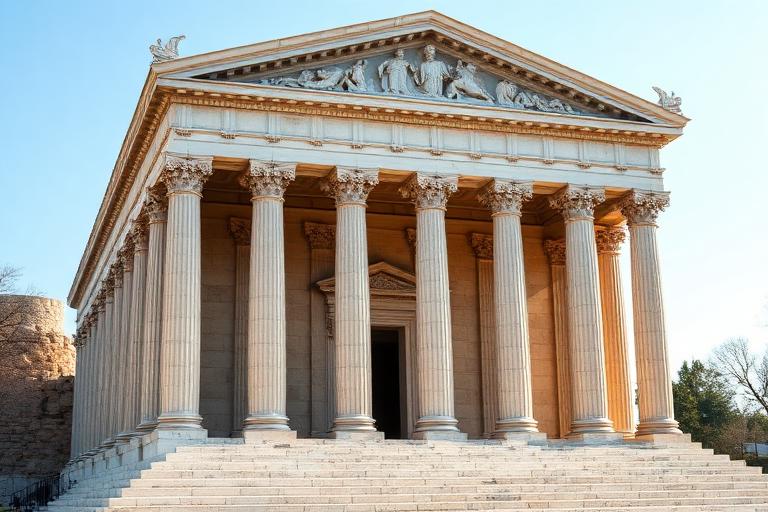
Architectural Postmodernism

Irony, quotation, and ornament returned - Venturi told architects to learn from Las Vegas, Johnson put a Chippendale top on a skyscraper, and Graves painted Portland's city hall in peach and blue.

Compare Architectural Postmodernism with another style →See the Architectural Postmodernism typefaces →On the timeline · 1960s
Record020-AP
AestheticArchitectural Postmodernism
ClassMaximal / Expressive
StatusINGESTING
Architectural Postmodernism aesthetic archive image
Archive plate · Architectural Postmodernism
01
The record

What it is, when it works, who it is for, and where it already exists.

How to use it

Record 020-AP - when it works, who it is for, what it looks like

FIELD 01

When to use it

  • Brand identity that embraces knowingness, wit, and historical wink
  • Fashion or lifestyle campaigns playing with pastiche and deliberate excess
  • Cultural institution branding that wants complexity over clarity
  • Editorial and publication design mining the 1980s postmodern archive
FIELD 02

Perfect for

  • Lifestyle and fashion brands with intellectual irony as a voice
  • Cultural institutions, galleries, and museums with eclectic collections
  • Hospitality and restaurant brands leaning into maximalist design conversation
  • Creative agencies wanting to signal historical awareness and cultural range

In the wild, Architectural Postmodernism aesthetic real-world examples

Where this aesthetic shows up in the real world · ↗ opens the source site

Omoro Style GuideEvery aesthetic, every field on this page, in one PDF.
$8Get the guide →
02
The anatomy

Where Architectural Postmodernism came from, what makes it recognisable, and the fingerprint it leaves.

History, Architectural Postmodernism aesthetic history

1966-1990s · United States, expanding to Europe and Japan

Postmodern architecture began as an intellectual rebellion. Robert Venturi's 'Complexity and Contradiction in Architecture' (1966) argued that Modernism's insistence on simplicity was reductive and dishonest. His mother's house in Philadelphia (1964), with its deliberately awkward split gable and oversized chimney, was architecture as argument. Charles Jencks declared Modernism dead in 1972 when the Pruitt-Igoe housing project in St. Louis was demolished, and a new movement needed a name.

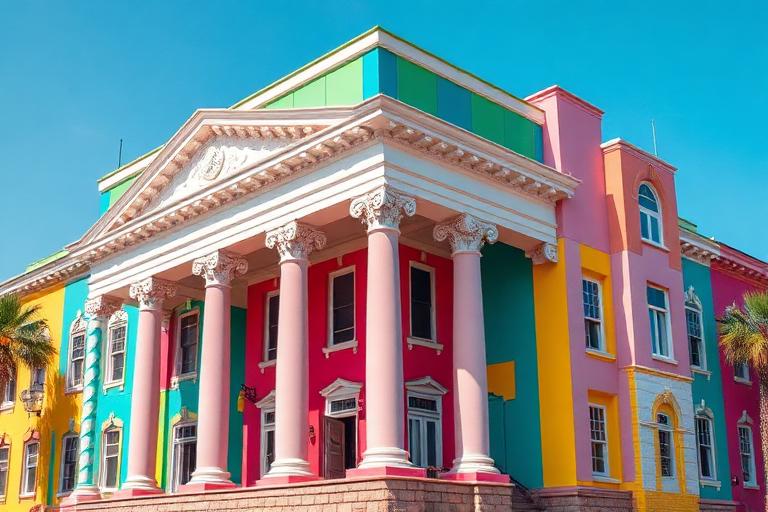
Through the 1970s and 1980s, Postmodernism became the dominant mode for public and commercial architecture. Michael Graves' Portland Building (1982) wrapped a concrete box in pastel-colored classical references. Philip Johnson's AT&T Building (1984) put a Chippendale pediment on a Manhattan skyscraper. Charles Moore's Piazza d'Italia in New Orleans (1978) stacked neon-lit classical columns in a public plaza. The movement treated architectural history as a free library of quotable forms, mixing eras, scales, and levels of seriousness.

Critics accused Postmodernism of being superficial, of applying historical decoration to the same cheap construction that Modernism used. By the 1990s, the movement's playfulness had curdled into formula, and Deconstructivism and Neo-Modernism offered alternatives. But Postmodernism's legacy endures: it broke the stranglehold of Modernist orthodoxy, legitimized color and ornament in serious architecture, and demonstrated that buildings could communicate through reference and humor as well as through structure and material.

Architecture learned to wink.

Omoro dossier · 020-AP

Visual markers, Architectural Postmodernism aesthetic visual markers

The visual DNA: what makes it recognisable

typography

See the fonts
  • Classical serif revivals: Garamond, Palatino, Bodoni
  • Playful mixing of serif and sans-serif in the same composition
  • Decorative and display typefaces used without irony or with full irony
  • Type as ornament: oversized, colored, and treated as graphic element

grid

  • Symmetrical facades broken by deliberate irregularities
  • Classical tripartite division (base, middle, top) applied to modern buildings
  • Layered facades with applied elements creating depth
  • Oversized or undersized elements playing with scale expectations

materials

  • Pastel-painted surfaces: salmon, teal, dusty rose, periwinkle
  • Polished granite and marble veneers: #C8B8A0, #E8D8C8
  • Bright accent colors: #E85040, #4088C0, #F0C040
  • Gold leaf and metallic finishes for classical references

motifs

  • Classical columns, pediments, and arches used out of context
  • Oversized keystones and exaggerated moldings
  • Split pediments and broken cornices
  • Neon lighting integrated into architectural elements

Aesthetic profile

8-channel console with the fingerprint on its display. Save the card, or share the page

Aesthetic Profile
Architectural Postmodernism
Postmodern
1970–1995
Attribute console · 020-AP
leans maximal, expressive, chaotic
8 CH
FIG. 1
MaximalMinimalAnalogDigitalExpressiveRestrainedWarmCoolNostalgicFuturisticChaoticStructuredLightDarkGeometricOrganic
01Minimal
Maximal60%
02Analog
Digital10%
03Restrained
Expressive60%
04Cool
Warm30%
05Futuristic
Nostalgic20%
06Structured
Chaotic40%
07Dark
Light30%
08Organic
Geometric20%
MaximalExpressiveChaotic2 materials
Omoro · Attribute console · 020-AP
omoro.io/styles/arch-postmodernism

Material assembly

The style's primary materials, assembled bottom-up

Tap a stratum for material detail · Full catalog

Place in history

Postmodern · 1970–1995 - tap any style to travel

Color Palettes, Architectural Postmodernism color palettes and hex codes

4 color interpretations of this aesthetic

Architectural Postmodernism
#4A7FB5 · #7B3F6E · #C17F3A · #E8DCC8 · #1A1410
Irony, ornament, and historical quotation reclaimed against Modernist austerity
AT&T Pediment
#1A1410 · #6A5838 · #A89070 · #D8C8A8 · #C85848
Philip Johnson's Chippendale top: granite skyscraper as furniture
Piazza d'Italia
#181828 · #C84020 · #3060C0 · #E0C030 · #D8D0C0
Charles Moore's neon-lit classical orders in New Orleans
Portland Building
#1A2830 · #2878A0 · #C87040 · #E8D8B0 · #D0A860
Graves' polychrome: terracotta, teal, and cream on a civic box
Omoro Palette Pack575 curated palettes across every aesthetic, 5 export formats.
$8Get the palettes →

Adjacent Palettes, styles related to Architectural Postmodernism

The colour of the styles sitting closest to this one

Classical Architecture
Neoclassical Architecture
Stripped Classicism
Art Deco Architecture
03
The direction

How to shoot it, how to prompt it, and how to board it.

Photo Direction

How to shoot this aesthetic

"Classical rules, borrowed and winked at in the same building"

Shot list

  • Wide shot of a facade with applied color and playful classical reference
  • Detail shot of ironic classical ornament an oversized keystone, an exaggerated column
  • Wide shot capturing bold polychrome facade panels

Lighting

Bright, even daylight that lets the applied color read at full saturation

Omoro Director's Briefs151 photo shot-lists like this one, ready to shoot from.
$8Get the briefs →

Generative Prompt

Drop this into Studio to generate in this aesthetic

Postmodern aesthetic with playful historicism, ironic classical references, Michael Graves and Robert Venturi influence

Paste as-is, or append your own subject

Mood Board

The record applied to your project. The record's kit is free; your brand, references and plates come with membership

Mood board
The Architectural Postmodernism board
8 frames · 4 selected
FIG. 4
Portland Teal4A7FB5Velvet Plum7B3F6ETerracottaC17F3AStucco CreamE8DCC8Lobby Dark1A1410
Brand and references
IdleBrand and references open with membership
With membership: the brand's own facts and colours in every prompt, references carried into every frame, and the plates generated.
01 · Hero application
02 · Material and finish
03 · Palette in context
04 · Photography direction
05 · Pattern plate
06 · Object
07 · Environment
08 · Digital presence
Demo kit free, the rest with membershipThe record as a demo kit, free. Name a project and it is written for that
Omoro · Mood board · 020-AP
04
The judgement

Whether to use it, what it costs to do properly, and where it stands right now.

Creative verdict, Architectural Postmodernism feasibility and strategic recommendation

Two written calls, seven meters, and when to walk away

Creative verdict
Should Architectural Postmodernism be the call?
7 meters
FIG. 2
Assessment

The quotation has to be specific enough to read. A pediment on a shed is only witty if the viewer recognises the pediment, so the reference needs to be canonical and clearly stated. Exaggerate the scale of the borrowed element. Colour is structural here, not applied, and a muted palette turns the joke into an accident.

Verdict

Worth reconsidering right now, because the buildings are reaching the age where demolition becomes a live question and preservationists are fighting for work the profession was embarrassed by a decade ago. Right when humour and legibility are the point, which was the original argument against a modernism that had become humourless. Wrong when the client cannot tolerate being called unserious.

Production cost
Medium

Ornament and quotation, often applied to an existing structure.

Creative difficulty
High

Irony has to land as commentary, not just a Chippendale top for its own sake.

Execution difficulty
Medium

Applying historical reference well is a curatorial skill, not raw craft.

Risk of misuse
Medium

Irony that doesn't land just reads as random ornament, not commentary.

Prevalence
Rare

A niche architectural reference outside academic and design-critical contexts.

Longevity
Enduring

Still a serious, debated position in architectural history.

Brand investment
Medium

Ornament and quotation, often applied to an existing structure.

Avoid if
The audience won't recognize what's being quoted
Irony and pastiche only land if the reference is familiar.
The brand needs to feel serious or restrained
This movement is built on playfulness and provocation.
Omoro · Creative verdict · 020-AP

Editorial Depth

A Pro feature: origins, practitioners, and pitfalls

Editorial depth
The Architectural Postmodernism file
14 sections
FIG. 3
Context02Brands02Perception04Use04Index02
01Common MisconceptionThe principle beneath the surface
02Historical ContextOrigins, cultural moment, and reaction
03Brands That Accidentally Use This StyleNatural alignment, not category claims
04Brands That Perfectly Represent This StyleExceptional execution
05Psychological EffectHow visual decisions change perception
06Visual ChecklistInclude and avoid
07Creative FormulaThe visual system reduced to essentials
08Recognition SignalsHow to recognize it in two seconds
09When To Use This StyleContexts where the language performs
10Common Creative MistakesWhere imitation weakens the signal
11Best Brand ApplicationsIndustries with a natural advantage
12Creative Application AnalysisFit, feasibility, and production reality
13Related StylesClose languages and the key distinction
14Visual DNA SummaryThe sentence to remember
The editorial depth, with membershipOpening soon
Omoro · Editorial depth · 020-AP
05
The index

Neighbours, cross-references, blends, and the questions people ask.

Related concepts

Connected across the creative knowledge graph

Cultural relevance, Architectural Postmodernism cultural relevance today

Where it stands now, and what it costs you to use it

Postmodern architecture was a genuine argument that modernism had become humourless and illegible, and for about fifteen years it won.

It then became the most despised period in recent architecture, which is only now reversing as the buildings reach the age where demolition becomes a live question.

Preservationists are currently fighting for buildings that the profession was embarrassed by a decade ago. That reversal is worth watching if you are deciding whether to quote it.

Cross-references

Architectural Modernismthe movement Postmodernism explicitly rejectedMemphisMemphis design was Postmodernism's furniture and object counterpartClassical ArchitectureClassical architecture provided the vocabulary Postmodernism quoted and subvertedDeconstructivismDeconstructivism succeeded Postmodernism as the avant-garde position

Blend

Mix Architectural Postmodernism with any style in the library

Architectural Postmodernism×
50%50%
56% alike
Architectural Postmodernism referenceClassical Architecture referenceArchitectural Postmodernism 50%Classical Architecture 50%

Merged palette

#4A7FB5

#2C2416

#7B3F6E

#6B5B45

#C17F3A

Leads nostalgic, analog, geometric

Typography · from Architectural Postmodernism

Abril Fatface over Lora

Materials

  • Pastel-painted surfaces: salmon, teal, dusty rose, periwinkle
  • Polished granite and marble veneers: #C8B8A0, #E8D8C8
  • White marble and limestone: #F0EDE8, #E8E4DC, #D8D4CC

The calls this blend forces

These two disagree on 2 things, and a blend cannot average them: you pick a side. At this mix:

Chaotic or Structured? Architectural Postmodernism is chaotic, Classical Architecture is structured. This mix lands structured.

Expressive or Restrained? Architectural Postmodernism is expressive, Classical Architecture is restrained. This mix lands expressive.

Use it

Postmodern aesthetic with playful historicism, ironic classical references, Michael Graves and Robert Venturi influence (50%), infused with Classical architecture with Greek and Roman orders (Doric, Ionic, Corinthian columns) pediments and entablatures, symmetrical proportion governed by classical ratio, marble and stone construction, timeless civic monumentality, color palette strictly #4A7FB5 #2C2416 #7B3F6E #6B5B45 #C17F3A, leaning chaotic over structured, expressive over restrained, overall character: nostalgic, analog, geometric

One-click generation opens with the studio

About this aesthetic

What is Postmodern architecture?

Postmodern architecture is a movement from the 1960s-1990s that rejected Modernism's austerity by reintroducing color, ornament, and historical references. It treated architectural history as a source of quotable forms, mixing classical elements with modern construction in compositions that ranged from ironic to celebratory.

What is the most famous Postmodern building?

Michael Graves' Portland Building (1982) is often cited as the canonical example: a municipal office building wrapped in pastel-colored classical references. Philip Johnson's AT&T Building (now 550 Madison Avenue) with its Chippendale pediment is equally iconic. Both demonstrated that serious architecture could be playful.

Is Postmodern architecture still being built?

Pure Postmodernism as a movement ended in the 1990s, but its influence persists. Contemporary architects freely mix historical references, use bold color, and embrace ornament without the anxiety that defined Modernism. The difference is that today's eclecticism is not branded as a movement.

Build with the architectural postmodernism aesthetic

Every style in the library is broken down like this one: the palette, the typography, the materials and the lineage.

Explore the style library →