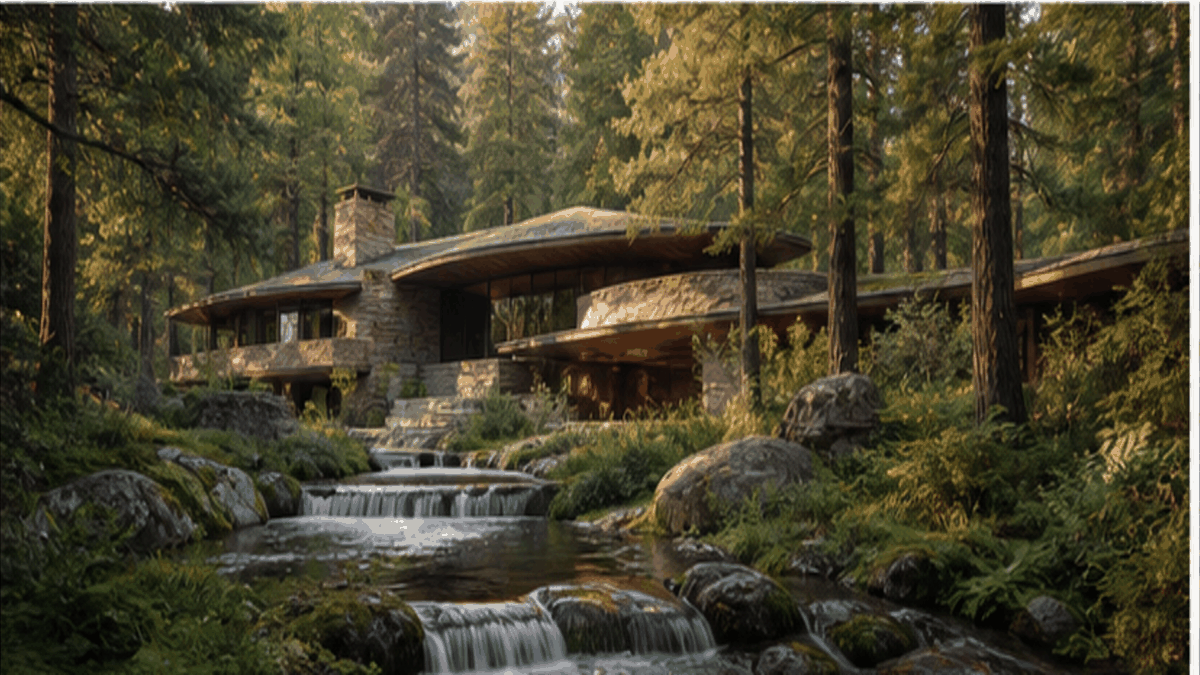
Architectural Expressionism

Buildings as psychic projection - Mendelsohn's Einstein Tower sculpted from concrete intuition, Gaudí's Sagrada Família growing from stone and faith, Poelzig's Grosses Schauspielhaus as a cave of stalactites: emotion precedes structure.

Compare Architectural Expressionism with another style →See the Architectural Expressionism typefaces →On the timeline · 1910s
Record020-AE
AestheticArchitectural Expressionism
ClassExpressive / Maximal
StatusINGESTING
Architectural Expressionism aesthetic archive image
Archive plate · Architectural Expressionism
01
The record

What it is, when it works, who it is for, and where it already exists.

How to use it

Record 020-AE - when it works, who it is for, what it looks like

FIELD 01

When to use it

  • Brand identity where emotional intensity, individuality, and creative force are the proposition
  • Cultural institution or performing arts brand requiring maximum visceral impact
  • Architecture firm or artist identity where the singular authorial voice is the differentiator
  • Fashion and luxury brand that positions the irrational and romantic against minimalist convention
FIELD 02

Perfect for

  • Performing arts organizations - opera houses, theater companies, music festivals
  • Architecture firms with a highly personal, expressive formal language
  • Luxury and haute couture fashion brands with a romantic, dramatic aesthetic
  • Artist estates, foundations, and museums celebrating singular creative visions

In the wild, Architectural Expressionism aesthetic real-world examples

Where this aesthetic shows up in the real world · ↗ opens the source site

Omoro Style GuideEvery aesthetic, every field on this page, in one PDF.
$8Get the guide →
02
The anatomy

Where Architectural Expressionism came from, what makes it recognisable, and the fingerprint it leaves.

History, Architectural Expressionism aesthetic history

1910-1925 (historical); ongoing influence · Germany, Netherlands, and Central Europe

Expressionist architecture emerged alongside Expressionism in painting and cinema in the years surrounding World War I. Where Modernism would later insist on rational function and structural logic, Expressionism sought emotional impact through distorted forms, unusual materials, and visionary spatial experiences. Erich Mendelsohn's Einstein Tower in Potsdam (1921) was designed as a flowing, organic sculpture in concrete, though construction limitations forced compromises with brick and stucco.

The movement produced two distinct strands. The visionary strand (Bruno Taut's Alpine Architecture drawings, Hermann Finsterlin's organic fantasies, Rudolf Steiner's Goetheanum in Dornach) imagined buildings as crystalline, organic, or cosmic forms that transcended conventional function. The built strand (Mendelsohn's commercial buildings, Fritz Hoger's Chilehaus in Hamburg, Michel de Klerk's housing in Amsterdam) applied expressive form to real programs, producing buildings that combined practical function with sculptural power.

Expressionism was largely absorbed into the International Style by the mid-1920s, as Mendelsohn and others moderated their formal experiments. But its influence persisted in the organic architecture of Aalto and Scharoun, the sculptural concrete of Le Corbusier's late work (Ronchamp, 1955), the Deconstructivist movement of the 1980s, and contemporary architects like Frank Gehry whose work prioritizes emotional and sensory impact over systematic rationality.

Architecture as the building's own nightmare or dream.

Omoro dossier · 020-AE

Visual markers, Architectural Expressionism aesthetic visual markers

The visual DNA: what makes it recognisable

typography

See the fonts
  • Angular, hand-drawn, and expressionistic lettering
  • Blackletter and fractured type forms
  • Irregular baselines and organic letter spacing
  • Display faces with dramatic contrast and sharp terminals

grid

  • Distorted geometries: acute angles, curved walls, tilted planes
  • Pointed and faceted rooflines creating crystalline silhouettes
  • Plans driven by sculptural intention rather than functional efficiency
  • Vertical emphasis with soaring interior volumes

materials

  • Brick in expressive bonding patterns: #8B4513, #A0522D, #6B3410
  • Sculpted concrete and stucco: #B0ACA4, #9C9890
  • Colored and stained glass: deep blues, ambers, rubies
  • Glazed tile and ceramic in vivid colors: #2255AA, #AA3322, #DDAA22

motifs

  • Crystalline and faceted roof forms
  • Pointed arches and parabolic curves
  • Towers and spires reaching dramatically upward
  • Sculpted facade surfaces with deep relief patterns

Aesthetic profile

8-channel console with the fingerprint on its display. Save the card, or share the page

Aesthetic Profile
Architectural Expressionism
Early Modern
1910–1925
Attribute console · 020-AE
leans expressive, maximal, chaotic
8 CH
FIG. 1
MaximalMinimalAnalogDigitalExpressiveRestrainedCoolWarmNostalgicFuturisticChaoticStructuredDarkLightOrganicGeometric
01Minimal
Maximal50%
02Analog
Digital20%
03Restrained
Expressive80%
04Cool
Warm10%
05Futuristic
Nostalgic30%
06Structured
Chaotic50%
07Dark
Light10%
08Organic
Geometric40%
ExpressiveMaximalChaotic4 materials
Omoro · Attribute console · 020-AE
omoro.io/styles/arch-expressionism

Material assembly

The style's primary materials, assembled bottom-up

Tap a stratum for material detail · Full catalog

Place in history

Early Modern · 1910–1925 - tap any style to travel

Color Palettes, Architectural Expressionism color palettes and hex codes

4 color interpretations of this aesthetic

Architectural Expressionism
#1E1008 · #7A3A1A · #C4803A · #E8C890 · #141010
The building as emotional projection, plasticity over logic
Einstein Tower
#1A1A18 · #484038 · #807868 · #B8B0A0 · #E0D8C8
Mendelsohn's sculpted concrete: organic curves defying gravity
Gaudí Mosaic
#1A1008 · #C86018 · #3878A0 · #D0A840 · #E8E0D0
Trencadís shimmer: broken tile and organic bone-like structure
Chilehaus
#141010 · #4A2018 · #7A4028 · #B08060 · #D0C8B8
Fritz Höger's ship prow: ten floors of dark clinker brick
Omoro Palette Pack575 curated palettes across every aesthetic, 5 export formats.
$8Get the palettes →

Adjacent Palettes, styles related to Architectural Expressionism

The colour of the styles sitting closest to this one

Organic Architecture
Gothic Architecture
Architectural Futurism
Blobitecture
03
The direction

How to shoot it, how to prompt it, and how to board it.

Photo Direction

How to shoot this aesthetic

"Concrete and brick, asked to express an emotion instead of a function"

Shot list

  • Wide shot of the building's dynamic, curved sculptural massing against the sky
  • Detail shot of brick or concrete used expressively flowing, not rectilinear
  • Low-angle shot emphasizing the dramatic silhouette over the functional plan

Lighting

Dramatic, directional light at dusk or dawn the mood this architecture wants is closer to sculpture lit for feeling than a building lit for legibility

Omoro Director's Briefs151 photo shot-lists like this one, ready to shoot from.
$8Get the briefs →

Generative Prompt

Drop this into Studio to generate in this aesthetic

Expressionist architecture with emotionally charged sculptural form, Erich Mendelsohn's dynamic curved massing, brick and concrete used expressively rather than rationally, dramatic silhouette conveying feeling over function

Paste as-is, or append your own subject

Mood Board

The record applied to your project. The record's kit is free; your brand, references and plates come with membership

Mood board
The Architectural Expressionism board
8 frames · 4 selected
FIG. 4
Tower Shadow1E1008Formed Concrete7A3A1ACurved SurfaceC4803APotsdam LightE8C890Clinker Dark141010
Brand and references
IdleBrand and references open with membership
With membership: the brand's own facts and colours in every prompt, references carried into every frame, and the plates generated.
01 · Hero application
02 · Material and finish
03 · Palette in context
04 · Photography direction
05 · Pattern plate
06 · Object
07 · Environment
08 · Digital presence
Demo kit free, the rest with membershipThe record as a demo kit, free. Name a project and it is written for that
Omoro · Mood board · 020-AE
04
The judgement

Whether to use it, what it costs to do properly, and where it stands right now.

Creative verdict, Architectural Expressionism feasibility and strategic recommendation

Two written calls, seven meters, and when to walk away

Creative verdict
Should Architectural Expressionism be the call?
7 meters
FIG. 2
Assessment

The form has to come from an idea, not a shape. Mendelsohn and Scharoun distorted geometry to express a purpose, while distortion for its own sake reads as arbitrary, and the plan gives it away. Sketch the intent before modelling. Brick and concrete were the materials because they could be moulded, so the construction method should match the ambition.

Verdict

Right when the brief wants emotional directness over the rational, which is what this surfaces for whenever a generation tires of the grid. Crystalline, distorted and deliberately strange. Very little survives, so the movement lives through the Einstein Tower, a handful of buildings and a great many unbuildable drawings, which is where most of its influence actually comes from.

Production cost
High

Sculptural concrete form is genuinely expensive to build.

Creative difficulty
High

Emotion has to precede structure, not just look dramatic.

Execution difficulty
High

Sculptural, intuitive concrete form is some of the hardest building there is.

Risk of misuse
High

Emotion has to precede structure, not just look dramatic after the fact.

Prevalence
Rare

A rare reference outside architecture history and design-critical contexts.

Longevity
Enduring

A century on, still a genuinely singular architectural voice.

Brand investment
High

Sculptural, intuitive concrete form is some of the hardest building there is.

Avoid if
There's no real emotional idea driving the form
Emotion has to precede the structure here, not just look dramatic after the fact.
The budget doesn't support sculptural concrete work
This is some of the hardest, most expensive building on this whole list.
Omoro · Creative verdict · 020-AE

Editorial Depth

A Pro feature: origins, practitioners, and pitfalls

Editorial depth
The Architectural Expressionism file
14 sections
FIG. 3
Context02Brands02Perception04Use04Index02
01Common MisconceptionThe principle beneath the surface
02Historical ContextOrigins, cultural moment, and reaction
03Brands That Accidentally Use This StyleNatural alignment, not category claims
04Brands That Perfectly Represent This StyleExceptional execution
05Psychological EffectHow visual decisions change perception
06Visual ChecklistInclude and avoid
07Creative FormulaThe visual system reduced to essentials
08Recognition SignalsHow to recognize it in two seconds
09When To Use This StyleContexts where the language performs
10Common Creative MistakesWhere imitation weakens the signal
11Best Brand ApplicationsIndustries with a natural advantage
12Creative Application AnalysisFit, feasibility, and production reality
13Related StylesClose languages and the key distinction
14Visual DNA SummaryThe sentence to remember
The editorial depth, with membershipOpening soon
Omoro · Editorial depth · 020-AE
05
The index

Neighbours, cross-references, blends, and the questions people ask.

Related concepts

Connected across the creative knowledge graph

Cultural relevance, Architectural Expressionism cultural relevance today

Where it stands now, and what it costs you to use it

German expressionist architecture ran briefly after the First World War and produced work that looks unlike anything before or since, crystalline, distorted and emotionally direct.

Very little survives, so the movement lives on through the Einstein Tower, a handful of buildings and a lot of unbuildable drawings.

Its influence surfaces whenever architects get tired of the rational, which is roughly every generation.

Cross-references

DeconstructivismDeconstructivism revived Expressionism's fragmented, emotionally charged formsOrganic Architectureorganic architecture shares Expressionism's interest in non-rectilinear, nature-derived formBrutalist Architecturelate Brutalism's sculptural concrete echoes Expressionism's material intensity

Blend

Mix Architectural Expressionism with any style in the library

Architectural Expressionism×
50%50%
82% alike
Architectural Expressionism referenceOrganic Architecture referenceArchitectural Expressionism 50%Organic Architecture 50%

Merged palette

#1E1008

#2E3D1F

#7A3A1A

#5C7A3E

#C4803A

Leads expressive, organic, maximal

Typography · from Architectural Expressionism

Raleway over Merriweather

Materials

  • Brick in expressive bonding patterns: #8B4513, #A0522D, #6B3410
  • Sculpted concrete and stucco: #B0ACA4, #9C9890
  • Local stone in rough-cut or rubble walls: #8A7C6C, #A09080, #7C6E5E

Use it

Expressionist architecture with emotionally charged sculptural form, Erich Mendelsohn's dynamic curved massing, brick and concrete used expressively rather than rationally, dramatic silhouette conveying feeling over function (50%), infused with Frank Lloyd Wright organic architecture with horizontal prairie lines, integration with natural landscape, Fallingwater-inspired cantilevers over water, Usonian warmth, natural stone and wood, color palette strictly #1E1008 #2E3D1F #7A3A1A #5C7A3E #C4803A, overall character: expressive, organic, maximal

One-click generation opens with the studio

About this aesthetic

What is Expressionist architecture?

Expressionist architecture (1910-1925) prioritized emotional and sensory impact over rational function. Emerging in Germany and the Netherlands alongside Expressionism in painting, it featured distorted forms, unusual materials, and visionary spatial experiences. Mendelsohn's Einstein Tower and Hoger's Chilehaus are key examples.

How is Expressionism different from Modernism?

Modernism sought rational, functional, reproducible solutions. Expressionism sought emotional, individual, often unrepeatable experiences. Where Modernism said 'form follows function,' Expressionism said 'form follows feeling.' Both rejected historical ornament but for different reasons.

Did Expressionist architecture influence later movements?

Significantly. Alvar Aalto's organic Modernism, Le Corbusier's late sculptural concrete work (Ronchamp), Hans Scharoun's Berlin Philharmonic, Deconstructivism, and Frank Gehry's sculptural buildings all descend from Expressionism's conviction that architecture can prioritize emotion and sensation.

Build with the architectural expressionism aesthetic

Every style in the library is broken down like this one: the palette, the typography, the materials and the lineage.

Explore the style library →