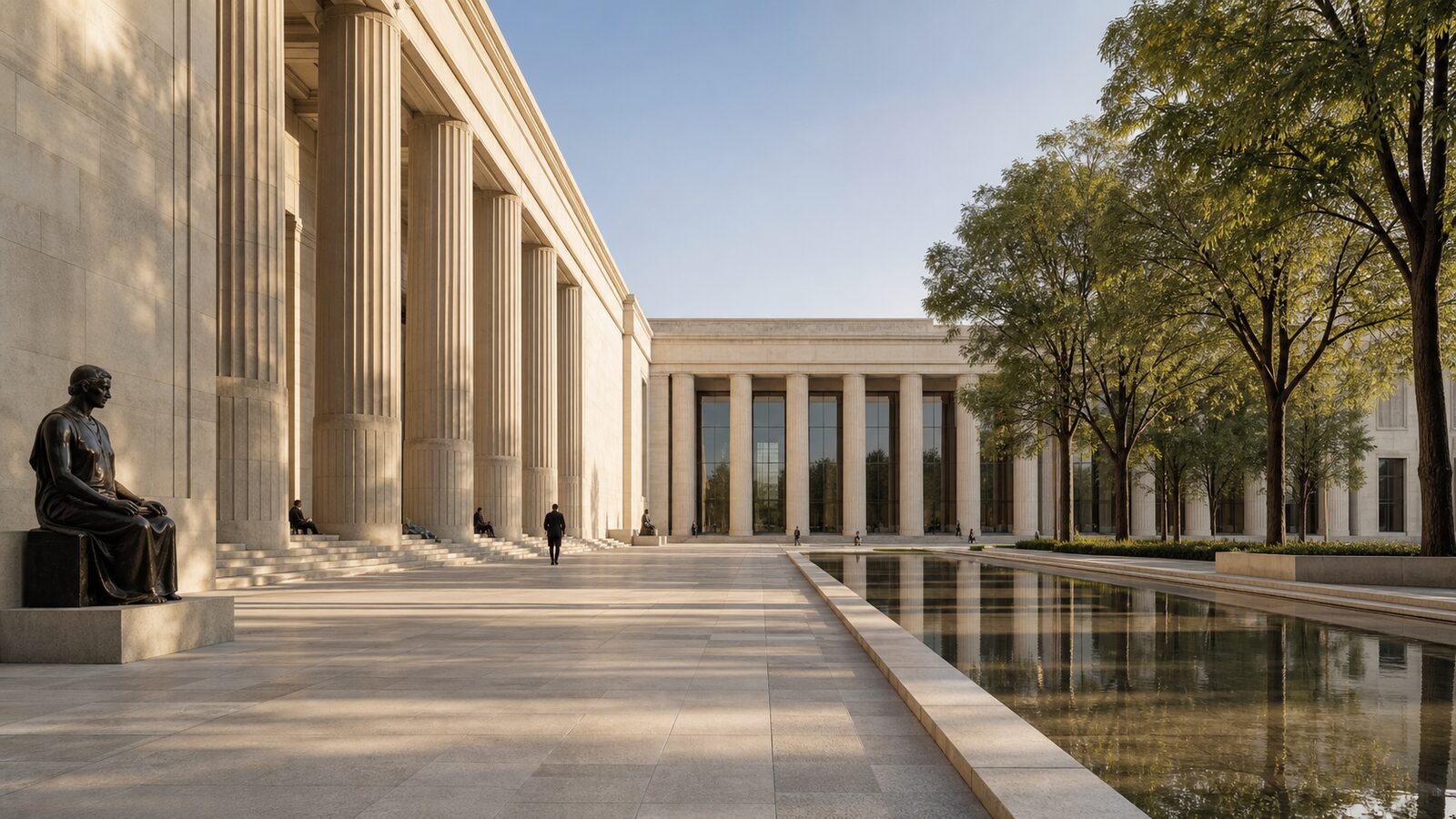
Stripped Classicism

Classical proportion with ornament removed - the 1930s compromise between Modernism's abstraction and government's need for civic authority, producing Paul Philippe Cret's Federal Reserve buildings and the ambiguous gravitas of interwar state architecture.

Compare Stripped Classicism with another style →See the Stripped Classicism typefaces →On the timeline · 1920s
Record020-AS
AestheticStripped Classicism
ClassStructured / Nostalgic
StatusINGESTING
Stripped Classicism aesthetic archive image
Archive plate · Stripped Classicism
01
The record

What it is, when it works, who it is for, and where it already exists.

How to use it

Record 020-AS - when it works, who it is for, what it looks like

FIELD 01

When to use it

  • Institutional brand identity requiring authority and permanence without historical pastiche
  • Civic and governmental communication that must signal stability and trustworthiness
  • Legal, financial, or regulatory institution needing gravitas without ostentation
  • Memorial, monument, or civic landmark brand requiring solemn, timeless presence
FIELD 02

Perfect for

  • Central banks, regulatory authorities, and governmental institutions
  • Law firms and judicial institutions communicating authority and permanence
  • Memorial foundations, war cemeteries, and civic monument organizations
  • Conservative luxury brands - private banking, insurance - needing institutional weight

In the wild, Stripped Classicism aesthetic real-world examples

Where this aesthetic shows up in the real world · ↗ opens the source site

Omoro Style GuideEvery aesthetic, every field on this page, in one PDF.
$8Get the guide →
02
The anatomy

Where Stripped Classicism came from, what makes it recognisable, and the fingerprint it leaves.

History, Stripped Classicism aesthetic history

1920s-1940s · Europe and United States

Stripped Classicism was the compromise position of the interwar period. While avant-garde architects pursued radical Modernism and traditionalists maintained full classical ornament, a large middle ground of institutional and governmental architecture took a pragmatic path: classical proportions, symmetry, and massing with the decorative ornament simplified or removed entirely. The result was buildings that read as dignified and monumental but acknowledged the modern world's discomfort with elaborate decoration.

The style appeared across the political spectrum. Albert Speer used it for Nazi Germany's governmental architecture. Mussolini's EUR district in Rome (the Palazzo della Civilta Italiana, 1942) is Stripped Classicism at its most stark. But democratic nations used it too: Washington D.C.'s Federal Triangle (1930s), many New Deal post offices and courthouses, and countless interwar commercial buildings adopted the same vocabulary. The style was politically neutral in form, acquiring meaning only through context and program.

Stripped Classicism declined after World War II as the International Style offered a more thoroughly modern alternative for institutional building. Its legacy is ambiguous: the association with totalitarian regimes (particularly Nazi Germany) made the style politically charged, even though its practitioners included liberals and democrats. Architecturally, it demonstrated that classicism could adapt to modern construction and modern sensibilities without abandoning its fundamental principles of proportion and symmetry.

Classicism held its breath and smoothed its facade.

Omoro dossier · 020-AS

Visual markers, Stripped Classicism aesthetic visual markers

The visual DNA: what makes it recognisable

typography

See the fonts
  • Simplified classical letterforms: Trajan, Perpetua, Albertus
  • Inscriptional capitals with wide tracking
  • Sans-serif alternatives for modern inflection: Gill Sans, Johnston
  • Carved or cast metal lettering on stone facades

grid

  • Strict bilateral symmetry on primary facades
  • Regular bay rhythms at monumental scale
  • Simplified pilasters or piers replacing full columns
  • Heavy cornices and bases with minimal decorative molding

materials

  • Cut limestone and marble: #E0DCD4, #D0CCC4, #C8C4BC
  • Polished granite bases: #4A4A4A, #3C3C3C
  • Bronze doors and metalwork: #8B7355, #6B5C4C
  • Buff and cream-colored brick: #D8CCA8, #C8BC98

motifs

  • Flat pilasters or piers without capitals or bases
  • Recessed entrance portals with minimal framing
  • Smooth wall surfaces with punched window openings
  • Stylized relief sculpture in limited locations

Aesthetic profile

8-channel console with the fingerprint on its display. Save the card, or share the page

Aesthetic Profile
Stripped Classicism
Early Modern
1920–1950
Attribute console · 020-AS
leans structured, nostalgic, geometric
8 CH
FIG. 1
MinimalMaximalAnalogDigitalRestrainedExpressiveCoolWarmNostalgicFuturisticStructuredChaoticLightDarkGeometricOrganic
01Minimal
Maximal30%
02Analog
Digital60%
03Restrained
Expressive20%
04Cool
Warm10%
05Futuristic
Nostalgic70%
06Structured
Chaotic80%
07Dark
Light20%
08Organic
Geometric70%
StructuredNostalgicGeometric3 materials
Omoro · Attribute console · 020-AS
omoro.io/styles/arch-stripped-classicism

Material assembly

The style's primary materials, assembled bottom-up

Tap a stratum for material detail · Full catalog

Place in history

Early Modern · 1920–1950 - tap any style to travel

Color Palettes, Stripped Classicism color palettes and hex codes

4 color interpretations of this aesthetic

Stripped Classicism
#3C3428 · #9E9080 · #C8BCA8 · #E8E0D0 · #141210
Classical proportion denuded of ornament, authority without decoration
Federal Triangle
#141210 · #484038 · #888070 · #C0B8A8 · #E0D8C8
Paul Cret: simplified columns on a government building
EUR
#101010 · #404040 · #808078 · #C8C0B0 · #F0ECE0
Palazzo della Civiltà: repeated arch in white travertine
Civic Order
#181410 · #504838 · #8A7860 · #C0B498 · #E8E0D0
Simplified entablature: classical authority without ornamental excess
Omoro Palette Pack575 curated palettes across every aesthetic, 5 export formats.
$8Get the palettes →

Adjacent Palettes, styles related to Stripped Classicism

The colour of the styles sitting closest to this one

Neoclassical Architecture
Classical Architecture
Architectural Modernism
Monolithic Architecture
03
The direction

How to shoot it, how to prompt it, and how to board it.

Photo Direction

How to shoot this aesthetic

"Classical order, with all the ornament confiscated"

Shot list

  • Wide symmetrical shot of an unornamented monumental facade
  • Detail shot of a plain, powerful column form with no carved capital
  • Wide shot conveying civic authority through mass and rhythm alone

Lighting

Hard, direct sunlight that models the building's mass through shadow alone, since there's no carved ornament for shadow to catch

Omoro Director's Briefs151 photo shot-lists like this one, ready to shoot from.
$8Get the briefs →

Generative Prompt

Drop this into Studio to generate in this aesthetic

Stripped Classicism architecture with classical proportion and symmetry retained but ornament removed, monumental civic authority through mass and rhythm alone, 1930s government-building tradition, austere dignified restraint

Paste as-is, or append your own subject

Mood Board

The record applied to your project. The record's kit is free; your brand, references and plates come with membership

Mood board
The Stripped Classicism board
8 frames · 4 selected
FIG. 4
Portico Dark3C3428Limestone9E9080Stripped ColumnC8BCA8Civic LightE8E0D0Deep Portico141210
Brand and references
IdleBrand and references open with membership
With membership: the brand's own facts and colours in every prompt, references carried into every frame, and the plates generated.
01 · Hero application
02 · Material and finish
03 · Palette in context
04 · Photography direction
05 · Pattern plate
06 · Object
07 · Environment
08 · Digital presence
Demo kit free, the rest with membershipThe record as a demo kit, free. Name a project and it is written for that
Omoro · Mood board · 020-AS
04
The judgement

Whether to use it, what it costs to do properly, and where it stands right now.

Creative verdict, Stripped Classicism feasibility and strategic recommendation

Two written calls, seven meters, and when to walk away

Creative verdict
Should Stripped Classicism be the call?
7 meters
FIG. 2
Assessment

Proportion survives when the ornament is removed. Take away the capitals and the cornice and any error in the underlying ratios becomes the only thing visible, so the classical setting-out still has to be correct. Keep the rhythm of the bays exact. The style carries heavy political associations from the 1930s, which is context to handle deliberately rather than ignore.

Verdict

Handle deliberately or not at all. It keeps classical proportion and removes the ornament, and it was the preferred language of authoritarian states in the 1930s in Germany, Italy and the Soviet Union alike, which is why architects discuss it carefully rather than casually. Democracies used it for civic buildings in the same decade, so the form does not settle the politics, but the audience brings the politics with them.

Production cost
Medium

Real masonry, but the ornament (the expensive part) is removed.

Creative difficulty
High

A specific historical compromise, not just 'plain classical.'

Execution difficulty
High

Proportion has to carry authority with none of the decoration to help.

Risk of misuse
Medium

A specific historical compromise, not just plain classical dressed down.

Prevalence
Rare

A niche reference, mostly in civic and government-adjacent work.

Longevity
Enduring

A specific historical moment that still reads clearly today.

Brand investment
Medium

Real masonry, but the ornament (the expensive part) is removed.

Avoid if
The audience won't recognize the specific historical compromise
This reads as generic 'plain classical' without that context.
The brand needs warmth or ornament
This was a civic authority position, deliberately stripped of decoration.
Omoro · Creative verdict · 020-AS

Editorial Depth

A Pro feature: origins, practitioners, and pitfalls

Editorial depth
The Stripped Classicism file
14 sections
FIG. 3
Context02Brands02Perception04Use04Index02
01Common MisconceptionThe principle beneath the surface
02Historical ContextOrigins, cultural moment, and reaction
03Brands That Accidentally Use This StyleNatural alignment, not category claims
04Brands That Perfectly Represent This StyleExceptional execution
05Psychological EffectHow visual decisions change perception
06Visual ChecklistInclude and avoid
07Creative FormulaThe visual system reduced to essentials
08Recognition SignalsHow to recognize it in two seconds
09When To Use This StyleContexts where the language performs
10Common Creative MistakesWhere imitation weakens the signal
11Best Brand ApplicationsIndustries with a natural advantage
12Creative Application AnalysisFit, feasibility, and production reality
13Related StylesClose languages and the key distinction
14Visual DNA SummaryThe sentence to remember

The editorial depth, with membershipOpening soon
Omoro · Editorial depth · 020-AS
05
The index

Neighbours, cross-references, blends, and the questions people ask.

Related concepts

Connected across the creative knowledge graph

Cultural relevance, Stripped Classicism cultural relevance today

Where it stands now, and what it costs you to use it

Stripped classicism keeps classical proportion and removes the ornament, and it was the preferred language of authoritarian states in the 1930s in Germany, Italy and the Soviet Union alike.

That association is unavoidable and architects treat it as unavoidable, which is why the style is discussed carefully rather than casually revived.

It was also used by democracies for civic buildings in the same decade. The form does not settle the politics, but the audience will bring the politics with them.

Cross-references

Classical ArchitectureStripped Classicism simplifies the classical vocabularyArt Deco Architecturecontemporaneous but different approach to modernizing classical architectureNeoclassical ArchitectureNeoclassicism is the fuller classical revival that Stripped Classicism reduced

Blend

Mix Stripped Classicism with any style in the library

Stripped Classicism×
50%50%
98% alike
Stripped Classicism referenceNeoclassical Architecture referenceStripped Classicism 50%Neoclassical Architecture 50%

Merged palette

#3C3428

#9E9080

#7A7060

#C8BCA8

#E8E0D0

Leads structured, nostalgic, geometric

Typography · from Stripped Classicism

Abril Fatface over Lora

Materials

  • Cut limestone and marble: #E0DCD4, #D0CCC4, #C8C4BC
  • Polished granite bases: #4A4A4A, #3C3C3C
  • White marble and limestone: #F0EDE8, #E8E4DC, #D8D4CC

Use it

Stripped Classicism architecture with classical proportion and symmetry retained but ornament removed, monumental civic authority through mass and rhythm alone, 1930s government-building tradition, austere dignified restraint (50%), infused with Neoclassical aesthetic with Greek and Roman revival, toga-draped classical figures and mythology scenes, cool cameo-relief color restraint, rigidly symmetrical composition and golden proportion, Jacques-Louis David painting influence, color palette strictly #3C3428 #9E9080 #7A7060 #C8BCA8 #E8E0D0, overall character: structured, nostalgic, geometric

One-click generation opens with the studio

About this aesthetic

What is Stripped Classicism?

Stripped Classicism is an architectural style from the 1920s-1940s that maintains classical proportions, symmetry, and massing while removing or simplifying traditional ornament. It was a compromise between full Modernism and traditional classicism, widely used for government buildings, institutions, and commercial architecture.

Is Stripped Classicism the same as Art Deco?

They are related but distinct. Both emerged in the interwar period and simplified classical ornament. Art Deco added geometric and machine-age decoration (zigzags, sunbursts, stylized flora). Stripped Classicism subtracted ornament, leaving smooth surfaces and simplified classical masses. Art Deco is decorative; Stripped Classicism is reductive.

Why is Stripped Classicism controversial?

Its association with totalitarian regimes (Nazi Germany, Fascist Italy) gives the style a political charge, even though it was equally used by democratic nations. The controversy is about context, not form: the same proportional system served power in Berlin and democracy in Washington.

Build with the stripped classicism aesthetic

Every style in the library is broken down like this one: the palette, the typography, the materials and the lineage.

Explore the style library →