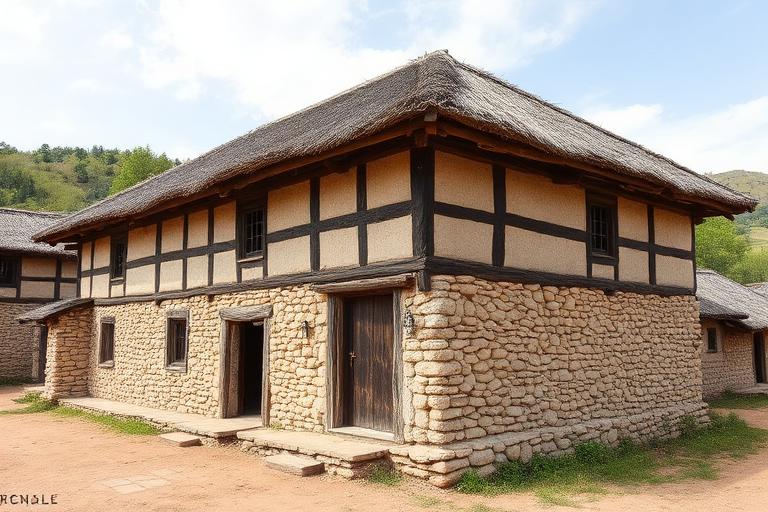
Pueblo Revival

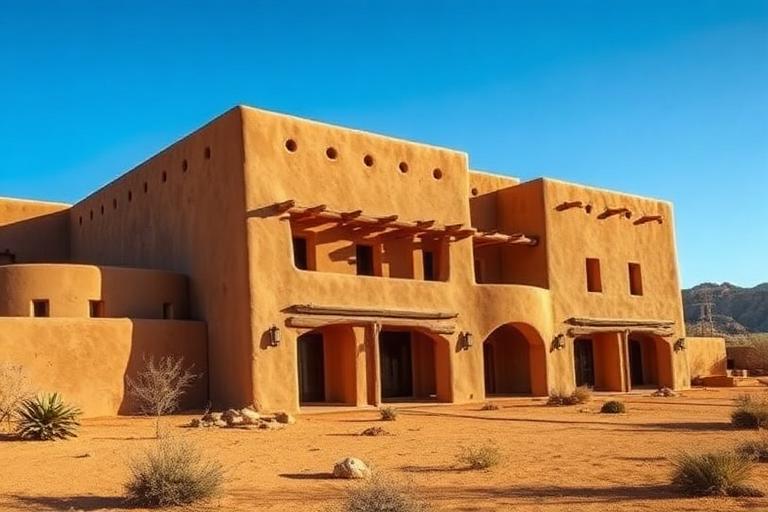
New Mexico's synthesis of Ancestral Puebloan adobe mass and Spanish mission tradition - rounded parapets, projecting vigas, interior kiva fireplaces, and John Gaw Meem's University of New Mexico campus as the definitive regional modern.

Compare Pueblo Revival with another style →See the Pueblo Revival typefaces →On the timeline · 1900s
Record020-AP
AestheticPueblo Revival
ClassAnalog / Nostalgic
StatusINGESTING
Pueblo Revival aesthetic archive image
Archive plate · Pueblo Revival
01
The record

What it is, when it works, who it is for, and where it already exists.

How to use it

Record 020-AP - when it works, who it is for, what it looks like

FIELD 01

When to use it

  • Brand identity asserting Southwestern American regional identity and landscape connection
  • Hospitality and resort brand in the American Southwest communicating authentic place
  • Cultural institution brand celebrating Native American and Hispanic heritage architecture
  • Real estate and residential development brand in New Mexico or Arizona markets
FIELD 02

Perfect for

  • Southwestern hospitality brands - resorts, spas, retreats in New Mexico, Arizona
  • Cultural institutions and tribal organizations preserving Puebloan heritage
  • Real estate developers working in Santa Fe, Taos, or Scottsdale architectural styles
  • Food, craft, and artisan brands from the American Southwest communicating terroir

In the wild, Pueblo Revival aesthetic real-world examples

Where this aesthetic shows up in the real world · ↗ opens the source site

Omoro Style GuideEvery aesthetic, every field on this page, in one PDF.
$8Get the guide →
02
The anatomy

Where Pueblo Revival came from, what makes it recognisable, and the fingerprint it leaves.

History, Pueblo Revival aesthetic history

1900s-present (as revival); adobe tradition is centuries old · New Mexico, American Southwest

Pueblo Revival architecture draws from the building traditions of the Puebloan peoples of the American Southwest, who have constructed multi-story adobe communities for over a thousand years. Taos Pueblo, continuously inhabited since at least 1000 CE, demonstrates the tradition's core principles: thick adobe walls providing thermal mass against extreme temperature swings, stepped massing creating terraces and shade, flat roofs with projecting vigas (roof beams), and an organic relationship between building and desert landscape.

The Revival style formalized as a conscious architectural movement in the early twentieth century. The Palace of the Governors reconstruction in Santa Fe (1909-1913) established the vocabulary that would define New Mexican architecture: rounded parapets, protruding vigas, deep-set windows in thick walls, and earthen plaster finishes in tones ranging from warm tan to deep terracotta. Santa Fe adopted building codes in 1957 requiring Pueblo Revival styling in its historic district, making it one of the few American cities with an architecturally unified character.

Contemporary Pueblo Revival ranges from literal reproduction of historical forms to interpretive work that engages with adobe's thermal performance, local material sourcing, and desert aesthetics without copying historical details. Antoine Predock, the most prominent architect working in this tradition, developed a powerful synthesis of Pueblo forms with Modernist spatial concepts. The style's emphasis on thermal mass, earth construction, and site integration makes it newly relevant to sustainable design in arid climates.

The desert built its own architecture.

Omoro dossier · 020-AP

Visual markers, Pueblo Revival aesthetic visual markers

The visual DNA: what makes it recognisable

typography

See the fonts
  • Warm serif faces: Adobe Caslon, Chaparral, Minion
  • Hand-lettered and carved signage traditions
  • Earthy, rustic display faces: Birch, Rosewood, Juniper
  • Text set in warm browns and terracotta rather than black

grid

  • Stepped massing creating terraces at each level
  • Thick walls with deep window and door reveals
  • Rounded corners and parapets (no sharp edges)
  • Enclosed courtyards (placitas) as central organizing spaces

materials

  • Adobe and earth plaster: #C8A878, #B89868, #A08050
  • Warm terracotta tones: #C87850, #B86840, #D89060
  • Rough-hewn timber vigas and latillas: #8C6840, #7C5830
  • Turquoise accents on doors and trim: #40A0B0, #308090

motifs

  • Projecting vigas (round roof beams) through exterior walls
  • Canales (scupper drains) projecting from parapets
  • Banco seating (built-in adobe benches) along walls
  • Kiva fireplaces in rounded corners

Aesthetic profile

8-channel console with the fingerprint on its display. Save the card, or share the page

Aesthetic Profile
Pueblo Revival
Vernacular
1900–1940
Attribute console · 020-AP
leans analog, nostalgic, warm
8 CH
FIG. 1
MinimalMaximalAnalogDigitalExpressiveRestrainedWarmCoolNostalgicFuturisticStructuredChaoticLightDarkOrganicGeometric
01Minimal
Maximal10%
02Analog
Digital80%
03Restrained
Expressive20%
04Cool
Warm70%
05Futuristic
Nostalgic80%
06Structured
Chaotic20%
07Dark
Light30%
08Organic
Geometric40%
AnalogNostalgicWarm4 materials
Omoro · Attribute console · 020-AP
omoro.io/styles/arch-pueblo-revival

Material assembly

The style's primary materials, assembled bottom-up

Tap a stratum for material detail · Full catalog

Place in history

Vernacular · 1900–1940 - tap any style to travel

Color Palettes, Pueblo Revival color palettes and hex codes

4 color interpretations of this aesthetic

Pueblo Revival
#5C3820 · #C4845A · #E8C4A0 · #F0D8BC · #2A1808
Sun-dried adobe and Spanish mission synthesized in rounded parapet
Adobe Parapet
#2A1808 · #8A5020 · #C09058 · #D8B880 · #F0E0C8
Rounded mud walls and vigas in New Mexico's golden light
Taos
#1A1008 · #6A4018 · #A87840 · #D0A870 · #2868A0
Ancestral multi-storey: sun-dried mud stepped against Sangre de Cristo
Turquoise Door
#2A1808 · #8A5028 · #28889A · #D0A868 · #F0E4CC
Santa Fe painted timber: turquoise beam against warm earth
Omoro Palette Pack575 curated palettes across every aesthetic, 5 export formats.
$8Get the palettes →

Adjacent Palettes, styles related to Pueblo Revival

The colour of the styles sitting closest to this one

Vernacular Architecture
Critical Regionalism
Organic Architecture
Mediterranean Architecture
03
The direction

How to shoot it, how to prompt it, and how to board it.

Photo Direction

How to shoot this aesthetic

"Sun-baked adobe, still standing exactly as it always has"

Shot list

  • Wide shot of rounded adobe walls under strong desert sun
  • Detail shot of exposed vigas projecting from a flat adobe roofline
  • Wide shot of stepped massing echoing ancestral Puebloan structures

Lighting

Warm, low-angle desert sunlight that reveals the hand-applied texture of adobe plaster

Omoro Director's Briefs151 photo shot-lists like this one, ready to shoot from.
$8Get the briefs →

Generative Prompt

Drop this into Studio to generate in this aesthetic

Pueblo Revival architecture with rounded adobe walls and exposed vigas, flat roofs and stepped massing echoing ancestral Puebloan structures, Santa Fe regional building tradition, warm sun-baked earthen material honesty

Paste as-is, or append your own subject

Mood Board

The record applied to your project. The record's kit is free; your brand, references and plates come with membership

Mood board
The Pueblo Revival board
8 frames · 4 selected
FIG. 4
Viga Dark5C3820Adobe WallC4845AMud WallE8C4A0Desert LightF0D8BCEarth Dark2A1808
Brand and references
IdleBrand and references open with membership
With membership: the brand's own facts and colours in every prompt, references carried into every frame, and the plates generated.
01 · Hero application
02 · Material and finish
03 · Palette in context
04 · Photography direction
05 · Pattern plate
06 · Object
07 · Environment
08 · Digital presence
Demo kit free, the rest with membershipThe record as a demo kit, free. Name a project and it is written for that
Omoro · Mood board · 020-AP
04
The judgement

Whether to use it, what it costs to do properly, and where it stands right now.

Creative verdict, Pueblo Revival feasibility and strategic recommendation

Two written calls, seven meters, and when to walk away

Creative verdict
Should Pueblo Revival be the call?
7 meters
FIG. 2
Assessment

The mass has to behave like earth. Adobe forms have rounded corners, battered walls and deep reveals because of how mud builds and dries, and a stucco box with sharp edges reads as a theme. Model the wall thickness honestly. The vigas should be structural or clearly not present, since decorative protruding beams are the most common tell.

Verdict

Approach carefully. It borrows from Indigenous building traditions of the American Southwest and was largely developed by non-Native architects for tourism and civic identity, an appropriation that is an active conversation now led by Indigenous architects rather than a settled footnote. The original construction logic, thermal mass against extreme daily swings, is sophisticated and mostly ignored by the revival.

Production cost
Medium

Adobe mass and vigas. Real regional material, not a generic stucco box.

Creative difficulty
High

A specific regional synthesis, not just 'earthy and rounded.'

Execution difficulty
High

Rounded parapets and adobe massing are precise, regional craft.

Risk of misuse
High

Generic 'earthy and rounded' misses a very specific regional synthesis.

Prevalence
Rare

A regional reference, rare outside the American Southwest.

Longevity
Timeless

A centuries-old regional tradition, still actively built today.

Brand investment
Medium

Real adobe mass and vigas, a specific regional material.

Avoid if
The project is outside the American Southwest
This is a specific regional synthesis, not a portable general look.
The materials are fake stucco rather than real adobe mass
Generic 'earthy and rounded' misses a very specific regional tradition.
Omoro · Creative verdict · 020-AP

Editorial Depth

A Pro feature: origins, practitioners, and pitfalls

Editorial depth
The Pueblo Revival file
14 sections
FIG. 3
Context02Brands02Perception04Use04Index02
01Common MisconceptionThe principle beneath the surface
02Historical ContextOrigins, cultural moment, and reaction
03Brands That Accidentally Use This StyleNatural alignment, not category claims
04Brands That Perfectly Represent This StyleExceptional execution
05Psychological EffectHow visual decisions change perception
06Visual ChecklistInclude and avoid
07Creative FormulaThe visual system reduced to essentials
08Recognition SignalsHow to recognize it in two seconds
09When To Use This StyleContexts where the language performs
10Common Creative MistakesWhere imitation weakens the signal
11Best Brand ApplicationsIndustries with a natural advantage
12Creative Application AnalysisFit, feasibility, and production reality
13Related StylesClose languages and the key distinction
14Visual DNA SummaryThe sentence to remember
The editorial depth, with membershipOpening soon
Omoro · Editorial depth · 020-AP
05
The index

Neighbours, cross-references, blends, and the questions people ask.

Related concepts

Connected across the creative knowledge graph

Cultural relevance, Pueblo Revival cultural relevance today

Where it stands now, and what it costs you to use it

Pueblo Revival borrows from Indigenous building traditions of the American Southwest, and it was largely developed by non-Native architects for tourism and civic identity.

That appropriation is an active conversation rather than a settled historical footnote, and Indigenous architects are now leading it.

The original construction logic, thermal mass against extreme daily temperature swings, is genuinely sophisticated and mostly ignored by the revival.

Cross-references

Vernacular ArchitecturePueblo architecture is one of the world's most sophisticated vernacular traditionsSustainable Architectureadobe's thermal mass and local material sourcing anticipate sustainable designCritical Regionalismthe best Pueblo Revival work engages critically with both tradition and modernity

Blend

Mix Pueblo Revival with any style in the library

Pueblo Revival×
50%50%
100% alike
Pueblo Revival referenceVernacular Architecture referencePueblo Revival 50%Vernacular Architecture 50%

Merged palette

#5C3820

#5C3D2E

#C4845A

#A87C5A

#E8C4A0

Leads analog, nostalgic, warm

Typography · from Pueblo Revival

Raleway over Merriweather

Materials

  • Adobe and earth plaster: #C8A878, #B89868, #A08050
  • Warm terracotta tones: #C87850, #B86840, #D89060
  • Mud brick and adobe: #C4A87C, #B89868, #A08858

Use it

Pueblo Revival architecture with rounded adobe walls and exposed vigas, flat roofs and stepped massing echoing ancestral Puebloan structures, Santa Fe regional building tradition, warm sun-baked earthen material honesty (50%), infused with Vernacular architecture built from local material and inherited regional technique, climate-responsive form passed down through generations of builders, unpretentious functional honesty, deep connection to place and available resource, color palette strictly #5C3820 #5C3D2E #C4845A #A87C5A #E8C4A0, overall character: analog, nostalgic, warm

One-click generation opens with the studio

About this aesthetic

What is Pueblo Revival architecture?

Pueblo Revival is a Southwestern architectural style that draws from the adobe building traditions of the Puebloan peoples and Spanish colonial settlements of New Mexico. Characterized by thick earthen walls, stepped massing, projecting vigas, rounded parapets, and desert-toned finishes, it is the defining architectural style of Santa Fe and much of the American Southwest.

What is adobe construction?

Adobe is sun-dried earth brick made from clay, sand, straw, and water. Walls are typically 18-24 inches thick, providing excellent thermal mass: they absorb daytime heat and release it at night, moderating the extreme temperature swings of desert climates. Modern adobe buildings often use stabilized earth blocks or rammed earth for improved durability.

Is Pueblo Revival architecture culturally appropriate?

This is an ongoing conversation. The style draws from living Puebloan and Hispano building traditions, and some practitioners (particularly Native architects like Acoma Pueblo's work) approach it from within those traditions. The Santa Fe building code's requirement for Pueblo Revival styling has been both praised for preserving architectural coherence and critiqued for commodifying indigenous forms.

Build with the pueblo revival aesthetic

Every style in the library is broken down like this one: the palette, the typography, the materials and the lineage.

Explore the style library →