High-Tech Architecture

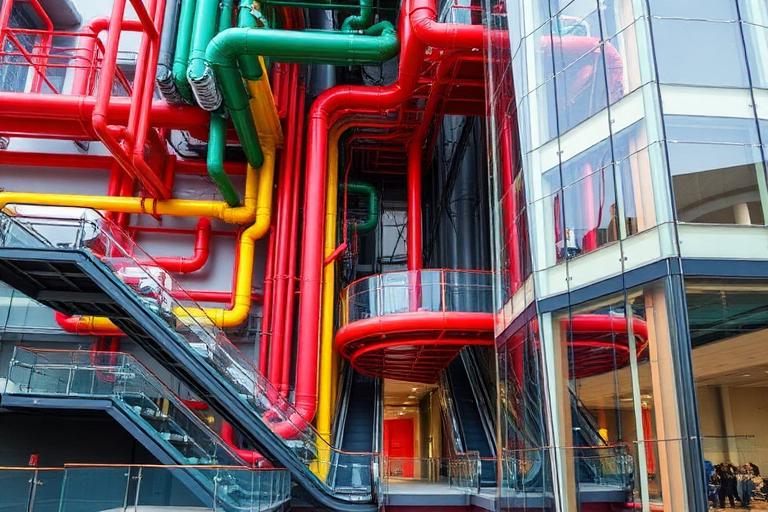
Structure and services made visible and celebrated - High-Tech turned buildings inside out, exposing steel trusses, ducts, and circulation in bright industrial colour, from the Pompidou Centre to Lloyd's of London and Foster's HSBC tower.

Compare High-Tech Architecture with another style →See the High-Tech Architecture typefaces →On the timeline · 1970s
Record020-AH
AestheticHigh-Tech Architecture
ClassDigital / Geometric
StatusINGESTING
High-Tech Architecture aesthetic archive image
Archive plate · High-Tech Architecture
01
The record

What it is, when it works, who it is for, and where it already exists.

How to use it

Record 020-AH - when it works, who it is for, what it looks like

FIELD 01

When to use it

  • Brand identity expressing engineering, transparency, and precision
  • Tech, aerospace, and engineering brands celebrating their systems
  • Editorial and product design with exposed-structure honesty
  • Campaigns where the mechanism is the hero, not hidden away
FIELD 02

Perfect for

  • Engineering, aerospace, and advanced-manufacturing firms
  • Architecture and structural-design practices
  • Tech brands signalling transparency and capability
  • Science and innovation institutions

In the wild, High-Tech Architecture aesthetic real-world examples

Where this aesthetic shows up in the real world · ↗ opens the source site

Omoro Style GuideEvery aesthetic, every field on this page, in one PDF.
$8Get the guide →
02
The anatomy

Where High-Tech Architecture came from, what makes it recognisable, and the fingerprint it leaves.

History, High-Tech Architecture aesthetic history

1970s-present · United Kingdom

High-Tech architecture emerged in 1970s Britain when a generation of architects decided that structural engineering and building services were more architecturally interesting than any applied decoration. Norman Foster, Richard Rogers, Renzo Piano, Nicholas Grimshaw, and Michael Hopkins developed an approach that exposed and celebrated the elements conventional buildings concealed: steel frames, tension cables, air ducts, and prefabricated components. The aesthetic drew equally from Victorian engineering (the Crystal Palace, railway stations) and aerospace technology.

Foster's Willis Faber & Dumas headquarters (1975), with its curved glass skin reflecting the Suffolk streetscape, and his Sainsbury Centre (1978), a single clear-span steel structure housing an art gallery, demonstrated that High-Tech could be both technically radical and spatially generous. Rogers' Lloyd's building in London (1986) and Foster's HSBC headquarters in Hong Kong (1986) applied the approach at commercial scale, proving that corporate clients would pay for architectural ambition.

High-Tech has evolved but never ended. Foster + Partners (the Gherkin, Apple Park), Rogers Stirk Harbour + Partners (the Leadenhall Building), and Renzo Piano Building Workshop (The Shard, Centre Pompidou) remain among the world's most prolific practices. The style has mellowed from its early industrial rawness toward more refined expression, but the core principle persists: architecture should express how it is made, and the engineering is the beauty.

The building as beautiful machine.

Omoro dossier · 020-AH

Visual markers, High-Tech Architecture aesthetic visual markers

The visual DNA: what makes it recognisable

typography

See the fonts
  • Precise sans-serifs: Frutiger, Univers, Neue Helvetica
  • Wayfinding systems with clear hierarchies
  • Technical lettering and engineering drawing influence
  • Corporate identity systems with systematic application rules

grid

  • Clear-span structural frames creating column-free interiors
  • Mast-and-cable structural systems inspired by sailing and aerospace
  • Modular construction allowing factory-fabricated components
  • External structural bracing as facade composition

materials

  • Structural steel painted or galvanized: #6B6B6B, #808080, #A0A0A0
  • Aluminum and stainless steel cladding: #C0C8D0, #B0B8C0
  • Glass in structural glazing systems with minimal frames
  • Tension cables and stainless steel rods: #D0D0D0, #C0C0C0

motifs

  • Exposed structural frames and bracing as primary visual element
  • External service cores (lifts, stairs, toilets) freeing floor plates
  • Mast-and-cable structures referencing yacht rigging and aerospace
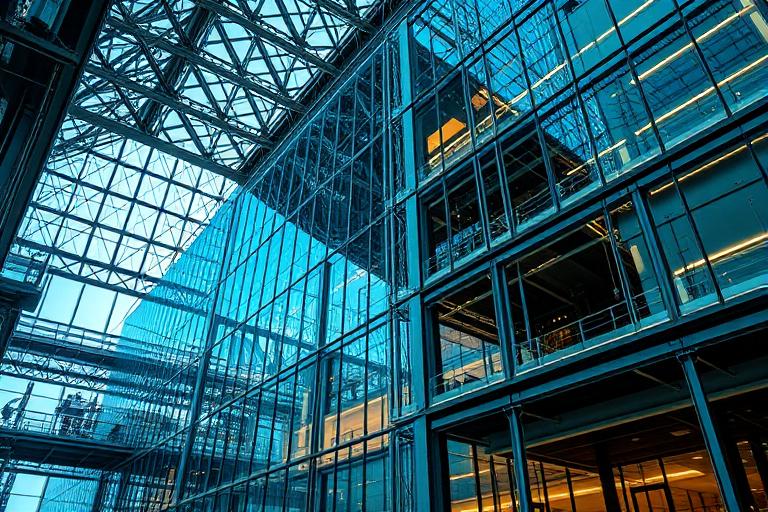
  • Full-height atria with exposed structural connections

Aesthetic profile

8-channel console with the fingerprint on its display. Save the card, or share the page

Aesthetic Profile
High-Tech Architecture
Postmodern
1970–present
Attribute console · 020-AH
leans digital, geometric, cool
8 CH
FIG. 1
MinimalMaximalDigitalAnalogRestrainedExpressiveCoolWarmFuturisticNostalgicStructuredChaoticLightDarkGeometricOrganic
01Minimal
Maximal10%
02Analog
Digital60%
03Restrained
Expressive20%
04Cool
Warm50%
05Futuristic
Nostalgic30%
06Structured
Chaotic50%
07Dark
Light10%
08Organic
Geometric60%
DigitalGeometricCool5 materials
Omoro · Attribute console · 020-AH
omoro.io/styles/arch-high-tech

Material assembly

The style's primary materials, assembled bottom-up

Tap a stratum for material detail · Full catalog

Place in history

Postmodern · 1970–present - tap any style to travel

Color Palettes, High-Tech Architecture color palettes and hex codes

4 color interpretations of this aesthetic

High-Tech Architecture
#6B6B6B · #808080 · #B0B8C0 · #C0C8D0 · #D0D0D0
The building as beautiful machine
Foster Gherkin
#0C1020 · #284878 · #70A0D0 · #B0C0D0 · #E8F0F8
Norman Foster: diagrid glass and steel, London's computational tower
Rogers Dome
#181818 · #E8D020 · #C8C0B0 · #4878A0 · #F0F0EC
Millennium Dome: tensile fabric stretched over yellow masts
Grimshaw Glass
#0C0C0C · #383838 · #688880 · #A8B8B8 · #E8F0F0
Eden Project to Waterloo: engineered glass and tubular steel
Omoro Palette Pack575 curated palettes across every aesthetic, 5 export formats.
$8Get the palettes →

Adjacent Palettes, styles related to High-Tech Architecture

The colour of the styles sitting closest to this one

Bowellism (High-Tech)
Industrial Architecture
Neo-Futurism
Parametric Architecture
03
The direction

How to shoot it, how to prompt it, and how to board it.

Photo Direction

How to shoot this aesthetic

"The building turned inside out, mechanical guts worn with pride"

Shot list

  • Wide shot from below, exposed structural trusses and ductwork framing the sky
  • Detail shot of color-coded service pipes blue for water, yellow for gas, red for fire
  • Detail shot of an exposed steel joint or bolted connection, engineering as texture

Lighting

Bright, even daylight through glass curtain walls structure needs to stay legible, so avoid heavy shadow that hides the engineering detail

Omoro Director's Briefs151 photo shot-lists like this one, ready to shoot from.
$8Get the briefs →

Generative Prompt

Drop this into Studio to generate in this aesthetic

High-tech aesthetic with exposed structural systems, technology as aesthetic expression, Rogers and Foster influence, color-coded service elements, industrial refinement

Paste as-is, or append your own subject

Mood Board

The record applied to your project. The record's kit is free; your brand, references and plates come with membership

Mood board
The High-Tech Architecture board
8 frames · 4 selected
FIG. 4
Deep Structural Steel Painted6B6B6BDark Structural Steel Painted808080Mid AluminumB0B8C0Light AluminumC0C8D0Tension CablesD0D0D0
Brand and references
IdleBrand and references open with membership
With membership: the brand's own facts and colours in every prompt, references carried into every frame, and the plates generated.
01 · Hero application
02 · Material and finish
03 · Palette in context
04 · Photography direction
05 · Pattern plate
06 · Object
07 · Environment
08 · Digital presence
Demo kit free, the rest with membershipThe record as a demo kit, free. Name a project and it is written for that
Omoro · Mood board · 020-AH
04
The judgement

Whether to use it, what it costs to do properly, and where it stands right now.

Creative verdict, High-Tech Architecture feasibility and strategic recommendation

Two written calls, seven meters, and when to walk away

Creative verdict
Should High-Tech Architecture be the call?
7 meters
FIG. 2
Assessment

Exposed structure is a fire and corrosion problem first. Steel loses strength fast in a fire, so every visible member needs intumescent coating or a water-filled section, which is the detail behind the honest look. Budget for the protection. The joints are the architecture: cast connections and pinned nodes are where this language is actually judged.

Verdict

Right when honesty about how the building works is the argument, with structure and services declared rather than hidden, and the Pompidou is still the clearest statement of it. The fair criticism, which the approach absorbed: exposure cost more in maintenance than the flexibility saved. Its diluted descendants are everywhere, exposed ductwork in a cafe being the end of a serious position.

Production cost
High

Real buildings at this scale, or detailed CGI to match.

Creative difficulty
High

Turning the building inside out has to read as a decision, not a mess.

Execution difficulty
High

Color-coded structure and circulation have to stay legible at full scale.

Risk of misuse
Medium

Turning the building inside out has to read as a decision, not a mess.

Prevalence
Rare

A niche reference outside architecture and industrial-design contexts.

Longevity
Enduring

Fifty years on and still a working architectural language.

Brand investment
High

Real buildings at this scale, or detailed CGI to match.

Avoid if
The brand needs to feel warm or traditional
Exposed structure and industrial color read as clinical, not cozy.
There's no budget for real or detailed CGI construction
This is one of the more expensive architectural references here.
Omoro · Creative verdict · 020-AH

Editorial Depth

A Pro feature: origins, practitioners, and pitfalls

Editorial depth
The High-Tech Architecture file
14 sections
FIG. 3
Context02Brands02Perception04Use04Index02
01Common MisconceptionThe principle beneath the surface
02Historical ContextOrigins, cultural moment, and reaction
03Brands That Accidentally Use This StyleNatural alignment, not category claims
04Brands That Perfectly Represent This StyleExceptional execution
05Psychological EffectHow visual decisions change perception
06Visual ChecklistInclude and avoid
07Creative FormulaThe visual system reduced to essentials
08Recognition SignalsHow to recognize it in two seconds
09When To Use This StyleContexts where the language performs
10Common Creative MistakesWhere imitation weakens the signal
11Best Brand ApplicationsIndustries with a natural advantage
12Creative Application AnalysisFit, feasibility, and production reality
13Related StylesClose languages and the key distinction
14Visual DNA SummaryThe sentence to remember
The editorial depth, with membershipOpening soon
Omoro · Editorial depth · 020-AH
05
The index

Neighbours, cross-references, blends, and the questions people ask.

Related concepts

Connected across the creative knowledge graph

Cultural relevance, High-Tech Architecture cultural relevance today

Where it stands now, and what it costs you to use it

High-tech put structure and services on the outside and argued that a building should declare how it works, with the Pompidou as the clearest statement.

Exposure turned out to cost more in maintenance than the flexibility saved, which is the fair criticism the approach has absorbed.

Its diluted descendants are everywhere now. Exposed ductwork in a cafe is the end of an argument that started as a serious position about honesty.

Cross-references

Bowellism (High-Tech)Bowellism is High-Tech's most visceral subset: services on the outsideIndustrial Architectureindustrial architecture's structural honesty inspired High-TechBrutalist Architectureboth expose structure but with different materials and temperaments

Compare

High-Tech Architecture vs Brutalist Architecture

Blend

Mix High-Tech Architecture with any style in the library

High-Tech Architecture×
50%50%
43% alike
High-Tech Architecture referenceBowellism (High-Tech) referenceHigh-Tech Architecture 50%Bowellism (High-Tech) 50%

Merged palette

#6B6B6B

#E8320A

#2D5FA6

#B0B8C0

#F5A800

Leads digital, cool, futuristic

Typography · from High-Tech Architecture

Space Grotesk over Inter

Materials

  • Structural steel painted or galvanized: #6B6B6B, #808080, #A0A0A0
  • Aluminum and stainless steel cladding: #C0C8D0, #B0B8C0
  • Stainless steel and polished metal: #C0C8D0, #A8B0B8

The calls this blend forces

These two disagree on 3 things, and a blend cannot average them: you pick a side. At this mix:

Structured or Chaotic? High-Tech Architecture is structured, Bowellism (High-Tech) is chaotic. This mix lands chaotic.

Geometric or Organic? High-Tech Architecture is geometric, Bowellism (High-Tech) is organic. This mix lands geometric.

Restrained or Expressive? High-Tech Architecture is restrained, Bowellism (High-Tech) is expressive. This mix lands expressive.

Use it

High-tech aesthetic with exposed structural systems, technology as aesthetic expression, Rogers and Foster influence, color-coded service elements, industrial refinement (50%), infused with High-tech aesthetic with exposed structural systems, technology as aesthetic expression, Rogers and Foster influence, color-coded service elements, industrial refinement, color palette strictly #6B6B6B #E8320A #2D5FA6 #B0B8C0 #F5A800, leaning structured over chaotic, geometric over organic, restrained over expressive, overall character: digital, cool, futuristic

One-click generation opens with the studio

About this aesthetic

What is High-Tech architecture?

High-Tech architecture exposes and celebrates building structure and services as the primary visual elements. Developed in 1970s Britain by Norman Foster, Richard Rogers, and others, it draws on industrial engineering, aerospace technology, and Victorian engineering precedents. The Centre Pompidou, Lloyd's of London, and the HSBC Hong Kong are defining examples.

How is High-Tech different from Brutalism?

Both expose structure, but in different materials and moods. Brutalism uses raw concrete for monumental, often confrontational effect. High-Tech uses steel, glass, and precision-engineered components for a lighter, more optimistic, technology-celebrating aesthetic. Brutalism is weighty; High-Tech is tensile.

Is High-Tech architecture still practiced?

Yes, extensively. Foster + Partners, Rogers Stirk Harbour + Partners, and Renzo Piano Building Workshop remain among the world's largest and most influential practices. The style has evolved toward greater refinement and environmental performance, but the core principle of structural expression endures.

Build with the high-tech architecture aesthetic

Every style in the library is broken down like this one: the palette, the typography, the materials and the lineage.

Explore the style library →