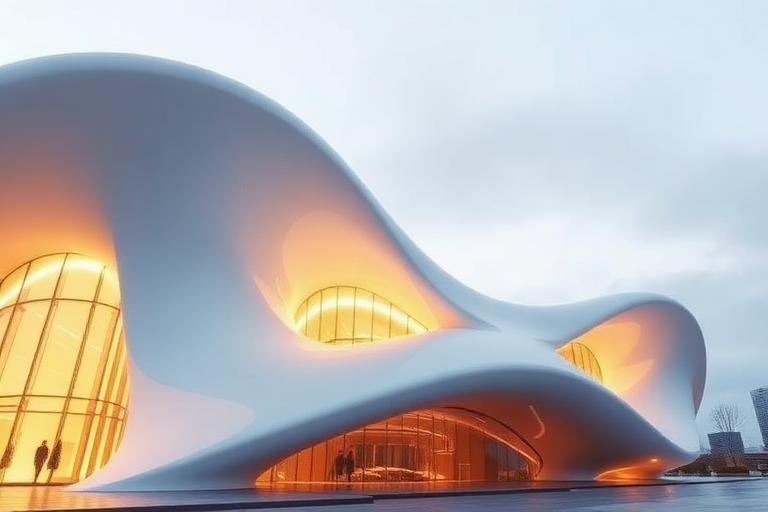
Blobitecture

When software freed architects from the right angle - Greg Lynn's embryological housing experiments, FOA's Yokohama International Passenger Terminal as continuous landscape, and NOX's Son-O-House as pure computational biology.

Compare Blobitecture with another style →See the Blobitecture typefaces →On the timeline · 1990s
Record020-AB
AestheticBlobitecture
ClassOrganic / Digital
StatusINGESTING
Blobitecture aesthetic archive image
Archive plate · Blobitecture
01
The record

What it is, when it works, who it is for, and where it already exists.

How to use it

Record 020-AB - when it works, who it is for, what it looks like

FIELD 01

When to use it

  • Brand identity for technology companies where fluid, non-linear form signals innovation
  • Cultural institution or museum pavilion brand that wants maximum conceptual provocation
  • Fashion and beauty brand using organic, biomorphic form as differentiator
  • Speculative design or concept project where the form itself is the argument
FIELD 02

Perfect for

  • Technology and biotech companies whose work operates beyond conventional boundaries
  • Luxury fashion brands commissioning temporary pavilions or installations
  • Cultural institutions and biennale exhibitions exploring computation and form
  • Industrial and product designers working with advanced manufacturing and 3D printing

In the wild, Blobitecture aesthetic real-world examples

Where this aesthetic shows up in the real world · ↗ opens the source site

Omoro Style GuideEvery aesthetic, every field on this page, in one PDF.
$8Get the guide →
02
The anatomy

Where Blobitecture came from, what makes it recognisable, and the fingerprint it leaves.

History, Blobitecture aesthetic history

1995-2010 (peak); ongoing influence · United States and Netherlands, with global adoption

Blobitecture emerged when new software tools (initially animation packages like Maya and Alias, later Rhino and Grasshopper) allowed architects to design and fabricate complex curved forms that had been geometrically impossible to draw or build with traditional methods. Architect Greg Lynn coined the term 'blob' in his 1995 essay 'Blobs, or Why Tectonics is Square and Topology is Groovy,' arguing that smooth, continuous surfaces could respond to site forces more fluidly than the sharp-cornered geometries of conventional architecture.

The first built blobs appeared in the late 1990s and early 2000s. Foreign Office Architects' (FOA) Yokohama International Passenger Terminal (2002) folded the ground plane into a continuous landscape of ramps, decks, and interiors with no clear distinction between floor, wall, and roof. Future Systems' Selfridges department store in Birmingham (2003), wrapped in aluminum discs, became an instant icon. Peter Cook and Colin Fournier's Kunsthaus Graz (2003) sat on the Austrian city's skyline like a blue bioluminescent organism.

Blobitecture faded as a named movement after 2010, partly because its formal tricks became routine and partly because the computational tools that enabled it evolved toward more sophisticated parametric and algorithmic approaches. But its legacy is significant: it permanently demonstrated that architecture need not be rectilinear, and the fabrication techniques developed for blob buildings (CNC-milled molds, doubly curved panels, parametric panelization) became standard tools for contemporary practice.

Architecture learned to bulge.

Omoro dossier · 020-AB

Visual markers, Blobitecture aesthetic visual markers

The visual DNA: what makes it recognisable

typography

See the fonts
  • Rounded, soft typefaces: Nunito, Quicksand, Comfortaa
  • Organic letterforms with no sharp corners
  • Flowing text layouts following curved surfaces
  • Futuristic display faces: Eurostile Extended, Orbitron

grid

  • No rectilinear grid: forms generated by topological surfaces
  • Continuous surfaces folding from floor to wall to roof
  • Interior spaces defined by curvature rather than partitions
  • Structural systems following doubly curved geometries

materials

  • Aluminum and metal cladding panels: #C0C8D0, #B0B8C0, #A0A8B0
  • Glass-reinforced concrete (GRC) in white or grey: #E0E0E0, #D0D0D0
  • Translucent materials: ETFE, polycarbonate: #E8ECF0, #D8DCE0
  • Sprayed concrete and shotcrete: #B0B0B0, #C0C0C0

motifs

  • Smooth, bulging surfaces without sharp edges
  • Building-as-organism metaphors
  • Perforated skins with irregular aperture patterns
  • Ground plane rising continuously into the building form

Aesthetic profile

8-channel console with the fingerprint on its display. Save the card, or share the page

Aesthetic Profile
Blobitecture
Future-Facing
1995–present
Attribute console · 020-AB
leans organic, digital, expressive
8 CH
FIG. 1
MaximalMinimalDigitalAnalogExpressiveRestrainedCoolWarmFuturisticNostalgicChaoticStructuredLightDarkOrganicGeometric
01Minimal
Maximal40%
02Analog
Digital60%
03Restrained
Expressive50%
04Cool
Warm10%
05Futuristic
Nostalgic50%
06Structured
Chaotic40%
07Dark
Light20%
08Organic
Geometric70%
OrganicDigitalExpressive5 materials
Omoro · Attribute console · 020-AB
omoro.io/styles/arch-blobitecture

Material assembly

The style's primary materials, assembled bottom-up

Tap a stratum for material detail · Full catalog

Place in history

Future-Facing · 1995–present - tap any style to travel

Color Palettes, Blobitecture color palettes and hex codes

4 color interpretations of this aesthetic

Blobitecture
#1C1C1C · #8A8888 · #D0CEC8 · #F0EEEA · #4A4848
Non-Euclidean form freed by computation, the right angle abandoned
Selfridges
#181820 · #404858 · #8090A0 · #C0C8D0 · #E8ECF0
Fifteen thousand aluminium discs: the building as alien organism
Yokohama Fold
#2A2018 · #6A5030 · #A08868 · #C8B898 · #E0D8C8
FOA's terminal: timber deck flowing from pier to rooftop park
Eden Biome
#1A2818 · #3A6830 · #7898A0 · #C0D0D0 · #F0F4F0
Geodesic pillows holding jungle atmosphere in Cornwall clay
Omoro Palette Pack575 curated palettes across every aesthetic, 5 export formats.
$8Get the palettes →

Adjacent Palettes, styles related to Blobitecture

The colour of the styles sitting closest to this one

Neo-Futurism
Architectural Expressionism
Organic Architecture
Retrofuturism
03
The direction

How to shoot it, how to prompt it, and how to board it.

Photo Direction

How to shoot this aesthetic

"A building that forgot it was supposed to have corners"

Shot list

  • Wide shot emphasizing the continuous curved silhouette against open sky
  • Detail shot of the membrane-like panel seams across the curved surface
  • Low-angle shot exaggerating the biomorphic bulge of the structure

Lighting

Soft, even light that travels across the continuous curve gradually hard directional light breaks the surface into segments rather than reading as one unbroken form

Omoro Director's Briefs151 photo shot-lists like this one, ready to shoot from.
$8Get the briefs →

Generative Prompt

Drop this into Studio to generate in this aesthetic

Blobitecture with amorphous organic-form architecture, smooth continuous curved surfaces with no straight edges, biomorphic computer-generated massing, Future Systems-adjacent influence, membrane-like structural skin

Paste as-is, or append your own subject

Mood Board

The record applied to your project. The record's kit is free; your brand, references and plates come with membership

Mood board
The Blobitecture board
8 frames · 4 selected
FIG. 4
Blob Shadow1C1C1CAluminium8A8888Panel GreyD0CEC8Sky GleamF0EEEADisc Shadow4A4848
Brand and references
IdleBrand and references open with membership
With membership: the brand's own facts and colours in every prompt, references carried into every frame, and the plates generated.
01 · Hero application
02 · Material and finish
03 · Palette in context
04 · Photography direction
05 · Pattern plate
06 · Object
07 · Environment
08 · Digital presence
Demo kit free, the rest with membershipThe record as a demo kit, free. Name a project and it is written for that
Omoro · Mood board · 020-AB
04
The judgement

Whether to use it, what it costs to do properly, and where it stands right now.

Creative verdict, Blobitecture feasibility and strategic recommendation

Two written calls, seven meters, and when to walk away

Creative verdict
Should Blobitecture be the call?
7 meters
FIG. 2
Assessment

The surface has to be rationalised or it will not get built. A smooth double-curved skin means thousands of unique panels, which is a budget nobody has, so the geometry needs resolving into repeatable families early. Model for fabrication from the start. The interiors are the usual casualty: curved shells produce awkward, unusable residual space.

Verdict

Right only when the curve has a reason, because this reads now as a specific technological optimism: almost all of it dates to a narrow window around 2000 to 2010, when NURBS modelling arrived and compound curves became drawable without hand-calculation. The software moment passed and the buildings turned out to be very expensive to clad.

Production cost
High

Software-driven form that's expensive to fabricate at any scale.

Creative difficulty
High

Freedom from the right angle only matters if the result means something.

Execution difficulty
High

Continuous curved surfaces demand real computational fabrication skill.

Risk of misuse
Medium

Freedom from the right angle only matters if the result means something.

Prevalence
Rare

A rare reference, mostly among computational-design specialists.

Longevity
Enduring

Tied to genuine computational capability, which keeps advancing.

Brand investment
High

Software-driven form that's expensive to fabricate at any scale.

Avoid if
There's no real computational design capability
Software-driven form that can't actually be fabricated is just a picture.
The curved form has no reason behind it
Freedom from the right angle only matters if the result means something.
Omoro · Creative verdict · 020-AB

Editorial Depth

A Pro feature: origins, practitioners, and pitfalls

Editorial depth
The Blobitecture file
14 sections
FIG. 3
Context02Brands02Perception04Use04Index02
01Common MisconceptionThe principle beneath the surface
02Historical ContextOrigins, cultural moment, and reaction
03Brands That Accidentally Use This StyleNatural alignment, not category claims
04Brands That Perfectly Represent This StyleExceptional execution
05Psychological EffectHow visual decisions change perception
06Visual ChecklistInclude and avoid
07Creative FormulaThe visual system reduced to essentials
08Recognition SignalsHow to recognize it in two seconds
09When To Use This StyleContexts where the language performs
10Common Creative MistakesWhere imitation weakens the signal
11Best Brand ApplicationsIndustries with a natural advantage
12Creative Application AnalysisFit, feasibility, and production reality
13Related StylesClose languages and the key distinction
14Visual DNA SummaryThe sentence to remember
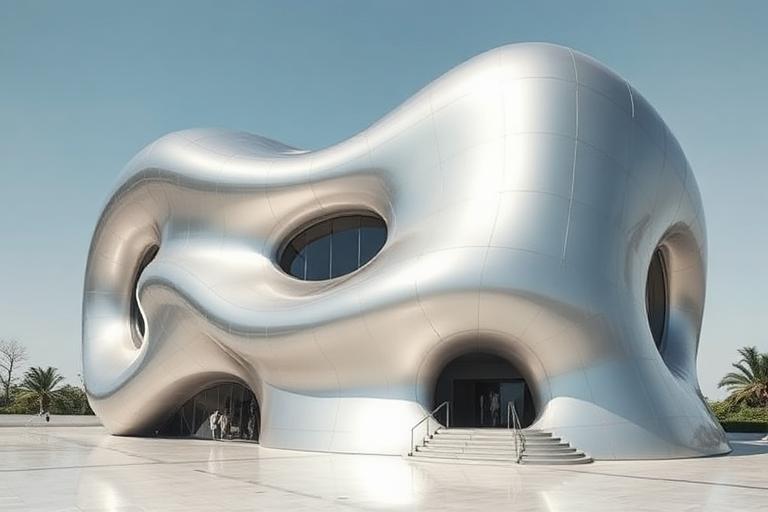
The editorial depth, with membershipOpening soon
Omoro · Editorial depth · 020-AB
05
The index

Neighbours, cross-references, blends, and the questions people ask.

Related concepts

Connected across the creative knowledge graph

Cultural relevance, Blobitecture cultural relevance today

Where it stands now, and what it costs you to use it

Blobitecture is what happened when NURBS modelling arrived and architects could finally draw compound curves without hand-calculating them. The name started as a joke and stuck.

Almost all of it dates to a narrow window around 2000 to 2010, because the software moment passed and the buildings turned out to be very expensive to clad.

It reads as a specific technological optimism now. Curved for a reason survives; curved because it was newly possible does not.

Cross-references

Parametric ArchitectureParametric architecture inherited and refined Blobitecture's computational approachNeo-Futurismboth pursue dynamic, non-rectilinear formOrganic ArchitectureBlobitecture updates organic architecture with digital tools

Blend

Mix Blobitecture with any style in the library

Blobitecture×
50%50%
94% alike
Blobitecture referenceNeo-Futurism referenceBlobitecture 50%Neo-Futurism 50%

Merged palette

#1C1C1C

#0A1628

#8A8888

#2E6DA4

#D0CEC8

Leads digital, futuristic, expressive

Typography · from Blobitecture

Raleway over Merriweather

Materials

  • Aluminum and metal cladding panels: #C0C8D0, #B0B8C0, #A0A8B0
  • Glass-reinforced concrete (GRC) in white or grey: #E0E0E0, #D0D0D0
  • White concrete and GRC (glass-reinforced concrete): #F0EEEA, #E4E2DE

Use it

Blobitecture with amorphous organic-form architecture, smooth continuous curved surfaces with no straight edges, biomorphic computer-generated massing, Future Systems-adjacent influence, membrane-like structural skin (50%), infused with Neo-Futurist architecture with fluid parametric-adjacent forms expressing forward-looking ambition, dramatic cantilevers and sweeping curves, Calatrava-influenced structural expressionism, tomorrow-facing civic monumentality, color palette strictly #1C1C1C #0A1628 #8A8888 #2E6DA4 #D0CEC8, overall character: digital, futuristic, expressive

One-click generation opens with the studio

About this aesthetic

What is Blobitecture?

Blobitecture is a term for architecture featuring smooth, organic, blob-like forms enabled by digital design and fabrication tools. Emerging in the late 1990s, it rejected rectilinear geometry in favor of continuous curved surfaces. Key examples include the Yokohama Terminal, Selfridges Birmingham, and the Kunsthaus Graz.

Is Blobitecture still practiced?

As a named movement, Blobitecture peaked around 2000-2010. Its formal vocabulary (complex curves, continuous surfaces, non-rectilinear geometry) has been absorbed into contemporary parametric and computational design. The tools and techniques it pioneered are now standard; the blob as a distinct category has dissolved into broader practice.

How were blob buildings constructed?

CNC-milled molds, custom-fabricated curved panels, and parametric software that translated complex geometries into buildable components. Each panel on a blob surface can have unique dimensions, requiring digital fabrication rather than standardized mass production. This made blob buildings expensive but pushed fabrication technology forward.

Build with the blobitecture aesthetic

Every style in the library is broken down like this one: the palette, the typography, the materials and the lineage.

Explore the style library →