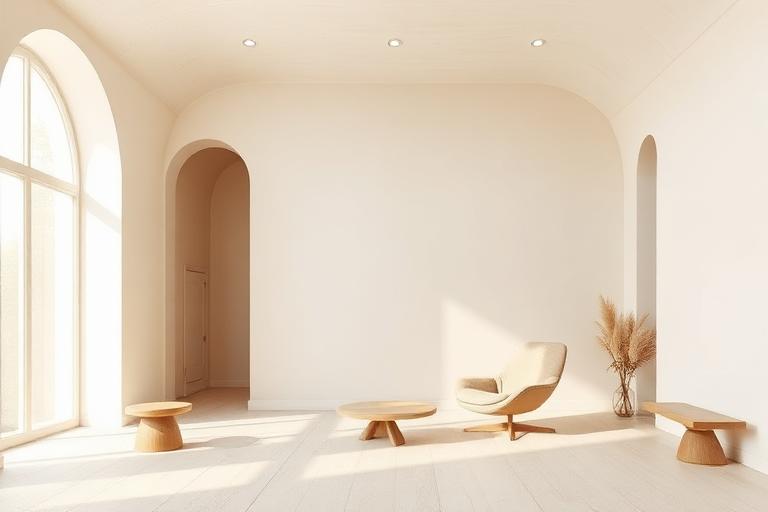
Architectural Minimalism

Every element justified, nothing added - Tadao Ando's concrete walls cut by a single shaft of light, John Pawson's Calvin Klein store that made emptiness a selling environment, Peter Zumthor's thermal baths at Vals.

Compare Architectural Minimalism with another style →See the Architectural Minimalism typefaces →On the timeline · 1980s
Record020-AM
AestheticArchitectural Minimalism
ClassMinimal / Structured
StatusINGESTING
Architectural Minimalism aesthetic archive image
Archive plate · Architectural Minimalism
01
The record

What it is, when it works, who it is for, and where it already exists.

How to use it

Record 020-AM - when it works, who it is for, what it looks like

FIELD 01

When to use it

  • Luxury brand identity where restraint signals confidence and wealth
  • Residential architecture portfolio with a reduction-based design philosophy
  • Retail and hospitality environments where the product is the only voice
  • Editorial design demanding maximum white space and typographic control
FIELD 02

Perfect for

  • Luxury fashion and retail brands - Jil Sander, The Row, Bottega Veneta
  • High-end residential architects and interior designers
  • Spa, wellness, and hospitality brands built on calm and clarity
  • Galleries and art institutions presenting work in neutral space

In the wild, Architectural Minimalism aesthetic real-world examples

Where this aesthetic shows up in the real world · ↗ opens the source site

Omoro Style GuideEvery aesthetic, every field on this page, in one PDF.
$8Get the guide →
02
The anatomy

Where Architectural Minimalism came from, what makes it recognisable, and the fingerprint it leaves.

History, Architectural Minimalism aesthetic history

1980s-present · Japan and Western Europe

Architectural Minimalism crystallized in the 1980s when two distinct traditions converged. In Japan, Tadao Ando was building concrete meditation spaces where light, water, and bare material replaced ornament entirely. The Church of the Light in Osaka (1989), with its cruciform slit cutting through a concrete wall, demonstrated that subtraction could be more powerful than addition. In Europe, John Pawson was stripping domestic and retail spaces to their structural essence, influenced by his time living in a Japanese monastery.

The movement drew from multiple sources: Mies van der Rohe's 'less is more' (itself borrowed from Peter Behrens), Japanese concepts of ma (negative space) and wabi-sabi (beauty in imperfection), and Donald Judd's sculptural installations in Marfa, Texas. What distinguished Minimalist architecture from simply austere Modernism was intentionality: every joint, every material transition, every light condition was deliberated. Peter Zumthor's Therme Vals (1996), carved from local quartzite, became a pilgrimage site for the movement.

Contemporary Minimalism has expanded beyond concrete and white plaster. Alberto Campo Baeza works with light as primary material. SANAA (Sejima and Nishizawa) dissolves boundaries between interior and landscape with transparent and translucent surfaces. Vincent Van Duysen and John Pawson demonstrate that minimalism and warmth are not contradictions. The common thread remains: nothing is present that does not earn its place.

The architecture of almost nothing.

Omoro dossier · 020-AM

Visual markers, Architectural Minimalism aesthetic visual markers

The visual DNA: what makes it recognisable

typography

See the fonts
  • Thin-weight sans-serifs: Helvetica Neue Light, Avenir, Gotham Thin
  • Extreme restraint: one typeface, one or two weights
  • Generous whitespace around text blocks
  • Type as quiet information, never as decoration

grid

  • Single-material surfaces extending uninterrupted across large planes
  • Concealed junctions: shadow gaps replace visible trim
  • Precise proportional relationships between openings and walls
  • Rooms defined by light conditions rather than by walls

materials

  • Poured concrete with controlled formwork: #A09C98, #8A8682
  • White plaster and lime wash: #F8F6F2, #EEECE8
  • Natural stone in monolithic slabs: #C8C4BC, #B0ACA4
  • Warm wood as counterpoint: oak, walnut, hinoki cypress

motifs

  • Slots and apertures framing specific views or light conditions
  • Water as reflective surface and spatial boundary
  • Flush doors and handleless cabinetry
  • Single sculptural staircase as the room's only event

Aesthetic profile

8-channel console with the fingerprint on its display. Save the card, or share the page

Aesthetic Profile
Architectural Minimalism
Contemporary
1960–present
Attribute console · 020-AM
leans minimal, structured, restrained
8 CH
FIG. 1
MinimalMaximalDigitalAnalogRestrainedExpressiveCoolWarmFuturisticNostalgicStructuredChaoticLightDarkGeometricOrganic
01Minimal
Maximal90%
02Analog
Digital10%
03Restrained
Expressive80%
04Cool
Warm30%
05Futuristic
Nostalgic10%
06Structured
Chaotic90%
07Dark
Light50%
08Organic
Geometric70%
MinimalStructuredRestrained3 materials
Omoro · Attribute console · 020-AM
omoro.io/styles/arch-minimalism

Material assembly

The style's primary materials, assembled bottom-up

Tap a stratum for material detail · Full catalog

Place in history

Contemporary · 1960–present - tap any style to travel

Color Palettes, Architectural Minimalism color palettes and hex codes

6 color interpretations of this aesthetic

Architectural Minimalism
#8A8682 · #A09C98 · #C8C4BC · #EEECE8 · #F8F6F2
The architecture of almost nothing
Black & White
#000000 · #181818 · #787878 · #D4D4D4 · #FFFFFF
Stark graphic contrast reduced to its irreducible elements
Warm Neutrals
#F2EDE4 · #DDD0BC · #B4A490 · #887870 · #C4B8A8
Quiet sand and linen tones that breathe with natural light
Stone
#36363C · #68686E · #98989E · #C8C8CC · #F0F0F2
Quarried cool and the silence of geological time
Japanese Ink
#080806 · #282826 · #686866 · #D4CCC0 · #F2EEE4
Sumi brushwork and the void between marks
Scandinavian White
#FAFAFA · #EEF0F2 · #D4D0C8 · #A4A4A0 · #383838
Nordic light diffused through birch and clean air
Omoro Palette Pack575 curated palettes across every aesthetic, 5 export formats.
$8Get the palettes →

Adjacent Palettes, styles related to Architectural Minimalism

The colour of the styles sitting closest to this one

Soft Minimalism
Japanese Minimalism
Monolithic Architecture
Wabi-Sabi
03
The direction

How to shoot it, how to prompt it, and how to board it.

Photo Direction

How to shoot this aesthetic

"Reduction, taken all the way to the essential form and no further"

Shot list

  • Wide shot of a single reduced volume against clean sky or water
  • Detail shot of a seamless material junction no visible fastener, no ornament
  • Interior shot emphasizing generous quiet negative space

Lighting

Soft, diffused daylight that reveals subtle material variation without harsh shadow minimalism depends on restraint at every level, lighting included

Omoro Director's Briefs151 photo shot-lists like this one, ready to shoot from.
$8Get the briefs →

Generative Prompt

Drop this into Studio to generate in this aesthetic

Minimalist architecture with radical reduction to essential form, monochromatic material palette and seamless detailing, generous quiet negative space, architecture as meditation on light and proportion

Paste as-is, or append your own subject

Mood Board

The record applied to your project. The record's kit is free; your brand, references and plates come with membership

Mood board
The Architectural Minimalism board
8 frames · 4 selected
FIG. 4
Deep Poured Concrete8A8682Dark Poured ConcreteA09C98Natural StoneC8C4BCLight White PlasterEEECE8Pale White PlasterF8F6F2
Brand and references
IdleBrand and references open with membership
With membership: the brand's own facts and colours in every prompt, references carried into every frame, and the plates generated.
01 · Hero application
02 · Material and finish
03 · Palette in context
04 · Photography direction
05 · Pattern plate
06 · Object
07 · Environment
08 · Digital presence
Demo kit free, the rest with membershipThe record as a demo kit, free. Name a project and it is written for that
Omoro · Mood board · 020-AM
04
The judgement

Whether to use it, what it costs to do properly, and where it stands right now.

Creative verdict, Architectural Minimalism feasibility and strategic recommendation

Two written calls, seven meters, and when to walk away

Creative verdict
Should Architectural Minimalism be the call?
7 meters
FIG. 2
Assessment

Detail cost rises as visible elements fall. A shadow gap, a flush reveal and a frameless junction each cost more than the trim they replace, which is the budget reality behind every white box. Set the tolerances before the design is fixed. Storage has to be designed in, because the first coat left on a chair destroys the whole proposition.

Verdict

Only with budget for detailing, because this is the most expensive way to build: every joint resolved, every service concealed, nowhere for an error to hide. What reads as simplicity is elaborate work, and cheap minimalism looks unfinished rather than restrained. There is also a standing argument about how such a building can actually be lived in, which the photographs never show.

Production cost
High

Every wall and shaft of light has to be built with total precision.

Creative difficulty
High

Emptiness has to be the point, not just an absence of ideas.

Execution difficulty
High

Nothing is hidden. Every seam and proportion is exposed.

Risk of misuse
High

Emptiness without real intent just reads as an unfinished room.

Prevalence
Common

The default premium-brand architectural language right now.

Longevity
Timeless

Restraint at this level of precision doesn't date.

Brand investment
High

Every wall and shaft of light built with total precision.

Avoid if
There's no budget for real material precision
Emptiness without real craft just reads as an unfinished room.
The brand needs personality or warmth
This is restraint taken to its most extreme, deliberately quiet form.
Omoro · Creative verdict · 020-AM

Editorial Depth

A Pro feature: origins, practitioners, and pitfalls

Editorial depth
The Architectural Minimalism file
14 sections
FIG. 3
Context02Brands02Perception04Use04Index02
01Common MisconceptionThe principle beneath the surface
02Historical ContextOrigins, cultural moment, and reaction
03Brands That Accidentally Use This StyleNatural alignment, not category claims
04Brands That Perfectly Represent This StyleExceptional execution
05Psychological EffectHow visual decisions change perception
06Visual ChecklistInclude and avoid
07Creative FormulaThe visual system reduced to essentials
08Recognition SignalsHow to recognize it in two seconds
09When To Use This StyleContexts where the language performs
10Common Creative MistakesWhere imitation weakens the signal
11Best Brand ApplicationsIndustries with a natural advantage
12Creative Application AnalysisFit, feasibility, and production reality
13Related StylesClose languages and the key distinction
14Visual DNA SummaryThe sentence to remember
The editorial depth, with membershipOpening soon
Omoro · Editorial depth · 020-AM
05
The index

Neighbours, cross-references, blends, and the questions people ask.

Related concepts

Connected across the creative knowledge graph

Cultural relevance, Architectural Minimalism cultural relevance today

Where it stands now, and what it costs you to use it

Architectural minimalism is the most expensive way to build. Every joint has to be resolved, every service concealed, and there is nowhere for an error to hide.

What reads as simplicity is almost always elaborate detailing, which is why cheap minimalism looks unfinished rather than restrained.

It also constrains how a building can be lived in, and that tension between the photograph and the occupation is a standing argument in the field.

Cross-references

Luxury Minimalluxury minimal applies the same reductive logic to interiors and brandingJapanese MinimalismJapanese minimalism provides the philosophical foundation: ma, wabi-sabi, reduction as spiritual practiceWabi-Sabiwabi-sabi's acceptance of imperfection tempers minimalism's pursuit of perfectionSoft Minimalismsoft minimalism adds tactile warmth to minimalism's ascetic discipline

Compare

Architectural Minimalism vs Brutalist Architecture

Blend

Mix Architectural Minimalism with any style in the library

Architectural Minimalism×
50%50%
87% alike
Architectural Minimalism referenceSoft Minimalism referenceArchitectural Minimalism 50%Soft Minimalism 50%

Merged palette

#8A8682

#7A6858

#C4B4A4

#C8C4BC

#EDE6DC

Leads minimal, structured, restrained

Typography · from Architectural Minimalism

Space Grotesk over Inter

Materials

  • Poured concrete with controlled formwork: #A09C98, #8A8682
  • White plaster and lime wash: #F8F6F2, #EEECE8
  • Warm white and cream plaster: #F5F0E8, #EDE6D8, #E8E0D0

The calls this blend forces

These two disagree on one thing, and a blend cannot average them: you pick a side. At this mix:

Geometric or Organic? Architectural Minimalism is geometric, Soft Minimalism is organic. This mix lands geometric.

Use it

Minimalist architecture with radical reduction to essential form, monochromatic material palette and seamless detailing, generous quiet negative space, architecture as meditation on light and proportion (50%), infused with Soft minimalist architecture with warm reductive interiors, rounded edges and tactile natural materials softening strict minimalism, gentle diffused daylight, calm uncluttered residential serenity, color palette strictly #8A8682 #7A6858 #C4B4A4 #C8C4BC #EDE6DC, leaning geometric over organic, overall character: minimal, structured, restrained

One-click generation opens with the studio

About this aesthetic

What is Minimalist architecture?

Minimalist architecture strips buildings to essential structure, material, and light. Every element must justify its presence. The movement draws from Mies van der Rohe's 'less is more,' Japanese spatial philosophy, and the material precision of sculptors like Donald Judd. Key practitioners include Tadao Ando, John Pawson, Peter Zumthor, and Alberto Campo Baeza.

Is Minimalist architecture the same as modern architecture?

No. Modern architecture (1920s-1970s) was a broad movement about rejecting historical ornament and embracing industrial materials. Minimalist architecture is a more specific position about radical reduction. All Minimalist architecture is modern in sensibility, but most modern buildings are not minimal enough to qualify.

Why is Minimalist architecture expensive?

Because simplicity requires precision. With no moldings to hide joints, no paint to cover imperfections, and no furniture to distract from surfaces, every material and junction must be perfect. The craftsmanship required to achieve apparent simplicity often exceeds what a more decorated building demands.

Build with the architectural minimalism aesthetic

Every style in the library is broken down like this one: the palette, the typography, the materials and the lineage.

Explore the style library →