Bowellism (High-Tech)

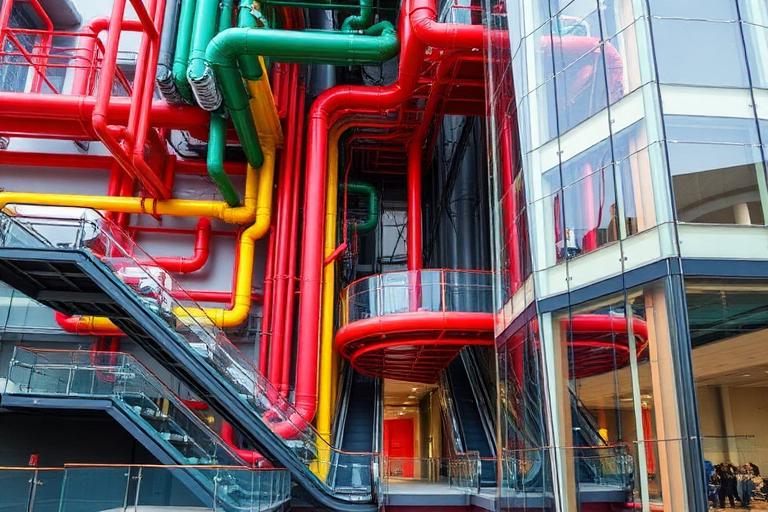
Rogers and Piano's Centre Pompidou turned the building inside out - color-coded ducts on the facade, escalators in transparent tubes, structure expressed as spectacle - and created the most photographed cultural building in the world.

Compare Bowellism (High-Tech) with another style →See the Bowellism (High-Tech) typefaces →On the timeline · 1970s
Record020-AB
AestheticBowellism (High-Tech)
ClassExpressive / Maximal
StatusINGESTING
Bowellism (High-Tech) aesthetic archive image
Archive plate · Bowellism (High-Tech)
01
The record

What it is, when it works, who it is for, and where it already exists.

How to use it

Record 020-AB - when it works, who it is for, what it looks like

FIELD 01

When to use it

  • Brand identity celebrating transparency of process, structure, and systems
  • Technology and engineering brand that wants to make complexity legible and beautiful
  • Architecture firm identity built around expressive structure and mechanical systems
  • Cultural institution brand positioning its inner workings as the public attraction
FIELD 02

Perfect for

  • Engineering, infrastructure, and technology companies making systems visible
  • Architecture firms with an expressive structural and mechanical approach
  • Science museums and technology centers communicating how things work
  • Manufacturing and industrial brands where process is the brand story

In the wild, Bowellism (High-Tech) aesthetic real-world examples

Where this aesthetic shows up in the real world · ↗ opens the source site

Omoro Style GuideEvery aesthetic, every field on this page, in one PDF.
$8Get the guide →
02
The anatomy

Where Bowellism (High-Tech) came from, what makes it recognisable, and the fingerprint it leaves.

History, Bowellism (High-Tech) aesthetic history

1970s-present · United Kingdom and France

Bowellism takes its name from the practice of placing a building's services (staircases, elevators, mechanical systems, structural bracing) on the exterior, making the building's functional 'innards' its primary visual feature. The term was coined to describe the Centre Pompidou in Paris (Renzo Piano and Richard Rogers, 1977), which turned convention inside out: color-coded service systems (blue for air, green for water, yellow for electricity, red for circulation) wrapped the exterior while the interior remained a flexible open floor plate.

Richard Rogers developed the approach further at the Lloyd's building in London (1986), where stainless steel service towers, exposed concrete structure, and glass-enclosed elevators create a composition that owes more to oil refineries than to traditional office architecture. The building demonstrated that the same principles could produce formal sophistication at the scale of a major commercial project, not just a cultural provocation.

Bowellism overlaps with and is often categorized within the broader High-Tech movement (which also includes Norman Foster's more refined, less visceral approach). The distinction is one of attitude: where Foster's High-Tech tends toward sleek minimalism with exposed structure, Bowellism revels in the visual complexity and industrial energy of visible systems. The approach has been influential in transport infrastructure (airports, stations) where exposed services and clear circulation are functionally as well as aesthetically justified.

The building that wears its guts on the outside.

Omoro dossier · 020-AB

Visual markers, Bowellism (High-Tech) aesthetic visual markers

The visual DNA: what makes it recognisable

typography

See the fonts
  • Industrial sans-serifs: DIN, Eurostile, Univers
  • Color-coded wayfinding systems
  • Technical drawing-influenced lettering
  • Signage integrated into structural and service elements

grid

  • Interior floor plates kept clear and flexible
  • Services, structure, and circulation pushed to the perimeter
  • Modular structural bays allowing plug-in expansion
  • Transparent facades revealing interior activity

materials

  • Stainless steel and polished metal: #C0C8D0, #A8B0B8
  • Color-coded service systems: #0057B8, #00A550, #FFD100, #E4002B
  • Exposed reinforced concrete: #A0A0A0, #B0B0B0
  • Glass and neoprene gaskets: #D0D8E0, #2C2C2C

motifs

  • External staircases and glass-enclosed elevators
  • Visible ductwork, pipes, and cable trays
  • Braced steel frames as facade composition
  • Gerberette brackets and tension rods as decorative engineering

Aesthetic profile

8-channel console with the fingerprint on its display. Save the card, or share the page

Aesthetic Profile
Bowellism (High-Tech)
Postmodern
1970–1990
Attribute console · 020-AB
leans expressive, maximal, chaotic
8 CH
FIG. 1
MaximalMinimalDigitalAnalogExpressiveRestrainedCoolWarmFuturisticNostalgicChaoticStructuredLightDarkOrganicGeometric
01Minimal
Maximal50%
02Analog
Digital40%
03Restrained
Expressive60%
04Cool
Warm20%
05Futuristic
Nostalgic40%
06Structured
Chaotic50%
07Dark
Light10%
08Organic
Geometric40%
ExpressiveMaximalChaotic4 materials
Omoro · Attribute console · 020-AB
omoro.io/styles/arch-bowellism

Material assembly

The style's primary materials, assembled bottom-up

Tap a stratum for material detail · Full catalog

Place in history

Postmodern · 1970–1990 - tap any style to travel

Color Palettes, Bowellism (High-Tech) color palettes and hex codes

4 color interpretations of this aesthetic

Bowellism (High-Tech)
#E8320A · #2D5FA6 · #F5A800 · #E8E8E8 · #1A1A1A
Structure and services turned inside out and painted for the world to see
Pompidou Pipe
#1A1A1A · #D83020 · #2858A0 · #40A040 · #E8E4DC
Inside-out: every service pipe painted and celebrated
Lloyd's Chrome
#0C0C10 · #383840 · #707880 · #B0B8C0 · #E0E4E8
Stainless ducts stacked on Leadenhall: Rogers' vertical city
Service Core
#181818 · #484040 · #C84020 · #E0C020 · #C8C4BC
Exposed risers and access gantries: the building as machine
Omoro Palette Pack575 curated palettes across every aesthetic, 5 export formats.
$8Get the palettes →

Adjacent Palettes, styles related to Bowellism (High-Tech)

The colour of the styles sitting closest to this one

Industrial Architecture
Neo-Futurism
Architectural Modernism
Constructivist Architecture
03
The direction

How to shoot it, how to prompt it, and how to board it.

Photo Direction

How to shoot this aesthetic

"The building turned inside out, mechanical guts worn with pride"

Shot list

  • Wide shot from below, exposed structural trusses and ductwork framing the sky
  • Detail shot of color-coded service pipes blue for water, yellow for gas, red for fire
  • Detail shot of an exposed steel joint or bolted connection, engineering as texture

Lighting

Bright, even daylight through glass curtain walls structure needs to stay legible, so avoid heavy shadow that hides the engineering detail

Omoro Director's Briefs151 photo shot-lists like this one, ready to shoot from.
$8Get the briefs →

Generative Prompt

Drop this into Studio to generate in this aesthetic

High-tech aesthetic with exposed structural systems, technology as aesthetic expression, Rogers and Foster influence, color-coded service elements, industrial refinement

Paste as-is, or append your own subject

Mood Board

The record applied to your project. The record's kit is free; your brand, references and plates come with membership

Mood board
The Bowellism (High-Tech) board
8 frames · 4 selected
FIG. 4
Escalator RedE8320ADuct Blue2D5FA6Service YellowF5A800Exposed SteelE8E8E8Structure Black1A1A1A
Brand and references
IdleBrand and references open with membership
With membership: the brand's own facts and colours in every prompt, references carried into every frame, and the plates generated.
01 · Hero application
02 · Material and finish
03 · Palette in context
04 · Photography direction
05 · Pattern plate
06 · Object
07 · Environment
08 · Digital presence
Demo kit free, the rest with membershipThe record as a demo kit, free. Name a project and it is written for that
Omoro · Mood board · 020-AB
04
The judgement

Whether to use it, what it costs to do properly, and where it stands right now.

Creative verdict, Bowellism (High-Tech) feasibility and strategic recommendation

Two written calls, seven meters, and when to walk away

Creative verdict
Should Bowellism (High-Tech) be the call?
7 meters
FIG. 2
Assessment

It only works if the services are genuinely on the outside. Rogers put ducts, lifts and structure on the facade for maintenance access, and decorative pipework is the opposite of that reasoning, which is the failure mode. Route things for real. Weatherproofing and fire protection of exposed elements is the actual expense, and it is what most versions skip.

Verdict

Only with a maintenance budget that matches the ambition, because putting the services on the outside accelerates wear and complicates upkeep, which is the criticism the approach has never fully answered. The stated logic is sound: services have shorter lifespans than structure, so making them accessible extends the building's life. Lloyd's of London is the argument, made once, definitively.

Production cost
High

Turning the building inside out is more expensive than hiding the ducts.

Creative difficulty
High

Structure as spectacle has to still be legible, not just loud.

Execution difficulty
High

Color-coded systems have to read clearly at full building scale.

Risk of misuse
Medium

Structure as spectacle has to still be legible, not just loud.

Prevalence
Rare

A rare reference outside architecture-specific contexts.

Longevity
Enduring

Still one of the most photographed buildings in the world, decades later.

Brand investment
High

Turning the building inside out costs more than hiding the ducts.

Avoid if
The brand needs to feel understated
Turning the building inside out is architecture as spectacle by design.
The exposed systems aren't organized clearly
Structure as spectacle has to stay legible, or it's just visual noise.
Omoro · Creative verdict · 020-AB

Editorial Depth

A Pro feature: origins, practitioners, and pitfalls

Editorial depth
The Bowellism (High-Tech) file
14 sections
FIG. 3
Context02Brands02Perception04Use04Index02
01Common MisconceptionThe principle beneath the surface
02Historical ContextOrigins, cultural moment, and reaction
03Brands That Accidentally Use This StyleNatural alignment, not category claims
04Brands That Perfectly Represent This StyleExceptional execution
05Psychological EffectHow visual decisions change perception
06Visual ChecklistInclude and avoid
07Creative FormulaThe visual system reduced to essentials
08Recognition SignalsHow to recognize it in two seconds
09When To Use This StyleContexts where the language performs
10Common Creative MistakesWhere imitation weakens the signal
11Best Brand ApplicationsIndustries with a natural advantage
12Creative Application AnalysisFit, feasibility, and production reality
13Related StylesClose languages and the key distinction
14Visual DNA SummaryThe sentence to remember
The editorial depth, with membershipOpening soon
Omoro · Editorial depth · 020-AB
05
The index

Neighbours, cross-references, blends, and the questions people ask.

Related concepts

Connected across the creative knowledge graph

Cultural relevance, Bowellism (High-Tech) cultural relevance today

Where it stands now, and what it costs you to use it

Bowellism is the nickname for putting a building's guts on the outside, and the Lloyd's building in London is the definitive example of it.

The stated logic was that services have shorter lifespans than structure, so making them accessible extends the building's life.

In practice exposure accelerates wear and complicates maintenance, which is the criticism the approach has never fully answered.

Cross-references

High-Tech ArchitectureBowellism is the most visceral expression of the High-Tech movementBrutalist Architectureboth share the conviction that a building should express its construction honestlyIndustrial Architectureindustrial architecture's exposed systems inspired Bowellism's aesthetic

Blend

Mix Bowellism (High-Tech) with any style in the library

Bowellism (High-Tech)×
50%50%
12% alike
Bowellism (High-Tech) referenceIndustrial Architecture referenceBowellism (High-Tech) 50%Industrial Architecture 50%

Merged palette

#E8320A

#2B2B2B

#2D5FA6

#4A4035

#F5A800

Leads maximal, cool, expressive

Typography · from Bowellism (High-Tech)

Space Grotesk over Inter

Materials

  • Stainless steel and polished metal: #C0C8D0, #A8B0B8
  • Color-coded service systems: #0057B8, #00A550, #FFD100, #E4002B
  • Exposed red and brown brick: #8B4513, #A0522D, #6B3410

The calls this blend forces

These two disagree on 3 things, and a blend cannot average them: you pick a side. At this mix:

Chaotic or Structured? Bowellism (High-Tech) is chaotic, Industrial Architecture is structured. This mix lands chaotic.

Expressive or Restrained? Bowellism (High-Tech) is expressive, Industrial Architecture is restrained. This mix lands expressive.

Futuristic or Nostalgic? Bowellism (High-Tech) is futuristic, Industrial Architecture is nostalgic. This mix lands nostalgic.

Use it

High-tech aesthetic with exposed structural systems, technology as aesthetic expression, Rogers and Foster influence, color-coded service elements, industrial refinement (50%), infused with Industrial architecture with exposed structural steel and brick, factory-scale volume and sawtooth skylights, functional honesty of pipes and ductwork left visible, warehouse and mill-building heritage, utilitarian material toughness, color palette strictly #E8320A #2B2B2B #2D5FA6 #4A4035 #F5A800, leaning chaotic over structured, expressive over restrained, futuristic over nostalgic, overall character: maximal, cool, expressive

One-click generation opens with the studio

About this aesthetic

What is Bowellism in architecture?

Bowellism is the practice of placing a building's services (structure, stairs, mechanical systems) on the exterior, making its functional systems the primary visual feature. Named for the building 'wearing its bowels on the outside,' the Centre Pompidou in Paris (1977) is the defining example.

How is Bowellism different from High-Tech architecture?

Bowellism is a subset of High-Tech. All Bowellist buildings are High-Tech, but not all High-Tech is Bowellist. Norman Foster's High-Tech tends toward refined minimalism with exposed structure. Bowellism (Rogers, Piano) specifically celebrates the visual complexity of externalized services and mechanical systems.

Why put services on the outside of a building?

Two practical reasons: it frees interior floor plates for maximum flexibility, and it makes services accessible for maintenance without disrupting occupied space. The aesthetic reason is ideological: transparency about how a building works, rejecting the convention of hiding functional systems behind decorative surfaces.

Build with the bowellism (high-tech) aesthetic

Every style in the library is broken down like this one: the palette, the typography, the materials and the lineage.

Explore the style library →