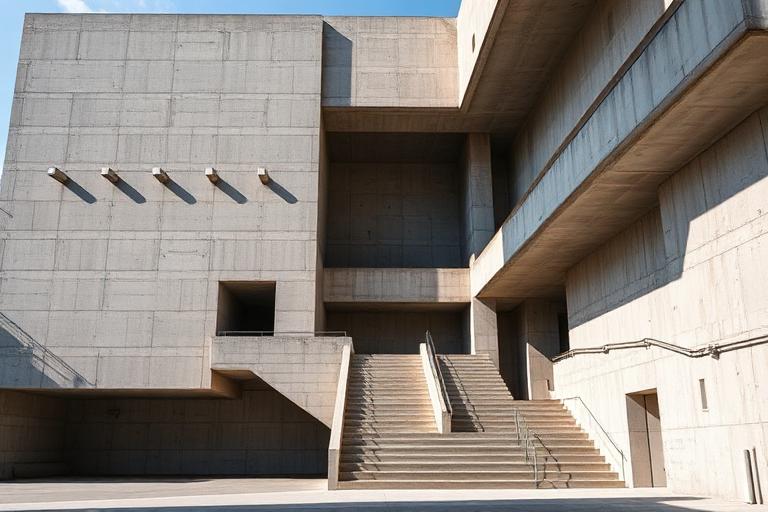
Socialist Modernism

The Eastern Bloc's own Modernism - prefab Plattenbau housing estates, heroic mosaic friezes, the Buzludzha monument's brutalized saucer on a Bulgarian mountain peak - collective ideology at maximum material scale.

Compare Socialist Modernism with another style →See the Socialist Modernism typefaces →On the timeline · 1950s
Record020-AS
AestheticSocialist Modernism
ClassStructured / Geometric
StatusINGESTING
Socialist Modernism aesthetic archive image
Archive plate · Socialist Modernism
01
The record

What it is, when it works, who it is for, and where it already exists.

How to use it

Record 020-AS - when it works, who it is for, what it looks like

FIELD 01

When to use it

  • Brand identity mining Cold War Eastern European aesthetics for contemporary edge
  • Documentary, editorial, or cultural project covering Soviet and Eastern Bloc architecture
  • Fashion brand with a utilitarian, anti-luxury, or political provocation aesthetic
  • Cultural institution brand for exhibitions on socialist design, urbanism, or material culture
FIELD 02

Perfect for

  • Cultural institutions and museums covering Cold War and socialist design history
  • Fashion and streetwear brands with a utilitarian or politically charged aesthetic
  • Documentary filmmakers and photojournalists covering Eastern European urbanism
  • Architecture tourism and heritage organizations focused on socialist modernist buildings

In the wild, Socialist Modernism aesthetic real-world examples

Where this aesthetic shows up in the real world · ↗ opens the source site

Omoro Style GuideEvery aesthetic, every field on this page, in one PDF.
$8Get the guide →
02
The anatomy

Where Socialist Modernism came from, what makes it recognisable, and the fingerprint it leaves.

History, Socialist Modernism aesthetic history

1955-1991 · Soviet Union, Eastern Bloc nations, Yugoslavia, Cuba

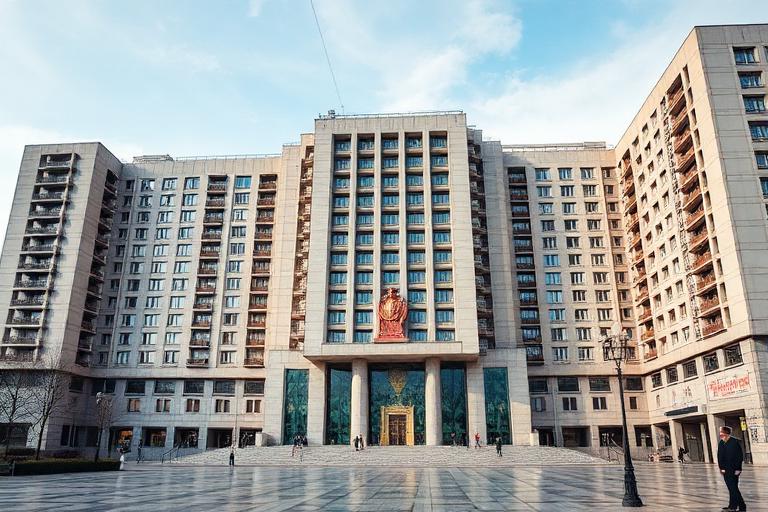
Socialist Modernism emerged after Stalin's death in 1953, when Khrushchev denounced the excesses of Stalinist architecture (ornate neoclassical facades applied to shoddy construction) and called for industrialized, efficient building. The result was a massive wave of prefabricated concrete panel housing that transformed the urban landscapes of the Soviet Union, East Germany, Poland, Czechoslovakia, Hungary, Bulgaria, and Yugoslavia. The Plattenbau in Germany, the Panelak in Czechoslovakia, and the Khrushchyovka in the Soviet Union housed hundreds of millions of people in buildings assembled from factory-produced concrete panels.

Beyond mass housing, Socialist Modernism produced remarkable public architecture. Each Eastern Bloc nation developed its own interpretation: Yugoslavia's spomenik monuments (abstract concrete war memorials), Bulgaria's Buzludzha monument, East Germany's Fernsehturm television tower, and Romania's Palace of the Parliament all pushed Modernist forms toward monumental, often surreal scales. Cultural buildings (cinemas, community centers, sports halls) used expressive concrete forms that Western Modernism's commercial constraints rarely permitted.

After the fall of communism in 1989-1991, Socialist Modernist buildings were widely despised as symbols of oppression and neglect. Many were demolished or re-clad. In the 2010s, a reassessment began: photographers, architects, and historians recognized the formal ambition and social idealism embedded in these structures, even as they acknowledged the human costs of the systems that built them. The debate over preservation versus demolition continues in every former Eastern Bloc nation.

The state built a future and moved everyone in.

Omoro dossier · 020-AS

Visual markers, Socialist Modernism aesthetic visual markers

The visual DNA: what makes it recognisable

typography

See the fonts
  • State-designed typefaces: Pragmatica, Baltica, TextBook
  • Bold sans-serifs for slogans and monumental inscriptions
  • Cyrillic and Latin in standardized state-approved faces
  • Propaganda poster aesthetics: condensed, urgent, uppercase

grid

  • Repetitive modular facades from prefabricated panel systems
  • Microrayon (micro-district) urban planning: towers in landscape
  • Monumental axes and ceremonial public spaces
  • Standardized floor plans repeated across entire nations

materials

  • Precast concrete panels: #A0A0A0, #909090, #B0B0B0
  • Exposed aggregate concrete: #8C8880, #9C9890
  • Mosaic and relief murals on gable walls: polychrome
  • Aluminum and anodized metal accents: #C0C0C0, #808080

motifs

  • Prefabricated panel joints as involuntary facade pattern
  • Ground-floor commercial or community spaces
  • Monumental sculptural elements at building entrances
  • Abstract geometric murals and mosaics on blank walls

Aesthetic profile

8-channel console with the fingerprint on its display. Save the card, or share the page

Aesthetic Profile
Socialist Modernism
Postwar
1955–1991
Attribute console · 020-AS
leans structured, geometric, cool
8 CH
FIG. 1
MinimalMaximalAnalogDigitalRestrainedExpressiveCoolWarmNostalgicFuturisticStructuredChaoticDarkLightGeometricOrganic
01Minimal
Maximal10%
02Analog
Digital20%
03Restrained
Expressive30%
04Cool
Warm40%
05Futuristic
Nostalgic40%
06Structured
Chaotic70%
07Dark
Light20%
08Organic
Geometric60%
StructuredGeometricCool3 materials
Omoro · Attribute console · 020-AS
omoro.io/styles/arch-socialist-modernism

Material assembly

The style's primary materials, assembled bottom-up

Tap a stratum for material detail · Full catalog

Place in history

Postwar · 1955–1991 - tap any style to travel

Color Palettes, Socialist Modernism color palettes and hex codes

4 color interpretations of this aesthetic

Socialist Modernism
#2A2E1E · #4A5A3A · #8A9A7A · #C0C8B0 · #D0C8B8
The Soviet Bloc's own brutalized Modernism, mammoth and grey
Panelák
#141414 · #3A3838 · #787878 · #B0A8A0 · #D0C8C0
Prefabricated concrete panel housing: efficient, grey, repeated
Palace of Culture
#0C0808 · #4A2818 · #C09828 · #D0C8B8 · #E8E0D0
Soviet civic monument: marble lobby and mural under chandeliers
Monument
#101010 · #383830 · #606858 · #A0A098 · #C8C0B0
Spomenik memorial: abstract concrete in a Yugoslav forest clearing
Omoro Palette Pack575 curated palettes across every aesthetic, 5 export formats.
$8Get the palettes →

Adjacent Palettes, styles related to Socialist Modernism

The colour of the styles sitting closest to this one

Brutalist Architecture
Constructivist Architecture
Architectural Modernism
Monolithic Architecture
03
The direction

How to shoot it, how to prompt it, and how to board it.

Photo Direction

How to shoot this aesthetic

"Monumental scale, built for the many rather than the few"

Shot list

  • Wide shot of monumental prefabricated concrete-panel construction
  • Detail shot of repetitive modular facade rhythm
  • Wide shot conveying austere utilitarian civic scale

Lighting

Flat, overcast light this style photographs most honestly under exactly the grey conditions of its original context, rather than flattering golden-hour warmth

Omoro Director's Briefs151 photo shot-lists like this one, ready to shoot from.
$8Get the briefs →

Generative Prompt

Drop this into Studio to generate in this aesthetic

Socialist Modernist architecture with monumental prefabricated concrete-panel construction, austere utilitarian civic scale, Eastern Bloc mass-housing and public-building tradition, repetitive modular facade rhythm, stark ideological monumentality

Paste as-is, or append your own subject

Mood Board

The record applied to your project. The record's kit is free; your brand, references and plates come with membership

Mood board
The Socialist Modernism board
8 frames · 4 selected
FIG. 4
Stairwell Dark2A2E1EConcrete Panel4A5A3AWeathered Block8A9A7AEastern SkyC0C8B0Ceiling LightD0C8B8
Brand and references
IdleBrand and references open with membership
With membership: the brand's own facts and colours in every prompt, references carried into every frame, and the plates generated.
01 · Hero application
02 · Material and finish
03 · Palette in context
04 · Photography direction
05 · Pattern plate
06 · Object
07 · Environment
08 · Digital presence
Demo kit free, the rest with membershipThe record as a demo kit, free. Name a project and it is written for that
Omoro · Mood board · 020-AS
04
The judgement

Whether to use it, what it costs to do properly, and where it stands right now.

Creative verdict, Socialist Modernism feasibility and strategic recommendation

Two written calls, seven meters, and when to walk away

Creative verdict
Should Socialist Modernism be the call?
7 meters
FIG. 2
Assessment

The scale and the system are the character. Prefabricated panel construction, repeated to an inhuman rhythm, is what defines this, and softening it into pleasant modernism removes the subject. Keep the repetition uncomfortable. The history is heavy and specific, so the work should have a position on it rather than treating it as a texture.

Verdict

Judge it on what it was built to do, which is the correction the last fifteen years of photography and scholarship have made: it housed and educated enormous numbers of people, and dismissing four decades across the Eastern bloc as uniform and grim does not survive contact with the actual variety. Right when that civic ambition is the reference. The buildings are being demolished or refaced as we speak.

Production cost
Medium

Prefab systems built for scale and speed, not luxury finish.

Creative difficulty
High

Collective ideology at material scale, not just gray panels.

Execution difficulty
High

Heroic mosaic and monument work at brutal, unforgiving scale.

Risk of misuse
Medium

Collective ideology at material scale, not just gray panels for the look.

Prevalence
Rare

A rare reference, mostly in design-history and Eastern European contexts.

Longevity
Enduring

A specific, well-documented historical moment that still reads clearly.

Brand investment
Medium

Prefab systems built for scale and speed, not luxury finish.

Avoid if
The audience is unfamiliar with the historical context
Without it, this reads as generic gray panels, not a specific ideology.
The brand needs to feel warm or premium
This was built for scale and speed, not luxury finish.
Omoro · Creative verdict · 020-AS

Editorial Depth

A Pro feature: origins, practitioners, and pitfalls

Editorial depth
The Socialist Modernism file
14 sections
FIG. 3
Context02Brands02Perception04Use04Index02
01Common MisconceptionThe principle beneath the surface
02Historical ContextOrigins, cultural moment, and reaction
03Brands That Accidentally Use This StyleNatural alignment, not category claims
04Brands That Perfectly Represent This StyleExceptional execution
05Psychological EffectHow visual decisions change perception
06Visual ChecklistInclude and avoid
07Creative FormulaThe visual system reduced to essentials
08Recognition SignalsHow to recognize it in two seconds
09When To Use This StyleContexts where the language performs
10Common Creative MistakesWhere imitation weakens the signal
11Best Brand ApplicationsIndustries with a natural advantage
12Creative Application AnalysisFit, feasibility, and production reality
13Related StylesClose languages and the key distinction
14Visual DNA SummaryThe sentence to remember
The editorial depth, with membershipOpening soon
Omoro · Editorial depth · 020-AS
05
The index

Neighbours, cross-references, blends, and the questions people ask.

Related concepts

Connected across the creative knowledge graph

Cultural relevance, Socialist Modernism cultural relevance today

Where it stands now, and what it costs you to use it

Socialist modernism covers four decades of building across the Eastern bloc, and it was long dismissed in the West as uniform and grim, which the actual variety does not support.

A generation of photographers and historians has spent the last fifteen years documenting it as the buildings are demolished or refaced.

It housed and educated enormous numbers of people. Judging it purely on appearance skips the part it was built to do.

Cross-references

Brutalist ArchitectureBrutalism and Socialist Modernism shared concrete construction and social ambitionsConstructivist ArchitectureConstructivism was the revolutionary precursor that Stalinist architecture suppressed and Socialist Modernism partially revivedInternational StyleSocialist Modernism adopted International Style principles for ideological purposes

Blend

Mix Socialist Modernism with any style in the library

Socialist Modernism×
50%50%
92% alike
Socialist Modernism referenceBrutalist Architecture referenceSocialist Modernism 50%Brutalist Architecture 50%

Merged palette

#2A2E1E

#2B2926

#4A5A3A

#5C5346

#8A9A7A

Leads structured, geometric, cool

Typography · from Socialist Modernism

Bebas Neue over Roboto

Materials

  • Precast concrete panels: #A0A0A0, #909090, #B0B0B0
  • Exposed aggregate concrete: #8C8880, #9C9890
  • Board-marked concrete showing formwork grain: #8A8682, #A09C98

Use it

Socialist Modernist architecture with monumental prefabricated concrete-panel construction, austere utilitarian civic scale, Eastern Bloc mass-housing and public-building tradition, repetitive modular facade rhythm, stark ideological monumentality (50%), infused with Brutalist design with raw architectural mass and exposed concrete beton brut texture, monolithic volumes with zero applied decoration, Alison and Peter Smithson and Le Corbusier Unite d'Habitation reference, weight and gravity as aesthetic values, anti-ornament philosophy, color palette strictly #2A2E1E #2B2926 #4A5A3A #5C5346 #8A9A7A, overall character: structured, geometric, cool

One-click generation opens with the studio

About this aesthetic

What is Socialist Modernism?

Socialist Modernism is the architectural production of communist states from the mid-1950s to 1991. It encompasses mass prefabricated housing (Plattenbau, Panelak), monumental public buildings, and experimental cultural architecture produced under planned economies. Its defining characteristic is architecture as state program rather than individual commission.

Why do all Eastern Bloc apartments look the same?

Prefabricated concrete panel systems were designed for industrial mass production. The same panel types, connection details, and floor plans were replicated across thousands of buildings and multiple countries, prioritizing speed and economy over variation. The standardization was intentional: housing was treated as a social right to be delivered at scale, not as individual expression.

Is Socialist Modernist architecture worth preserving?

This is actively debated. Proponents argue these buildings represent significant social ambitions, remarkable engineering, and irreplaceable cultural heritage. Critics point to poor construction quality, inflexible plans, and painful associations. The emerging consensus favors selective preservation of the most architecturally significant examples while allowing modification of standard housing stock.

Build with the socialist modernism aesthetic

Every style in the library is broken down like this one: the palette, the typography, the materials and the lineage.

Explore the style library →