Making one kilo releases about 4 kg of CO₂: copper and tin, both energy-heavy to smelt.
01The building that proves it
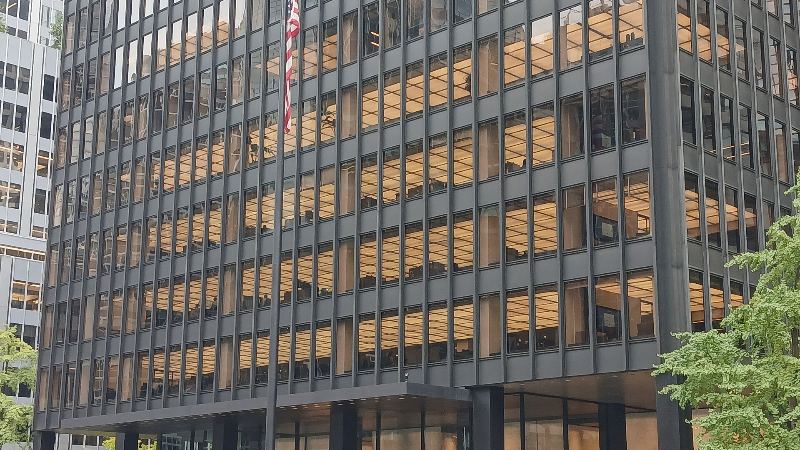
Bronze here: bronze mullions and tinted glass, the first bronze curtain wall.
About the building ↗02Try it on a board
Pick up to three materials to sit beside bronze. The board shows the styles that use all of them, and writes a prompt you can take to an image or video generator.
03The styles built on it
- Frasurbane Interior Design"Brass and bronze fittings: picture lights, lamp bases and door hardware"
- Sculpture"Lost-wax cast bronze with chemical patina"
- Visual Art"Bronze, marble, steel and found material in three dimensions"
- Bronze Age"Cast and hammered tin bronze, with green and brown patina"
- Art Deco"Gold leaf, gilded bronze and nickel-silver inlay"
- Arcology"Bronze and ceramic windbells cast on site to fund Arcosanti"
- International Style"Glass curtain wall on bronze or aluminium mullions, as at the Seagram Building"
- Neo-Modernism"Bronze and anodised aluminium window frames set in deep reveals"
- Monolithic Architecture"Deep-set bronze or timber window frames in thick reveals"
- Neoclassical"Gilt-bronze ormolu mounts and water-gilded mouldings"
- Futurism"Polished bronze sculpture, as in Boccioni's Unique Forms of Continuity in Space"
- Quiet Luxury"Patinated bronze and unlacquered brass, darkened by handling"
04Up close
- Architectural bronzeactually a brass, used for doors and window frames
- Statuary bronzethe casting alloy of sculpture
- Silicon bronzefor hardware and marine fittings
Cast in sand or lost-wax moulds, or extruded into frames and handrails; chased and patinated by hand.
Darkens from gold to chocolate brown, green where rain sits, and polishes bright again wherever hands rub it.
Heavier and warmer than brass, with a brown patina that has depth; handrails are bright on top and dark beneath.
05Questions
Which design styles use bronze?
Classical Architecture, Neoclassical Architecture, Art Deco Architecture, Stripped Classicism and Frasurbane Interior Design, and 11 more.
What goes well with bronze?
Bronze pairs well with marble, limestone and plate glass.
What does bronze communicate?
Classical dignity, Ornamental weight and Aging grace. It suits entrances, hardware and deco-era restoration.
What kinds of bronze are there?
Architectural bronze, Statuary bronze and Silicon bronze. Architectural bronze: actually a brass, used for doors and window frames.
How does bronze age?
Darkens from gold to chocolate brown, green where rain sits, and polishes bright again wherever hands rub it.
How can you tell real bronze?
Heavier and warmer than brass, with a brown patina that has depth; handrails are bright on top and dark beneath.
What is the carbon footprint of bronze?
Making one kilo of bronze releases about 4 kg of CO₂, cradle to gate: copper and tin, both energy-heavy to smelt.