Making one kilo releases about 0.06 kg of CO₂: soft, local, and cut with little energy.
01The building that proves it
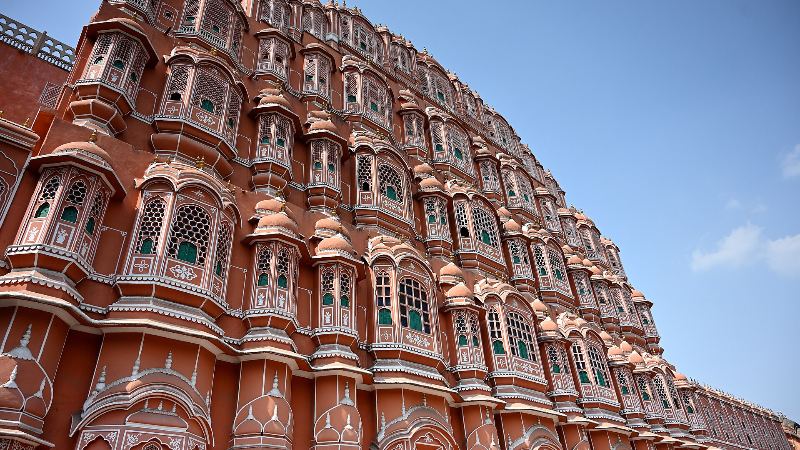
Sandstone here: red and pink sandstone screens across 953 windows.
About the building ↗02Try it on a board
Pick up to three materials to sit beside sandstone. The board shows the styles that use all of them, and writes a prompt you can take to an image or video generator.
03The styles built on it
04Up close
- Yorkstonebuff to grey, the flag of northern English streets
- Red sandstonethe warm red of Glasgow and Edinburgh tenements
- Brownstonethe chocolate stoops of New York
- Sydney sandstonegolden, the city's civic buildings
Splits cleanly along its bedding into flags and can be tooled with a chisel; laid with the bedding horizontal or it delaminates.
Soft grades erode at the edges and grow lichen; face-bedded stone flakes in sheets, which is what ruined many brownstones.
A sandy, granular surface you can feel, visible bedding lines, and it darkens dramatically when wet.
05Questions
Which design styles use sandstone?
Gothic Architecture, Vernacular Architecture, Architectural Expressionism, Critical Regionalism and Contextualism.
What goes well with sandstone?
Sandstone pairs well with oak, terracotta tile and wrought iron.
What does sandstone communicate?
Regional identity, Warm antiquity and Vernacular rootedness. It suits heritage renovation, civic architecture and desert-climate builds.
What kinds of sandstone are there?
Yorkstone, Red sandstone, Brownstone and Sydney sandstone. Yorkstone: buff to grey, the flag of northern English streets.
How does sandstone age?
Soft grades erode at the edges and grow lichen; face-bedded stone flakes in sheets, which is what ruined many brownstones.
How can you tell real sandstone?
A sandy, granular surface you can feel, visible bedding lines, and it darkens dramatically when wet.
What is the carbon footprint of sandstone?
Making one kilo of sandstone releases about 0.06 kg of CO₂, cradle to gate: soft, local, and cut with little energy.