Making one kilo releases about 0.02 kg of CO₂: local subsoil and a little lime or cement.
01The building that proves it
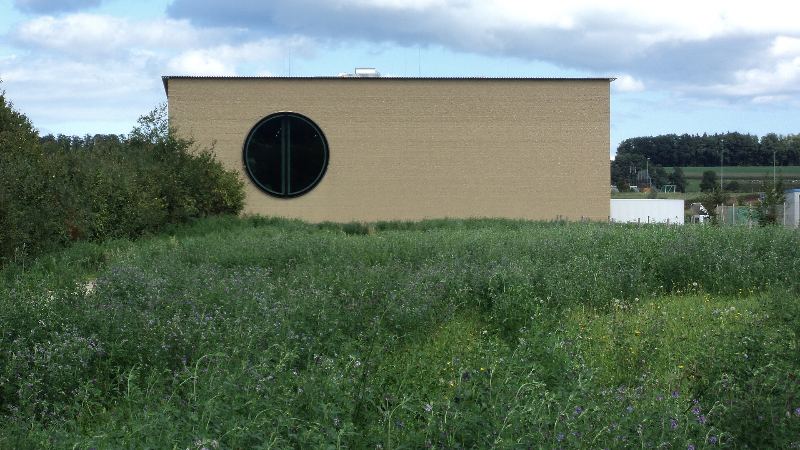
Rammed Earth here: the largest rammed-earth building in Europe, made from local clay.
About the building ↗02Try it on a board
Pick up to three materials to sit beside rammed earth. The board shows the styles that use all of them, and writes a prompt you can take to an image or video generator.
03The styles built on it
- Solarpunk"Rammed earth, cob and lime plaster walls"
- Monolithic Architecture"Rammed earth and compressed soil built up in visible layers"
04Up close
- Traditional pisésoil, gravel and a little clay, unstabilised
- Stabilised rammed earthwith a few percent cement
- Prefabricated panelsrammed in a factory, craned in
Damp earth is tipped into formwork in layers of about 15 cm and pounded down, by hand or pneumatic rammer, so each lift leaves a stripe.
Soft edges erode slowly at the base if rain splashes; a good hat and boots (roof overhang and plinth) keep it for centuries.
Horizontal strata like a geological section, varying in colour with each batch of earth.
05Questions
Which design styles use rammed earth?
Organic Architecture, Vernacular Architecture, Biophilic Design, Sustainable Architecture and Critical Regionalism, and 2 more.
What goes well with rammed earth?
Rammed Earth pairs well with reclaimed timber, cedar and cor-ten steel.
What does rammed earth communicate?
Near-zero impact, Geological stratification and Grounded permanence. It suits sustainable architecture, desert and arid builds and regenerative design.
What kinds of rammed earth are there?
Traditional pisé, Stabilised rammed earth and Prefabricated panels. Traditional pisé: soil, gravel and a little clay, unstabilised.
How does rammed earth age?
Soft edges erode slowly at the base if rain splashes; a good hat and boots (roof overhang and plinth) keep it for centuries.
How can you tell real rammed earth?
Horizontal strata like a geological section, varying in colour with each batch of earth.
What is the carbon footprint of rammed earth?
Making one kilo of rammed earth releases about 0.02 kg of CO₂, cradle to gate: local subsoil and a little lime or cement.