Making one kilo releases about 1.3 kg of CO₂: float glass; coatings and laminates add a little.
01The building that proves it
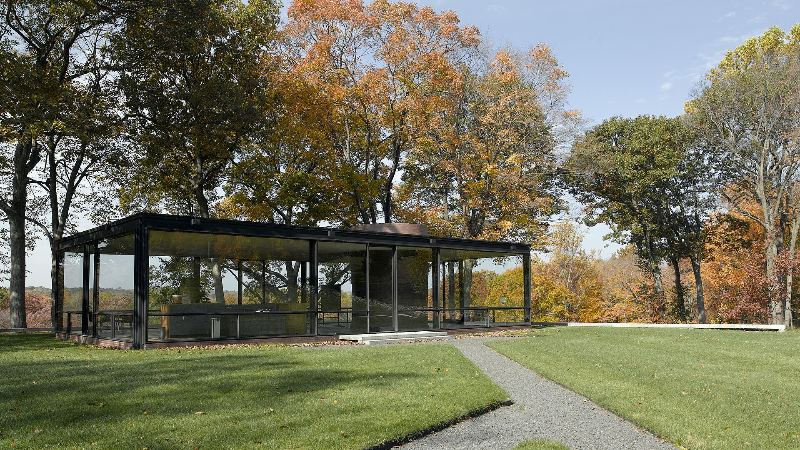
Plate Glass here: floor-to-ceiling plate glass on all four sides.
About the building ↗02Try it on a board
Pick up to three materials to sit beside plate glass. The board shows the styles that use all of them, and writes a prompt you can take to an image or video generator.
03The styles built on it
- Photorealism"Plate glass shopfronts doubling the street in reflection"
- Bauhaus"Plate glass in steel frames: the Dessau workshop curtain wall"
- Architecture"Steel frame with plate glass infill and slim mullions"
- De Stijl"Plate glass in steel corner windows that open fully"
- Googie"Plate glass walls and glass block on diners and coffee shops"
- Arte Povera"Plate glass sheets and neon tube lettering, as in Merz's igloos"
04Up close
- Float glassthe modern flat glass, made on molten tin since 1959
- Low-ironextra clear, no green edge
- Toughenedheat-treated, four times stronger, breaks into crumbs
- Laminatedtwo sheets with a plastic interlayer, holds when broken
Cut with a scored line and snapped, then edged; toughened and laminated after cutting, since they cannot be cut afterwards.
Does not weather, but coatings can fail at the edges and old sealed units fog between the panes.
A green tint at the cut edge (unless low-iron), a faint tin-side sheen, and perfectly flat reflections.
05Questions
Which design styles use plate glass?
Architectural Modernism, International Style, Bauhaus Architecture, Mid-Century Modern and Industrial Architecture, and 6 more.
What goes well with plate glass?
Plate Glass pairs well with structural steel, travertine and chrome.
What does plate glass communicate?
Transparency, Precision and Light. It suits showrooms, modern interiors and hospitality.
What kinds of plate glass are there?
Float glass, Low-iron, Toughened and Laminated. Float glass: the modern flat glass, made on molten tin since 1959.
How does plate glass age?
Does not weather, but coatings can fail at the edges and old sealed units fog between the panes.
How can you tell real plate glass?
A green tint at the cut edge (unless low-iron), a faint tin-side sheen, and perfectly flat reflections.
What is the carbon footprint of plate glass?
Making one kilo of plate glass releases about 1.3 kg of CO₂, cradle to gate: float glass; coatings and laminates add a little.