When to use it
- Luxury brand identity with heritage authority
- Legal, financial, and institutional branding
- Museum and cultural institution design
- Wedding and event stationery
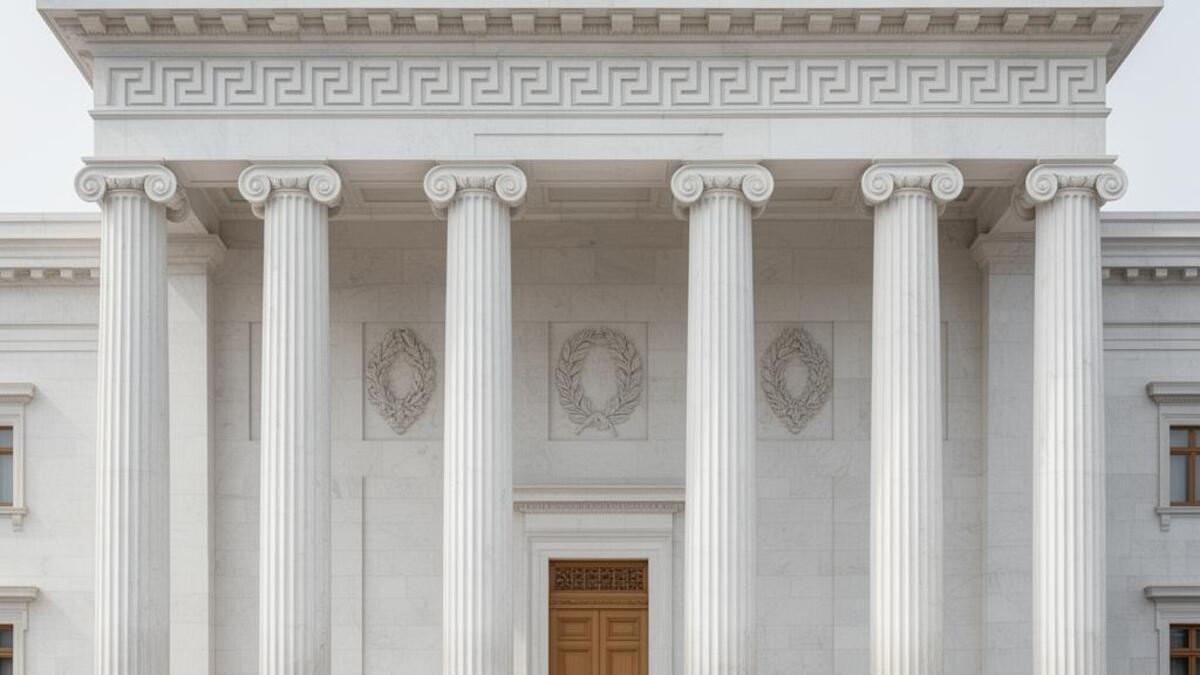
Greek-Roman revival brought to contemporary design - white marble, formal symmetry, engraved quality, and Enlightenment rationalism as aesthetic foundation
What it is, when it works, who it is for, and where it already exists.
Record 033-NE - when it works, who it is for, what it looks like
Where this aesthetic shows up in the real world · ↗ opens the source site
Where Neoclassical came from, what makes it recognisable, and the fingerprint it leaves.
1750s–1850s (formative); ongoing revival cycles · Europe; response to Baroque excess and the rediscovery of Pompeii and Herculaneum
Neoclassicism emerged in mid-18th-century Europe as a reaction against Baroque and Rococo's ornamental excess, and as a direct response to the archaeological discovery of Pompeii (1748) and Herculaneum. Theorist Johann Winckelmann's writings on ancient Greek art established the ideal of 'noble simplicity and quiet grandeur' that neoclassical artists and architects pursued. The movement coincided with the Enlightenment's valorization of reason, order, and civic virtue: values the classical world was felt to embody.
In architecture, neoclassicism produced the Greek Revival (columns, pediments, symmetrical facades) and the Roman Revival (domes, arches, monumental scale) styles that define the public buildings of Europe and America: the Parthenon-inspired Lincoln Memorial, the White House, the British Museum, and virtually every 19th-century bank, courthouse, and university building in the Western world. In fine art, it produced David's history paintings, Canova's sculpture, and the visual grammar of imperial ambition.
Neoclassicism returns in every era that wants to project permanence, authority, and cultural legitimacy: American federal architecture of the 19th century, Mussolini's stripped classicism, Stalin's socialist classicism, and contemporary luxury brand identity that uses Grecian columns and marble to signal timeless quality. Understanding neoclassicism means understanding the visual grammar of authority: which makes it essential for both using and critiquing it.
“Every era that wants to seem eternal borrows from Greece and Rome.
The visual DNA: what makes it recognisable
8-channel console with the fingerprint on its display. Save the card, or share the page

4 color interpretations of this aesthetic
The colour of the styles sitting closest to this one
How to shoot it, how to prompt it, and how to board it.
How to shoot this aesthetic
"Marble's discipline, borrowed for the twenty-first century"
Shot list
Lighting
Hard, single-source directional light, as if lit for sculpture strong shadow that reveals form the way gallery lighting reveals a marble bust
Drop this into Studio to generate in this aesthetic
Neoclassical aesthetic with Greek and Roman revival, toga-draped classical figures and mythology scenes, cool cameo-relief color restraint, rigidly symmetrical composition and golden proportion, Jacques-Louis David painting influence
The record applied to your project. The record's kit is free; your brand, references and plates come with membership
01 · Hero applicationWhether to use it, what it costs to do properly, and where it stands right now.
Two written calls, seven meters, and when to walk away
Symmetry is unforgiving of small errors. A misalignment of two millimetres on a symmetrical composition is visible, where the same error passes unnoticed in an asymmetric one, so the setting-out has to be exact. Work to a proportional system throughout. White marble is a historical mistake: the originals were painted, and knowing that is what separates research from a texture choice.
Understand that the politics do not detach on request. This has been the architecture of state power for two hundred and fifty years, claimed by republics and dictatorships alike, and recent attempts to mandate it for public buildings made that argument current rather than historical. The proportional system underneath is genuinely durable and worth learning.
Real formal symmetry and engraved quality, or convincing rendering.
Enlightenment rationalism as foundation, not just white marble texture.
Formal symmetry is unforgiving of even small misalignment.
White marble texture without Enlightenment rationalism behind it misses the point.
A constant reference for institutional and luxury branding.
A revival of a style that was already ancient when it revived.
Real formal symmetry and engraved quality, or convincing rendering.
A Pro feature: origins, practitioners, and pitfalls
Neighbours, cross-references, blends, and the questions people ask.
Connected across the creative knowledge graph
Where it stands now, and what it costs you to use it
Neoclassicism has been the architecture of state power for two hundred and fifty years, which makes it the least neutral style in this library. It has been claimed by republics and by dictatorships with equal conviction.
That contested history is active rather than historical, since attempts to mandate classical style for public buildings have been live political arguments in the last few years.
The proportional system underneath is genuinely durable and worth learning. The politics attached to it do not detach on request.
Mix Neoclassical with any style in the library
 Neoclassical 50%Dark Academia 50%
Merged palette
#546E7A
#1C1208
#90A4AE
#4A2E1A
#CFB53B
Leads nostalgic, analog, structured
Typography · from Neoclassical
Playfair Display over Crimson Text
Materials
The calls this blend forces
These two disagree on 2 things, and a blend cannot average them: you pick a side. At this mix:
Light or Dark? Neoclassical is light, Dark Academia is dark. This mix lands dark.
Geometric or Organic? Neoclassical is geometric, Dark Academia is organic. This mix lands geometric.
Use it
Neoclassical aesthetic with Greek and Roman revival, toga-draped classical figures and mythology scenes, cool cameo-relief color restraint, rigidly symmetrical composition and golden proportion, Jacques-Louis David painting influence (50%), infused with Dark academia aesthetic with candlelit atmosphere, Caravaggio-style chiaroscuro lighting, moody sepia-toned scholarly romanticism, handwritten letters and antique brass detail, color palette strictly #546E7A #1C1208 #90A4AE #4A2E1A #CFB53B, leaning light over dark, geometric over organic, overall character: nostalgic, analog, structured
Neoclassical aesthetic draws from ancient Greek and Roman visual culture: bilateral symmetry, Doric/Ionic/Corinthian columns, pediment compositions, marble (#F5F2EE), gold (#C8922A), and deep blue (#1A2B4A). Emerged in 18th-century Europe as a reaction to Baroque excess and Enlightenment valorization of reason. Every era that wants to project permanence and authority borrows this visual grammar: from American federal architecture to luxury brand identity.
Classical refers to the original Greek (480–323 BCE) and Roman (1st century BCE–2nd century CE) architectural and artistic traditions. Neoclassical refers to any later period's revival and interpretation of those traditions. The 18th-century neoclassical movement was the largest and most systematic revival. But neoclassical revivals have occurred in every subsequent era: Greek Revival (1820s–1850s), Beaux-Arts (1880s–1920s), stripped classicism (1930s), and ongoing contemporary applications.
Luxury brand identity (Chanel, Versace's Medusa, Ralph Lauren's equestrian classicism), high-end fragrance and skincare packaging (columns, marble textures), financial institution branding (banks have used classical columns since the 19th century to signal stability), law firm and government agency identity, architectural restoration and new traditional architecture, and luxury residential and hotel interior design (marble, symmetry, gilded detail).
Every style in the library is broken down like this one: the palette, the typography, the materials and the lineage.
Explore the style library →