Making one kilo releases about 30 kg of CO₂: among the highest per kilogram of any building material.
01The building that proves it
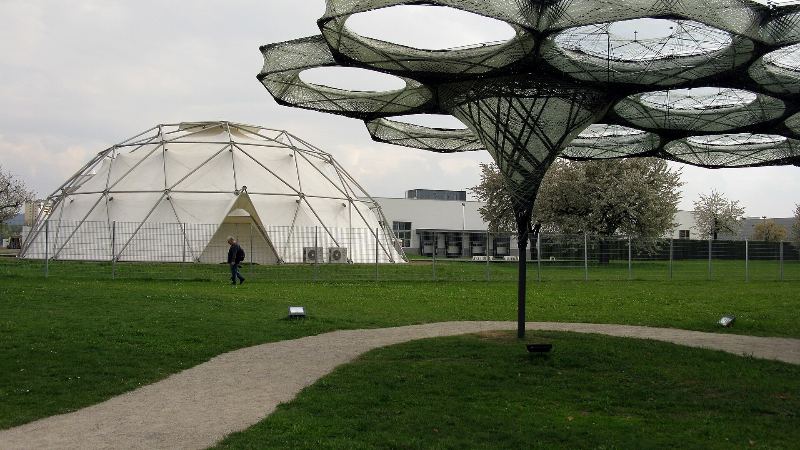
Carbon Fibre Composite here: robotically wound carbon and glass fibre cells.
About the building ↗02Try it on a board
Pick up to three materials to sit beside carbon fibre composite. The board shows the styles that use all of them, and writes a prompt you can take to an image or video generator.
03The styles built on it
04Up close
- Twill weavethe visible diagonal pattern
- Unidirectionalall fibres one way, for strength
- Forgedchopped fibres pressed, a marbled look
Pre-impregnated cloth laid in a mould and cured under heat and pressure, often in an autoclave; expensive tooling, light parts.
Clear coats yellow and craze in the sun, exposing the weave; the structure itself does not fatigue like metal.
A black, glossy, diagonal weave with depth, on parts that are absurdly light for their size.
05Questions
Which design styles use carbon fibre composite?
Neo-Futurism, Architectural Futurism and Parametric Architecture.
What goes well with carbon fibre composite?
Carbon Fibre Composite pairs well with titanium, structural glass and glass-fibre reinforced concrete.
What does carbon fibre composite communicate?
High-performance engineering, Extreme efficiency and Cutting-edge ambition. It suits high-performance architecture, signature structures and lightweight cladding.
What kinds of carbon fibre composite are there?
Twill weave, Unidirectional and Forged. Twill weave: the visible diagonal pattern.
How does carbon fibre composite age?
Clear coats yellow and craze in the sun, exposing the weave; the structure itself does not fatigue like metal.
How can you tell real carbon fibre composite?
A black, glossy, diagonal weave with depth, on parts that are absurdly light for their size.
What is the carbon footprint of carbon fibre composite?
Making one kilo of carbon fibre composite releases about 30 kg of CO₂, cradle to gate: among the highest per kilogram of any building material.