Making one kilo releases about 0.16 kg of CO₂: as concrete, sprayed with some rebound waste.
01The building that proves it
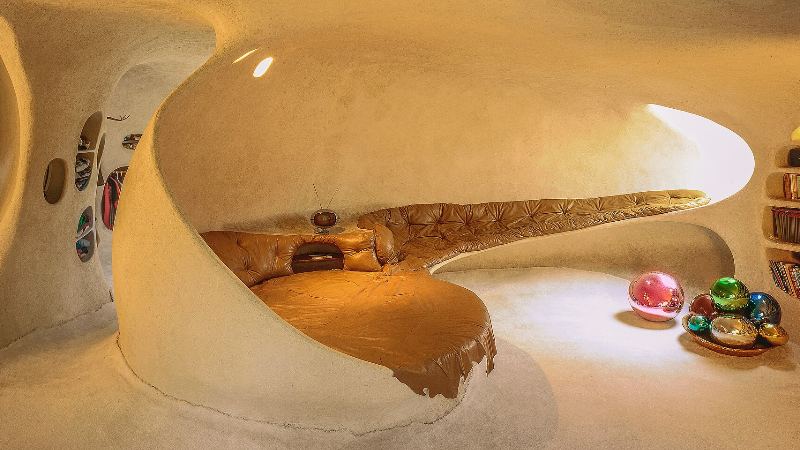
Sprayed Concrete here: sprayed concrete over a mesh shell, buried in a garden.
About the building ↗02Try it on a board
Pick up to three materials to sit beside sprayed concrete. The board shows the styles that use all of them, and writes a prompt you can take to an image or video generator.
03The styles built on it
04Up close
- Wet-mixpumped as concrete, sprayed
- Dry-mix (gunite)water added at the nozzle
- Fibre-reinforcedsteel or synthetic fibres in the mix
Sprayed at high velocity onto a surface or mesh, so it can follow curves and go on overhead; the pool and tunnel method.
As concrete; the rough surface holds dirt and the rebound layer can be weak if badly applied.
A lumpy, orange-peel surface and shapes that curve freely, with no formwork marks.
05Questions
Which design styles use sprayed concrete?
Blobitecture and Organic Architecture.
What goes well with sprayed concrete?
Sprayed Concrete pairs well with structural glass, glass-fibre reinforced concrete and living roof substrate.
What does sprayed concrete communicate?
Organic freedom, Sculptural spontaneity and Structural expressionism. It suits free-form shells, expressionist architecture and sculptural structures.
What kinds of sprayed concrete are there?
Wet-mix, Dry-mix (gunite) and Fibre-reinforced. Wet-mix: pumped as concrete, sprayed.
How does sprayed concrete age?
As concrete; the rough surface holds dirt and the rebound layer can be weak if badly applied.
How can you tell real sprayed concrete?
A lumpy, orange-peel surface and shapes that curve freely, with no formwork marks.
What is the carbon footprint of sprayed concrete?
Making one kilo of sprayed concrete releases about 0.16 kg of CO₂, cradle to gate: as concrete, sprayed with some rebound waste.