Making one kilo releases about 0.15 kg of CO₂: local bluestone quarried close to where it is laid.
01The building that proves it
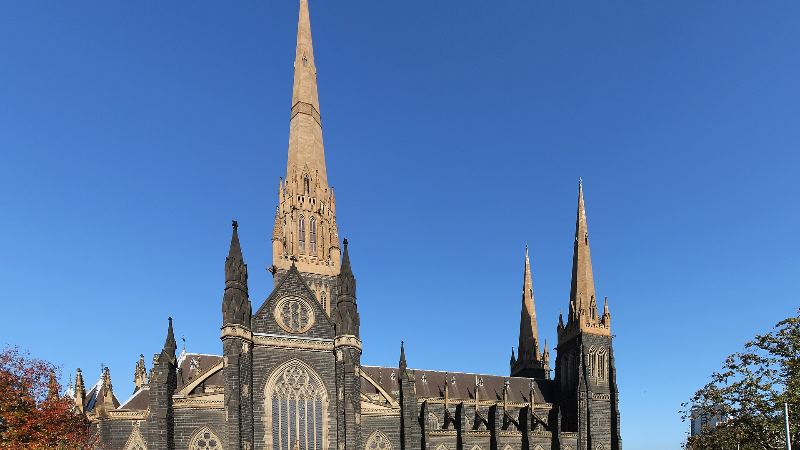
Basalt here: Melbourne bluestone, a local basalt, for the whole body.
About the building ↗02Try it on a board
Pick up to three materials to sit beside basalt. The board shows the styles that use all of them, and writes a prompt you can take to an image or video generator.
03The styles built on it
- Sculpture"Basalt, earth and salt water worked in place, as in Smithson's Spiral Jetty"
- Architectural Minimalism"Monolithic stone slabs: honed limestone, basalt or quartzite"
04Up close
- Bluestonethe dark grey paving of Melbourne and Belgian streets
- Columnar basalthexagonal columns cut as they cooled
- Lava stonevesicular, with gas holes, from Etna and the Auvergne
Hard and abrasive to cut; sawn into pavers and cladding, or split along natural columns.
Almost inert, keeps its dark colour, and the honed face takes on a soft sheen from feet.
Dense, fine-grained and very dark, heavier than it looks, sometimes with small round gas holes.
05Questions
Which design styles use basalt?
Monolithic Architecture, Critical Regionalism, Organic Architecture, Vernacular Architecture and Sculpture, and 1 more.
What goes well with basalt?
Basalt pairs well with cor-ten steel, structural steel and oak.
What does basalt communicate?
Geological weight, Somber authority and Raw drama. It suits monuments, landscape and minimalist facades.
What kinds of basalt are there?
Bluestone, Columnar basalt and Lava stone. Bluestone: the dark grey paving of Melbourne and Belgian streets.
How does basalt age?
Almost inert, keeps its dark colour, and the honed face takes on a soft sheen from feet.
How can you tell real basalt?
Dense, fine-grained and very dark, heavier than it looks, sometimes with small round gas holes.
What is the carbon footprint of basalt?
Making one kilo of basalt releases about 0.15 kg of CO₂, cradle to gate: local bluestone quarried close to where it is laid.