Quadtree

Quadtree divides a square into four cells, then subdivides selected cells again. The changing scale turns spatial data into a visual language of density, hierarchy, and resolution.

Collect references in this style →
Quadtree visual example
Visual language · Quadtree

Quadtree divides a square into four cells, then subdivides selected cells again. The changing scale turns spatial data into a visual language of density, hierarchy, and resolution.

Key colors
Era
1974 as a data structure; a visual style from the 2010s
Origin
Computer science and creative coding
Typography
Neutral grotesk or monospaced type, Labels aligned to cell edges
Best for
Generative art and computational print
Explore Micrographics
Record036-QU
AestheticQuadtree
ClassGeometric / Digital
StatusINGESTING
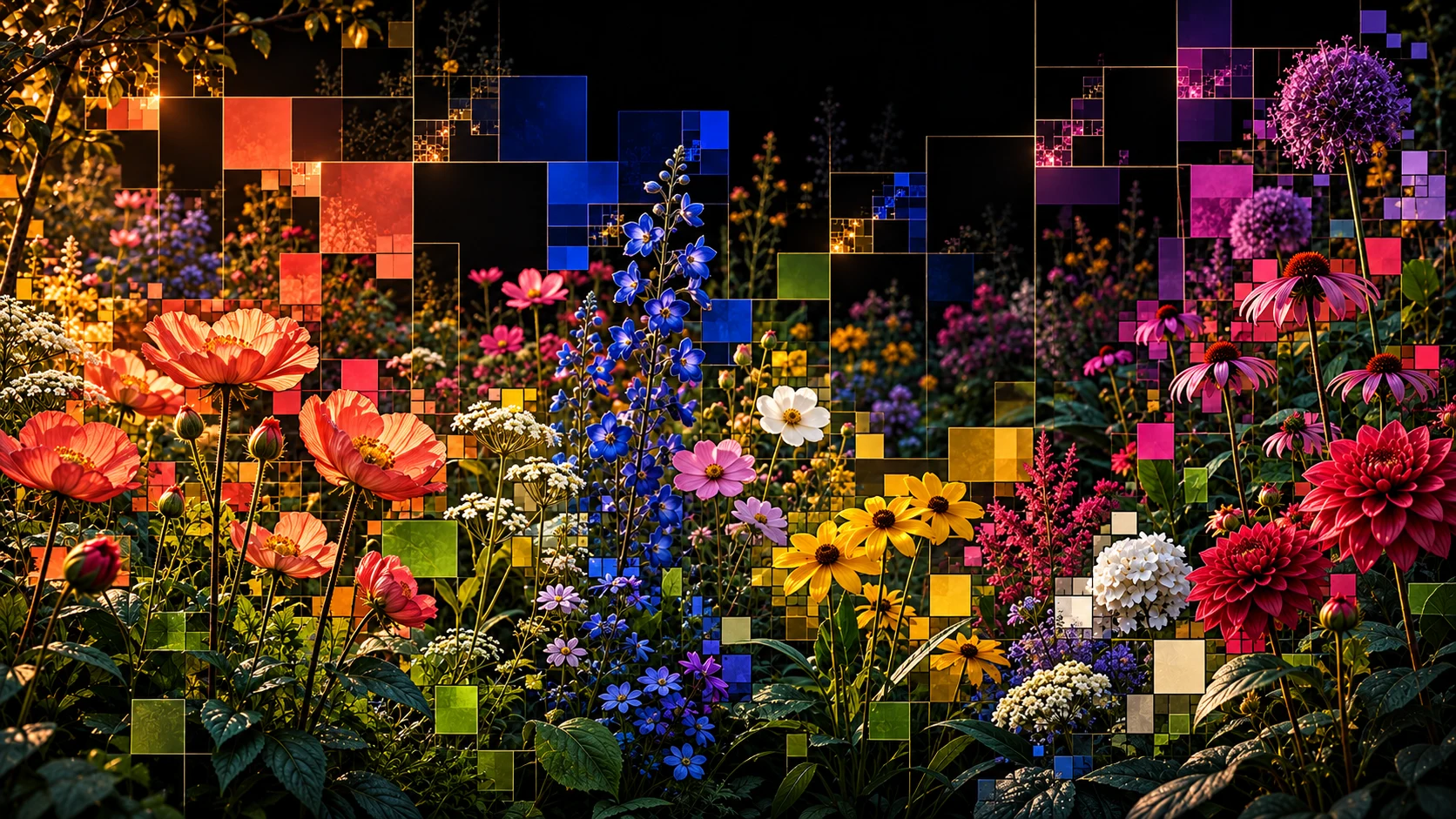
A lush, colorful garden rendered with recursive quadtree blocks, with many flowers and foliage against a dramatic black ground.
Archive plate · Quadtree
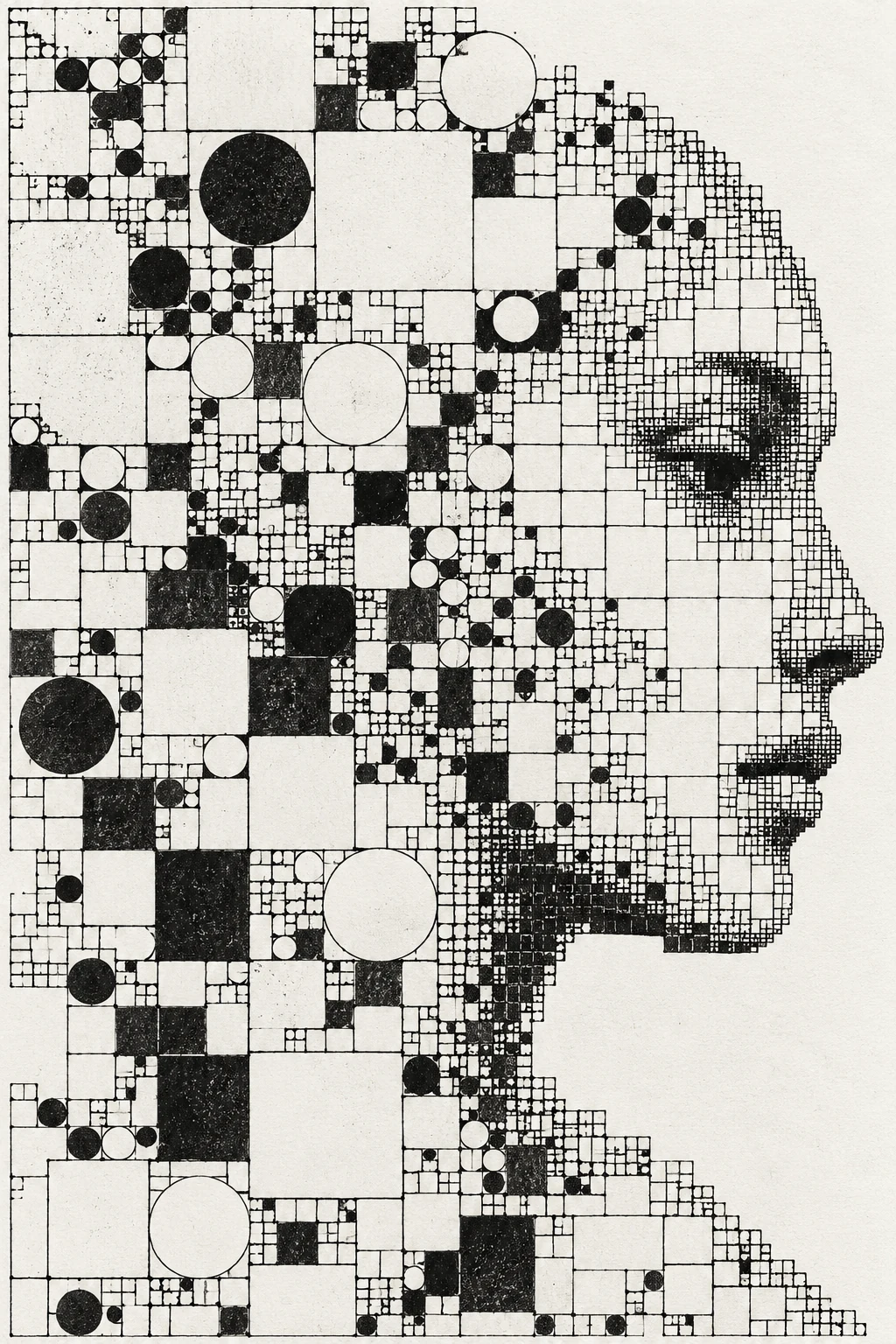
A face emerges from dense black and ivory rounded squares, with large cells framing the portrait and tiny cells shaping its features.
Dossier sceneInk portrait · 1/6
01
The record

What it is, when it works, who it is for, and where it already exists.

How to use it

Record 036-QU - when it works, who it is for, what it looks like

FIELD 01

When to use it

  • A visual system needs to show how detail changes across space
  • Maps, data, or images benefit from adaptive rather than uniform grids
  • A digital composition should make its underlying structure visible
  • A modular identity needs to shift from broad fields to fine detail
FIELD 02

Perfect for

  • Generative art and computational print
  • Spatial maps and data visualization
  • Modular digital identities and interfaces
  • Architectural graphics and interactive installations
FIELD 03

What it looks like

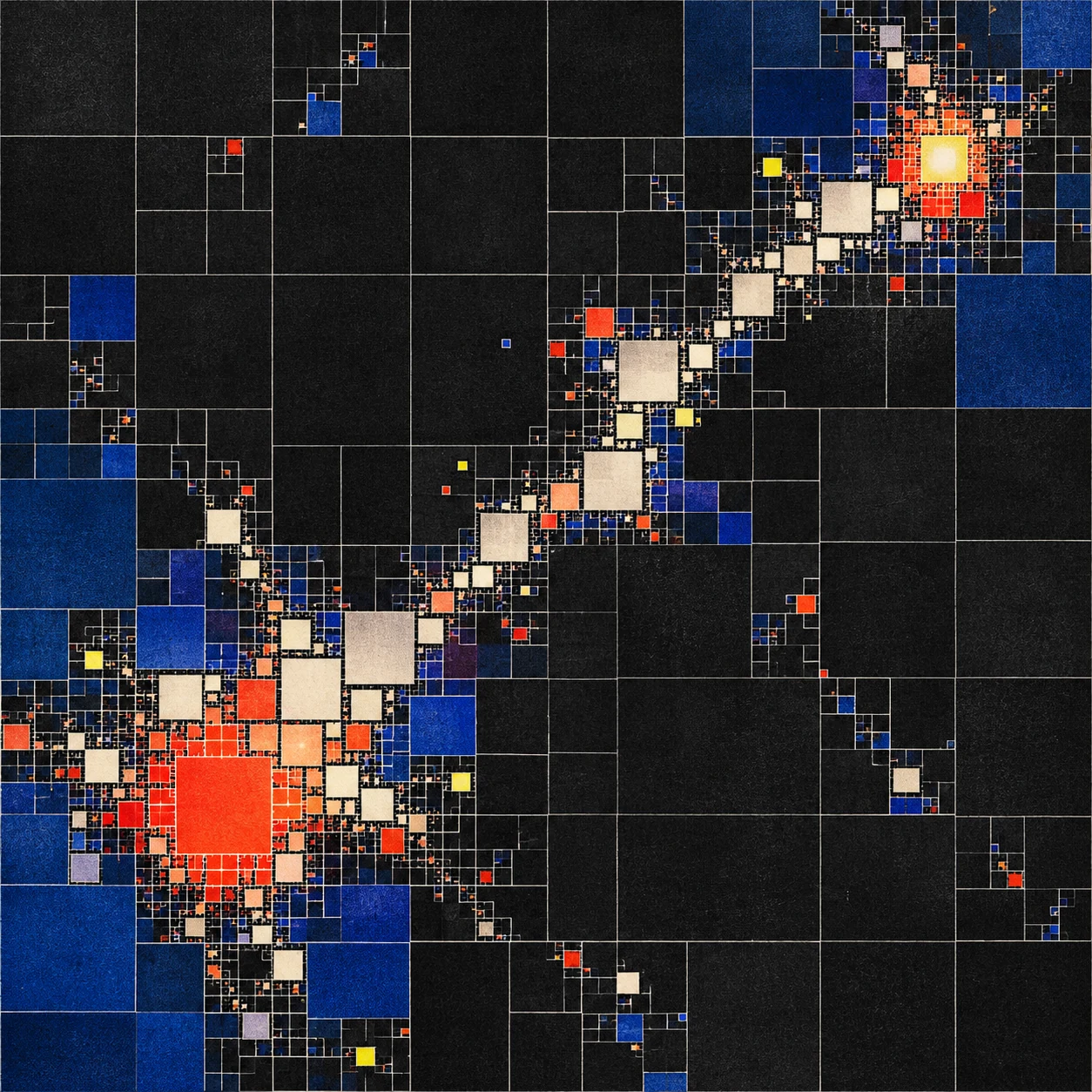
  • A square grid that subdivides around a signal path, growing finer near points of activity
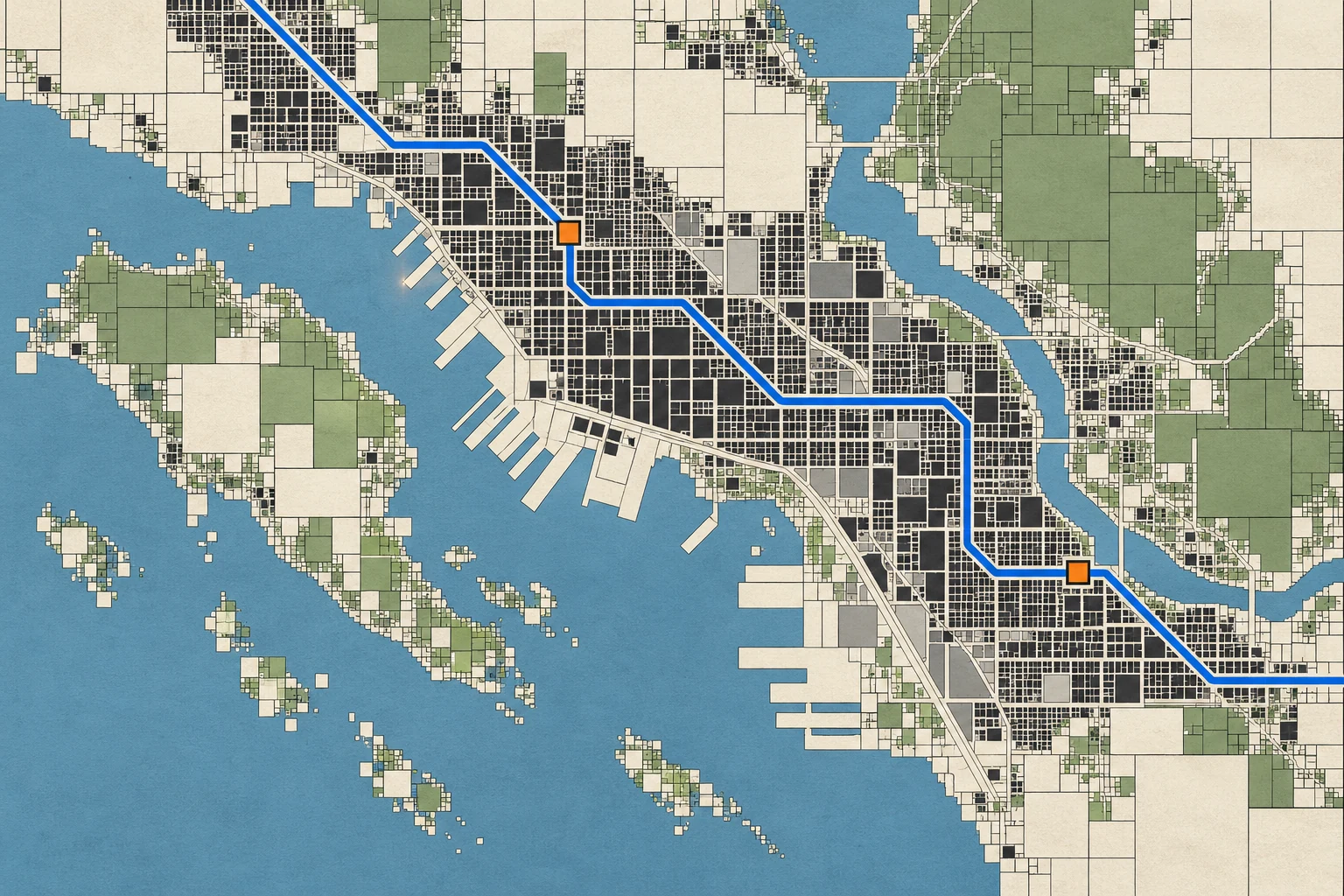
  • A map where large quiet cells give way to dense street-level detail
  • A modular poster using cell size and color to reveal a changing hierarchy
  • An interface that allocates resolution only where users need to look closely
Omoro Style GuideEvery aesthetic, every field on this page, in one PDF.
$8Get the guide →
02
The anatomy

Where Quadtree came from, what makes it recognisable, and the fingerprint it leaves.

History, Quadtree aesthetic history

1974 as a data structure; a visual style from the 2010s · Computer science and creative coding

A quadtree is a way of dividing space. Start with a square, split it into four equal squares, then split again only the squares that need more detail. The structure was named in 1974 by Raphael Finkel and Jon Bentley, and it became a workhorse of computing: image compression, collision detection, mapping and the tiled zoom levels of online maps all rely on the same idea.

Creative coders turned the structure into a visual style. Split an image wherever its colour changes and you get a portrait made of squares, coarse in the background and fine around the eyes. Split a map around activity and the grid becomes a picture of where things happen. The result reads as both precise and organic.

As a design language, quadtree uses cell size as information. Large quiet cells and dense small ones create hierarchy without type, and a limited palette keeps the structure legible. It suits brands that want to show data, intelligence or attention, as long as the subdivision follows something real.

Spend resolution only where something is happening.

Omoro dossier · 036-QU

Visual markers, Quadtree aesthetic visual markers

The visual DNA: what makes it recognisable

typography

See the fonts
  • Neutral grotesk or monospaced type
  • Labels aligned to cell edges
  • Coordinates and index numbers

grid

  • Square cells split recursively into four
  • Cell size following detail, data or attention
  • Thin consistent cell borders

materials

  • Flat colour fills in square cells, generated by code
  • Pixel grids at mixed scales, coarse in calm areas and fine in busy ones
  • Creative-coding canvases: Processing, p5.js and openFrameworks output
  • Screen display on LCD where each cell aligns to the pixel grid
  • Plotter or inkjet prints that keep the cell edges hard
  • Flat, even light: no gradient or shading inside any cell

motifs

  • Recursive subdivision around a focal point
  • Images rebuilt from mixed-size squares
  • Maps that grow finer where activity is
  • One signal colour marking the densest cell

Aesthetic profile

8-channel console with the fingerprint on its display. Save the card, or share the page

Aesthetic Profile
Quadtree
1974 as a data structure; a visual style from the 2010s · Computer science and creative coding
Attribute console · 036-QU
leans geometric, digital, structured
8 CH
FIG. 1
MaximalMinimalDigitalAnalogRestrainedExpressiveCoolWarmFuturisticNostalgicStructuredChaoticLightDarkGeometricOrganic
01Minimal
Maximal20%
02Analog
Digital70%
03Restrained
Expressive30%
04Cool
Warm10%
05Futuristic
Nostalgic30%
06Structured
Chaotic60%
07Dark
Light30%
08Organic
Geometric96%
GeometricDigitalStructured
Omoro · Attribute console · 036-QU
omoro.io/styles/quadtree

Color Palettes, Quadtree color palettes and hex codes

The definitive color scheme for this aesthetic

Quadtree
#171717 · #F1EEE5 · #E7B500 · #174ED8 · #E54A32
Adaptive geometry in ink and paper, with sparse signal colors that clarify density and direction
Omoro Palette Pack575 curated palettes across every aesthetic, 5 export formats.
$8Get the palettes →

Adjacent Palettes, styles related to Quadtree

The colour of the styles sitting closest to this one

Micrographics
Digital Art
Pixel Art
Blueprint
03
The direction

How to shoot it, how to prompt it, and how to board it.

Photo Direction

How to shoot this aesthetic

"Resolution where it matters."

Shot list

  • An overhead city or landscape shot that will be subdivided around one point of activity
  • A product on a gridded set with a pin-sharp hero detail and calm surroundings
  • A tiled facade or floor whose squares shrink toward a focal point

Lighting

Flat, even daylight or soft top light so the square grid and cell edges stay clean.

Omoro Director's Briefs151 photo shot-lists like this one, ready to shoot from.
$8Get the briefs →

Prompts

Click any prompt row to edit. Copy uses your edited text.

Make
Quadtree · image
Style

Quadtree visual language built from recursive subdivision of a square into four child cells; vary cell size and density according to spatial signal or image detail

Visual cues

keeping exact right-angle geometry, visible hierarchy, disciplined negative space, crisp boundaries, and a limited palette of ink, warm paper, cobalt, ochre, and restrained vermilion; make the adaptive grid legible rather than decorative

Paste as-is, or add your own subject.

Variant 1 of 8Same style, a different picture each time: new subject, setting, framing and light. Add a model if you want someone in the picture.
Frame
Variant 1 · image
Shot

Photograph: an overhead city or landscape shot that will be subdivided around one point of activity.

Setting

Set in tiled plaza. Shot wide, the whole scene with room around it, flat, even daylight or soft top light so the square grid and cell edges stay clean..

Detail

Keep maps that grow finer where activity is in the frame.

Style

Style: Quadtree visual language built from recursive subdivision of a square into four child cells; vary cell size and density according to spatial signal or image detail, keeping exact right-angle geometry, visible hierarchy, disciplined negative space, crisp boundaries, and a limited palette of ink, warm paper, cobalt, ochre, and restrained vermilion; make the adaptive grid legible rather than decorative.

Palette

Colour palette #171717 #F1EEE5 #E7B500 #174ED8 #E54A32.

Wardrobe

Solid blocks of colour with no busy prints, so subdivision reads against the figure.

Frame

Composed for a 16:9 landscape frame.

Rules

Photographic, not an illustration. No text, no logos, no watermark.

Use as skill

The whole record as a portable skill for Claude, ChatGPT, Gemini, image and video models, or a human brief

The whole record, compiled into a skill another system can work inside: lineage, axes, palettes, type, materials, photography, verdicts and a critique checklist. Nothing is generated; it is the dossier, restructured.

Mood Board

The record applied to your project. The record's kit is free; your brand, references and plates come with membership

Mood board
The Quadtree board
8 frames · 4 selected
FIG. 4
Grid Ink171717Warm PaperF1EEE5Signal OchreE7B500Cobalt Node174ED8Alert VermilionE54A32
Brand and references
IdleBrand and references open with membership
With membership: the brand's own facts and colours in every prompt, references carried into every frame, and the plates generated.
01 · Hero application
02 · Material and finish
03 · Palette in context
04 · Photography direction
05 · Pattern plate
06 · Object
07 · Environment
08 · Digital presence
Demo kit free, the rest with membershipThe record as a demo kit, free. Name a project and it is written for that
Omoro · Mood board · 036-QU
04
The judgement

Whether to use it, what it costs to do properly, and where it stands right now.

Creative verdict, Quadtree feasibility and strategic recommendation

Two written calls, seven meters, and when to walk away

Creative verdict
Should Quadtree be the call?
7 meters
FIG. 2
Assessment

Quadtree earns its keep when it gives a brand a standard of judgment, not just a finish. It falls apart the moment recognizable cues get collected without a point of view behind them. The tell is always proportion: what's shown, what's held back, and whether every choice belongs to the same world.

Verdict

Use Quadtree when the brand can back a real point of view and protect it through execution. Not when the goal is broad, neutral, or cheap to produce. The advantage is differentiation through judgment: the work reads as authored, not packaged. Average executions borrow the signals and lose the coherence. The best ones treat the visual language as a system of choices, including what they leave out.

Production cost
Medium

Budget goes into art direction and casting, not the toolkit.

Creative difficulty
High

Anyone can spot the references. A real system out of them is the hard part.

Execution difficulty
High

One wrong prop or one off color reads as costume instead of conviction.

Risk of misuse
High

The surface is easy to copy. What separates the real thing from a knockoff is the system underneath.

Prevalence
Common

The ingredients are everywhere right now. A disciplined execution is still the minority.

Longevity
Enduring

This holds up because it's built on composition and material, not a filter that ages out.

Brand investment
High

It only works if every touchpoint agrees. Cut a corner anywhere and the whole thing shows it.

Avoid if
Everyone needs to read the message instantly
A strong point of view asks for a second look. If the work has to land in one glance, that's the wrong ask of this language.
The team can't hold the standard
One inconsistent shoot, one off-brand asset, and the whole system reads as an accident, not a decision.
Omoro · Creative verdict · 036-QU

Editorial Depth

A Pro feature: origins, practitioners, and pitfalls

Editorial depth
The Quadtree file
14 sections
FIG. 3
Context02Brands02Perception04Use04Index02
01Common MisconceptionThe principle beneath the surface
02Historical ContextOrigins, cultural moment, and reaction
03Brands That Accidentally Use This StyleNatural alignment, not category claims
04Brands That Perfectly Represent This StyleExceptional execution
05Psychological EffectHow visual decisions change perception
06Visual ChecklistInclude and avoid
07Creative FormulaThe visual system reduced to essentials
08Recognition SignalsHow to recognize it in two seconds
09When To Use This StyleContexts where the language performs
10Common Creative MistakesWhere imitation weakens the signal
11Best Brand ApplicationsIndustries with a natural advantage
12Creative Application AnalysisFit, feasibility, and production reality
13Related StylesClose languages and the key distinction
14Visual DNA SummaryThe sentence to remember
The editorial depth, with membershipOpening soon
Omoro · Editorial depth · 036-QU
05
The index

Neighbours, cross-references, blends, and the questions people ask.

Related concepts

Connected across the creative knowledge graph

Cross-references

MicrographicsBoth use structure and density to carry information.Pixel ArtBoth build images from squares; quadtree varies their size.Swiss / InternationalShares a grid-first, rational approach to layout.GlitchBoth expose digital structure; quadtree does it with order rather than error.

Blend

Mix Quadtree with any style in the library, or see the pairs worth trying

Quadtree×
50%50%
96% alike
Quadtree referenceMicrographics referenceQuadtree 50%Micrographics 50%

Merged palette

#171717

#F4F2EC

#E7B500

#16A8E8

#174ED8

Leads geometric, structured, digital

Typography · from Quadtree

IBM Plex Sans over IBM Plex Mono

Materials

  • Flat colour fills in square cells, generated by code
  • Pixel grids at mixed scales, coarse in calm areas and fine in busy ones
  • Matte uncoated paper or a neutral screen as the ground

Use it

DIRECTION

Create one visual direction that synthesizes Quadtree × Micrographics. Preserve a clear hierarchy; do not make a contact sheet or a collage of unrelated styles.

CHARACTER

Let it read as geometric, structured, digital. Resolve the strongest tensions deliberately: keep the balance coherent.

PALETTE

Use these colors as a controlled system: #171717 (Grid Ink) · #F4F2EC (Archive Paper) · #E7B500 (Signal Ochre) · #16A8E8 (Signal Blue) · #174ED8 (Cobalt Node).

TYPE

Use IBM Plex Sans for display type and IBM Plex Mono for supporting text.

MATERIALS

Bring in Flat colour fills in square cells, generated by code, Pixel grids at mixed scales, coarse in calm areas and fine in busy ones, Matte uncoated paper or a neutral screen as the ground, Thin vector strokes at one consistent weight across every pictogram.

OUTPUT

Keep one subject or one clear interface state in focus. Use the visual language to guide composition, lighting, spacing and material decisions.

Open in blends, with pairs worth trying →

About this aesthetic

Is quadtree art the same as pixel art?

No. Pixel art uses a fixed grid of equal squares. A quadtree uses squares of many sizes, so detail appears only where it is needed.

Does the subdivision have to mean something?

It works best when it does. Split around real data, a face or a product detail; random subdivision quickly looks like decoration.

Where is it used?

Data and technology brands, mapping and logistics, AI and analytics products, and generative identities that change with their input.

Build with the quadtree aesthetic

Every style in the library is broken down like this one: the palette, the typography, the materials and the lineage.

Explore the style library →