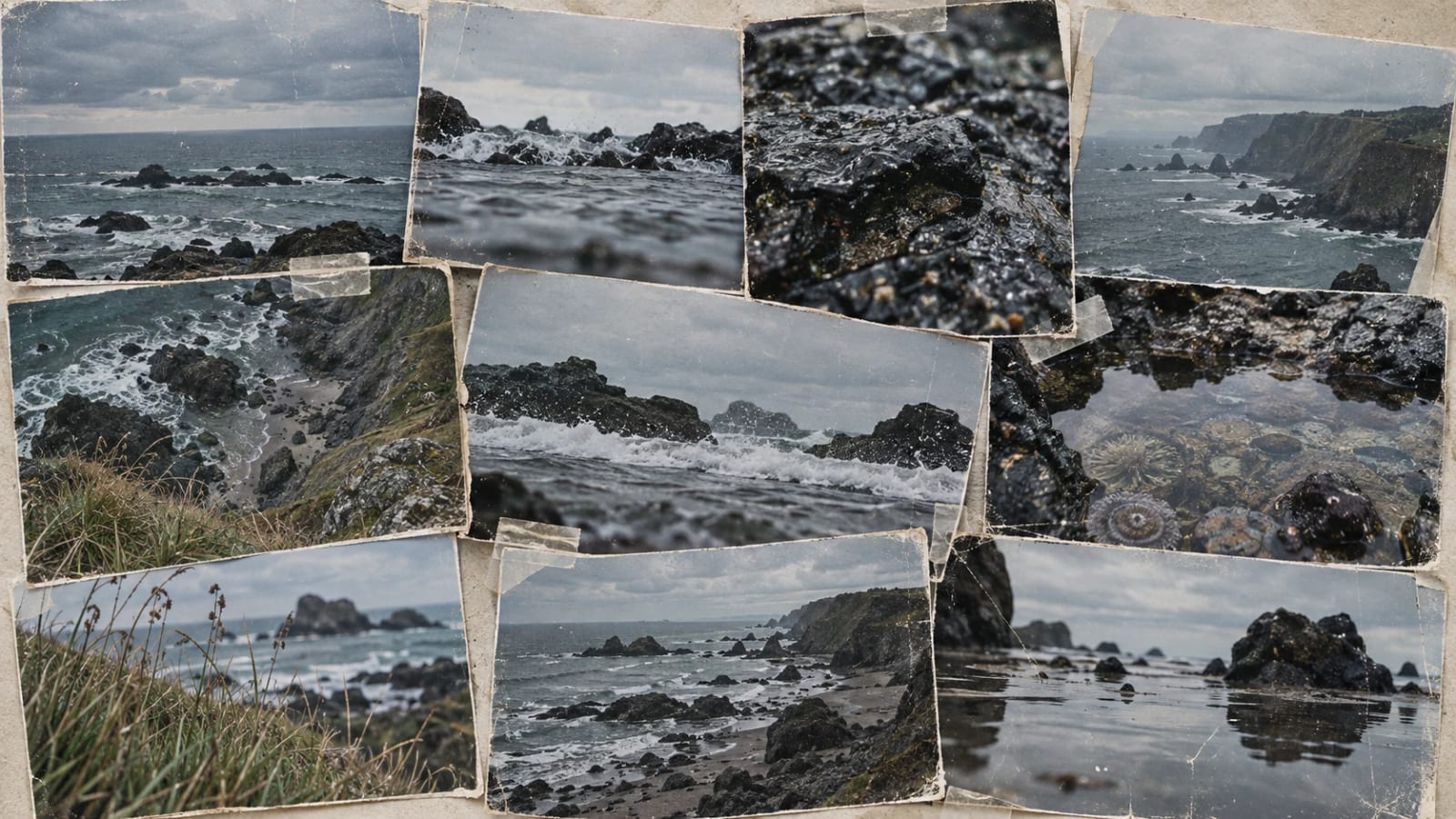
Panography

A composite photographic image made from overlapping fragments of the same scene, observed across shifting viewpoints and moments

Collect references in this style →
Panography visual example
Visual language · Panography

A composite photographic image made from overlapping fragments of the same scene, observed across shifting viewpoints and moments

Key colors
Era
1982 to now
Origin
Composite instant prints and 35mm joiners made in Los Angeles, London and Paris in the early 1980s, drawing on Cubism
Typography
No type on the image itself; the prints carry the picture, A small dated caption beside it, place and days, like an exhibition label
Best for
Magazines and photo editors
Explore Cubism
Record035-PJ
AestheticPanography
ClassAnalog / Nostalgic
StatusINGESTING
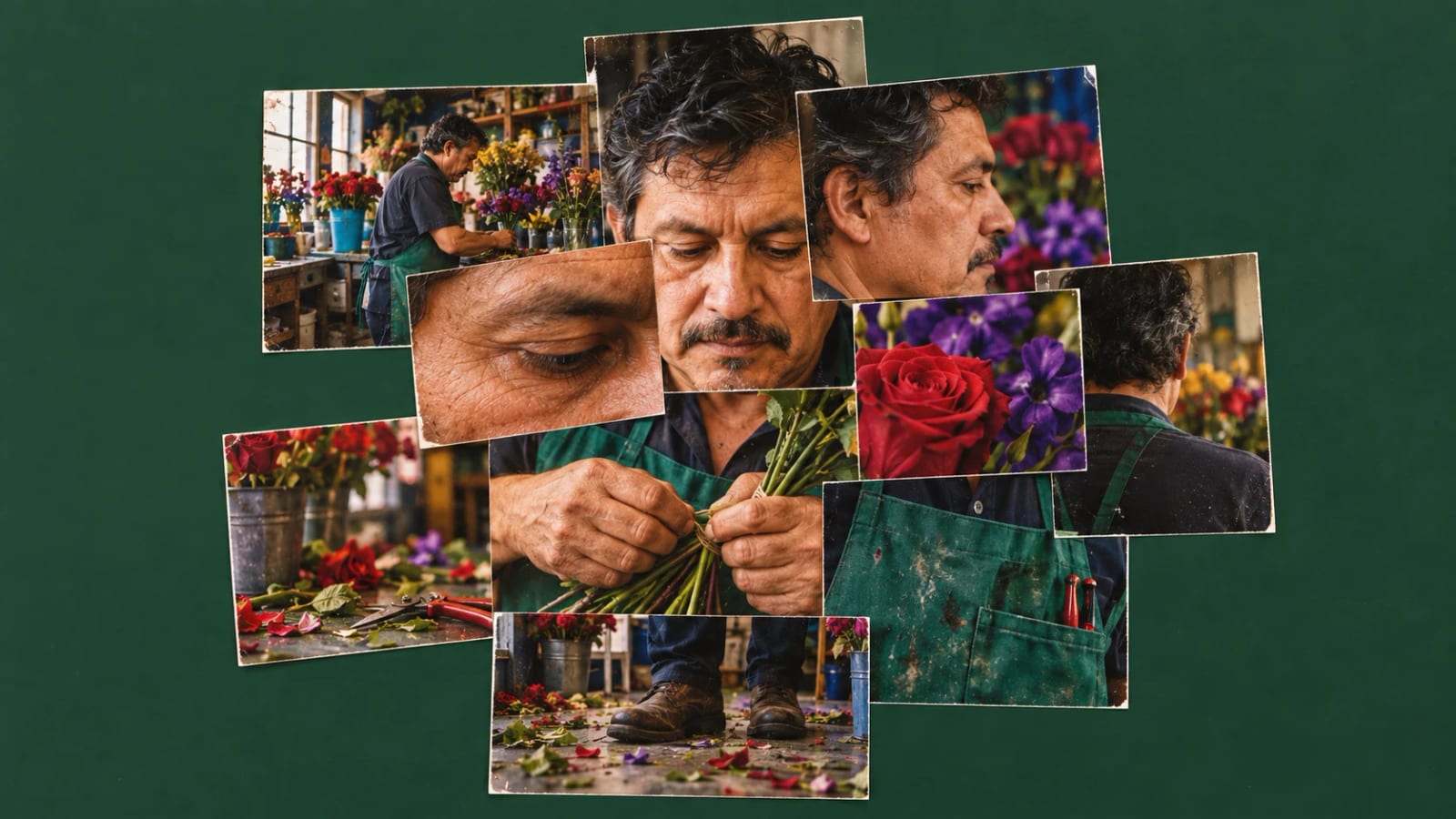
A florist in a green apron pieced together from overlapping prints on a green board: arranging bouquets in a sunlit workshop, his face head-on and in profile, a close-up of one eye, hands binding rose stems, and boots among fallen petals.
Archive plate · Panography
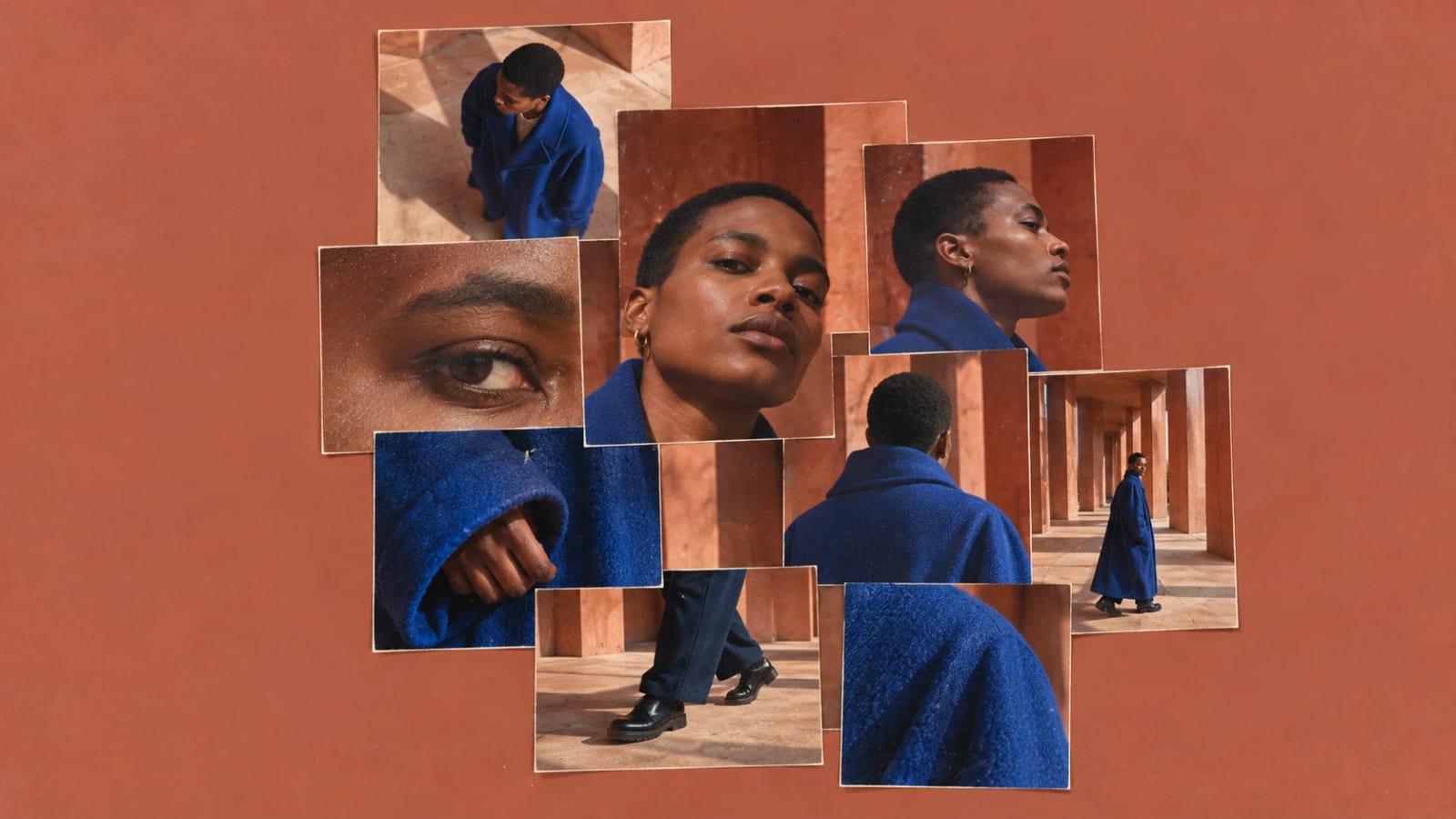
A model with close-cropped hair in a long cobalt wool coat, rebuilt from overlapping prints on terracotta paper: seen from above, face-on and in profile, a fist in the cuff, and walking through a sunlit colonnade.
Dossier sceneFashion · 1/5
01
The record

What it is, when it works, who it is for, and where it already exists.

How to use it

Record 035-PJ - when it works, who it is for, what it looks like

FIELD 01

When to use it

  • Editorial features and cover stories about a place, a home or a person's day
  • Music campaigns and sleeves that want time and movement inside a still image
  • Cultural institutions, travel and interiors, where walking through a space is the story
  • Film key art and personal storytelling that need memory rather than a single decisive moment
FIELD 02

Perfect for

  • Magazines and photo editors
  • Record labels and music campaigns
  • Museums, galleries and festivals
  • Hotels, architects and interior studios
FIELD 03

What it looks like

  • David Hockney, composite Polaroids shown at the Centre Pompidou, 1982
  • David Hockney, Cameraworks, book with Lawrence Weschler, 1984
  • David Hockney, Place Furstenberg, Paris, 1985
  • David Hockney, Pearblossom Hwy., 11–18th April 1986

In the wild, Panography aesthetic real-world examples

Where this aesthetic shows up in the real world · ↗ opens the source site

Omoro Style GuideEvery aesthetic, every field on this page, in one PDF.
$8Get the guide →
02
The anatomy

Where Panography came from, what makes it recognisable, and the fingerprint it leaves.

History, Panography aesthetic history

1982 to now · Composite instant prints and 35mm joiners made in Los Angeles, London and Paris in the early 1980s, drawing on Cubism

The joiner grew out of an argument with the camera. A single photograph fixes one viewpoint at one instant, which is not how anyone looks at a room: the eye moves, the head turns, and a scene is built up over seconds. Cubism had made the same objection to painting. In the years after 1907 Picasso and Braque showed objects from several sides at once, and the idea that a picture could hold more than one position and more than one moment became part of modern art. Earlier still, Eadweard Muybridge's sequences of the 1870s had shown what the camera saw when it was asked to record time instead of freezing it.

In 1982, while preparing an exhibition of his photographs for the Centre Pompidou in Paris, the painter David Hockney began photographing rooms, gardens and friends with an instant camera and arranging the square prints in grids. The exhibition, David Hockney photographe, opened that July. He soon moved to small 35mm prints, which he could overlap freely, and called the results joiners. Works such as Place Furstenberg, Paris (1985) and Pearblossom Hwy. (1986), assembled from hundreds of prints and now in the J. Paul Getty Museum, show the viewpoint moving across a scene, with borders, tilts and repeated details left in. Cameraworks, with Lawrence Weschler, collected the work in 1984.

What makes a joiner distinct from photo collage is its subject and its method. Collage and photomontage combine images from different sources to make something new; a joiner stays in one place and rebuilds it through sequential looking, so the changes in angle, scale, time and alignment become the content. The technique has since become a standard exercise in photography teaching, and it returns in editorial, music and travel work whenever a single frame feels too still for a place or a person. Its failure modes are the seamless panorama, which hides the looking, and the shattered-glass filter, which imitates the look without the observation.

A composite photographic image made from overlapping fragments of the same scene, observed across shifting viewpoints and moments.

Omoro dossier · 035-PJ

Visual markers, Panography aesthetic visual markers

The visual DNA: what makes it recognisable

typography

See the fonts
  • No type on the image itself; the prints carry the picture
  • A small dated caption beside it, place and days, like an exhibition label
  • A plain grotesk or typewriter face set well apart, on the same off-white ground

grid

  • Overlapping prints, each with a visible white border or paper edge
  • An irregular grid that tilts and steps as the viewpoint drifts
  • Close frames that together make a wide scene, legible from a distance
  • A non-linear composition: the eye travels, the edge of the whole is ragged

materials

  • Polaroid SX-70 instant prints with white borders, gridded together
  • Small-format 35mm colour prints overlapped and pasted on board
  • Foam board or card backing with visible glue and tape
  • Rephotographed composites made from the physical collage
  • Paper edges lifting slightly to cast thin shadows
  • Shifting California afternoon light that changes from frame to frame

motifs

  • A hand, a foot or a face repeated as the person moves
  • Perspective drift: lines of a floor or horizon stepping between frames
  • Small changes in light or position that show time passing
  • Paper edges lifting slightly and casting thin shadows

Aesthetic profile

8-channel console with the fingerprint on its display. Save the card, or share the page

Aesthetic Profile
Panography
1982 to now · Composite instant prints and 35mm joiners made in Los Angeles, London and Paris in the early 1980s, drawing on Cubism
Attribute console · 035-PJ
leans analog, nostalgic, expressive
8 CH
FIG. 1
MaximalMinimalAnalogDigitalExpressiveRestrainedWarmCoolNostalgicFuturisticChaoticStructuredLightDarkOrganicGeometric
01Minimal
Maximal40%
02Analog
Digital90%
03Restrained
Expressive50%
04Cool
Warm40%
05Futuristic
Nostalgic60%
06Structured
Chaotic40%
07Dark
Light40%
08Organic
Geometric10%
AnalogNostalgicExpressive
Omoro · Attribute console · 035-PJ
omoro.io/styles/photographic-joiners

Color Palettes, Panography color palettes and hex codes

The definitive color scheme for this aesthetic

Panography
#F4F1EA · #E6D3B3 · #5B8DB3 · #C0633F · #2F2B28
Daylight colour held together by white print borders: warm plaster and terracotta, one clear blue, and the thin shadow where one photograph lies over another
Omoro Palette Pack575 curated palettes across every aesthetic, 5 export formats.
$8Get the palettes →

Adjacent Palettes, styles related to Panography

The colour of the styles sitting closest to this one

Cubism
Collage
Analog Photography
Dada
03
The direction

How to shoot it, how to prompt it, and how to board it.

Photo Direction

How to shoot this aesthetic

"One real place, looked at many times: overlapping prints that keep the shifts in angle, scale and time"

Shot list

  • A sunlit artist studio reconstructed through overlapping instant-photo fragments, with one fully visible person moving through the space, the floor, easel and windows drifting slightly from print to print
  • A complete portrait of one person seated by a window, assembled from slightly offset close and medium photographic fragments, the face, hands and knees seen from a little different angles
  • A pedestrian crossing a quiet city street, shown through overlapping frames that shift subtly in viewpoint and time, the figure appearing more than once as they cross

Lighting

Natural daylight throughout, as it was in the room or the street at the time. Keep the exposure close from frame to frame but let it drift a little, so the prints read as separate looks taken over minutes, not one exposure cut up.

Omoro Director's Briefs151 photo shot-lists like this one, ready to shoot from.
$8Get the briefs →

Prompts

Click any prompt row to edit. Copy uses your edited text.

Make
Panography · image
Style

Panography

Visual cues

one real scene reconstructed from many overlapping rectangular photographic prints with white borders, each print taken from a slightly different viewpoint and moment, visible paper edges and seams, perspective drifting from print to print, a moving person caught more than once, natural daylight, warm plaster, terracotta and pool blue, prints laid on a plain ground, editorial photograph, not a seamless panorama, not a digital glitch, not a scrapbook of different places, no text

Paste as-is, or add your own subject.

Variant 1 of 8Same style, a different picture each time: new subject, setting, framing and light. Add a model if you want someone in the picture.
Frame
Variant 1 · image
Shot

Photograph: a sunlit artist studio reconstructed through overlapping instant-photo fragments, with one fully visible person moving through the space, the floor, easel and windows drifting slightly from print to print.

Setting

Set in a quiet city street or crossing. Shot wide, the whole scene with room around it, natural daylight throughout, as it was in the room or the street at the time.

Detail

Keep small changes in light or position that show time passing in the frame.

Style

Style: Panography, one real scene reconstructed from many overlapping rectangular photographic prints with white borders, each print taken from a slightly different viewpoint and moment, visible paper edges and seams, perspective drifting from print to print, a moving person caught more than once, natural daylight, warm plaster, terracotta and pool blue, prints laid on a plain ground, editorial photograph, not a seamless panorama, not a digital glitch, not a scrapbook of different places, no text.

Palette

Colour palette #F4F1EA #E6D3B3 #5B8DB3 #C0633F #2F2B28.

Wardrobe

Simple, everyday clothes in plain colours that hold together across many small frames: a white shirt, a blue jumper, linen trousers.

Frame

Composed for a 16:9 landscape frame.

Rules

Photographic, not an illustration. No text, no logos, no watermark.
Use as skill

The whole record as a portable skill for Claude, ChatGPT, Gemini, image and video models, or a human brief

The whole record, compiled into a skill another system can work inside: lineage, axes, palettes, type, materials, photography, verdicts and a critique checklist. Nothing is generated; it is the dossier, restructured.

Mood Board

The record applied to your project. The record's kit is free; your brand, references and plates come with membership

Mood board
The Panography board
8 frames · 4 selected
FIG. 4
Instant BorderF4F1EAAfternoon PlasterE6D3B3Pool Blue5B8DB3Terracotta FloorC0633FSeam Shadow2F2B28
Brand and references
IdleBrand and references open with membership
With membership: the brand's own facts and colours in every prompt, references carried into every frame, and the plates generated.
01 · Hero application
02 · Material and finish
03 · Palette in context
04 · Photography direction
05 · Pattern plate
06 · Object
07 · Environment
08 · Digital presence
Demo kit free, the rest with membershipThe record as a demo kit, free. Name a project and it is written for that
Omoro · Mood board · 035-PJ
04
The judgement

Whether to use it, what it costs to do properly, and where it stands right now.

Creative verdict, Panography feasibility and strategic recommendation

Two written calls, seven meters, and when to walk away

Creative verdict
Should Panography be the call?
7 meters
FIG. 2
Assessment

Shoot one real place, slowly. Take many close frames from a few nearby positions over a few minutes, then lay them out by hand so the overlaps, borders and small shifts in angle and time stay visible. Let a person or a shadow move between frames. If it looks like a panorama, a glitch or a scrapbook of different places, it is not a joiner.

Verdict

Right when the story is about being in a place over time: a home, a studio, a walk, a performance, a person seen from several sides. It suits editorial, music, travel, interiors and cultural institutions. Borrow the overlapping prints, the visible borders and the drift of viewpoint from one real scene; never fake it with a shatter filter or stitch it into a seamless panorama.

Production cost
Low

One camera, one location and prints or a careful digital layout; the cost is time, not equipment.

Creative difficulty
Medium

The idea is simple, but choosing where to stand, what to repeat and how much drift to allow takes judgement.

Execution difficulty
High

Dozens of frames must be shot from planned positions and then assembled by hand so the scene holds together while the seams still show.

Risk of misuse
Medium

It is easily flattened into a grid of random photos or a digital shatter effect, and it is often reduced to one artist's name.

Prevalence
Rare

Widely taught in photography courses but seldom used in brand or campaign work, where it still looks distinctive.

Longevity
Enduring

Four decades on, the joiners still hang in major museums and the idea of looking over time has not dated.

Brand investment
Medium

Cheap to shoot, but the assembly is slow and every layout is made by hand.

Avoid if
You want a clean, seamless view of the place
A joiner shows the looking, not just the place. If the brief needs one correct perspective, shoot a single frame or a stitched panorama; a joiner that hides its seams has lost its point.
The images come from different places or sources
That is collage or photomontage, a different style. A joiner is one real scene observed over time; mixing locations, cut-outs or found images turns it into a scrapbook.
Omoro · Creative verdict · 035-PJ

Editorial Depth

A Pro feature: origins, practitioners, and pitfalls

Editorial depth
The Panography file
14 sections
FIG. 3
Context02Brands02Perception04Use04Index02
01Common MisconceptionThe principle beneath the surface
02Historical ContextOrigins, cultural moment, and reaction
03Brands That Accidentally Use This StyleNatural alignment, not category claims
04Brands That Perfectly Represent This StyleExceptional execution
05Psychological EffectHow visual decisions change perception
06Visual ChecklistInclude and avoid
07Creative FormulaThe visual system reduced to essentials
08Recognition SignalsHow to recognize it in two seconds
09When To Use This StyleContexts where the language performs
10Common Creative MistakesWhere imitation weakens the signal
11Best Brand ApplicationsIndustries with a natural advantage
12Creative Application AnalysisFit, feasibility, and production reality
13Related StylesClose languages and the key distinction
14Visual DNA SummaryThe sentence to remember
The editorial depth, with membershipOpening soon
Omoro · Editorial depth · 035-PJ
05
The index

Neighbours, cross-references, blends, and the questions people ask.

Related concepts

Connected across the creative knowledge graph

Cultural relevance, Panography cultural relevance today

Where it stands now, and what it costs you to use it

The joiner answers a question photography keeps asking: how to show being somewhere, rather than one instant of it. For editorial, music, travel, interiors and cultural institutions, it turns a place or a person into something the viewer walks through, and it rewards the slow, active looking that feeds rarely allow. It carries memory well, because the fragments feel like the way a room or a day is remembered: in pieces, slightly out of order, still whole.

It is often reduced to one artist's name, and imitated with a filter that cracks a single photograph into tiles. The work that lands is actually shot in sequence from one real place, with the drift of viewpoint and time kept honest and the seams left for the viewer to cross.

Cross-references

CubismThe same idea in paint: several viewpoints and moments in one pictureCollageCut and assembled too, but from different sources rather than one observed sceneAnalog PhotographyThe prints, the contact sheet and the physical process the joiner is made fromDadaPhotomontage's origin, where fragments are combined into a new and often impossible image

Blend

Mix Panography with any style in the library, or see the pairs worth trying

Panography×
50%50%
90% alike
Panography referenceCubism referencePanography 50%Cubism 50%

Merged palette

#F4F1EA

#2C3E50

#E6D3B3

#8B6914

#5B8DB3

Leads analog, nostalgic, expressive

Typography · from Panography

Zilla Slab over Source Sans 3

Materials

  • Polaroid SX-70 instant prints with white borders, gridded together
  • Small-format 35mm colour prints overlapped and pasted on board
  • Oil paint on canvas in thin, muted, near-monochrome layers

Use it

DIRECTION

Create one visual direction that synthesizes Panography × Cubism. Preserve a clear hierarchy; do not make a contact sheet or a collage of unrelated styles.

CHARACTER

Let it read as analog, nostalgic, expressive. Resolve the strongest tensions deliberately: keep the balance coherent.

PALETTE

Use these colors as a controlled system: #F4F1EA (Instant Border) · #2C3E50 (Slate Blue) · #E6D3B3 (Afternoon Plaster) · #8B6914 (Ochre) · #5B8DB3 (Pool Blue).

TYPE

Use Zilla Slab for display type and Source Sans 3 for supporting text.

MATERIALS

Bring in Polaroid SX-70 instant prints with white borders, gridded together, Small-format 35mm colour prints overlapped and pasted on board, Oil paint on canvas in thin, muted, near-monochrome layers, Papier collé: cut newspaper, wallpaper and faux-wood-grain paper pasted on.

OUTPUT

Keep one subject or one clear interface state in focus. Use the visual language to guide composition, lighting, spacing and material decisions.

Open in blends, with pairs worth trying →

About this aesthetic

What is a photographic joiner?

A composite picture made from many overlapping photographs of the same scene, each taken from a slightly different position or moment. The prints are laid out so the scene can be read as a whole while the borders, overlaps and shifts in angle and time stay visible. The name comes from the joiners David Hockney made from 1982.

How is a joiner different from a photo collage or a panorama?

A collage or photomontage combines images from different sources into a new picture, sometimes an impossible one, as in Surrealist montage. A panorama stitches frames so the seams disappear. A joiner stays in one real place and keeps the seams: it reconstructs the scene through sequential observation, so the changes in angle, scale, time and alignment are part of the picture.

How do you make a photographic joiner?

Choose one place or subject. Photograph it in many close frames that overlap by about a third, moving a step or turning between groups of shots and letting a few minutes pass. Print the frames small, lay them out by hand on a plain board and fix them where the scene reads best, leaving borders, tilts and small mismatches in place.

Build with the panography aesthetic

Every style in the library is broken down like this one: the palette, the typography, the materials and the lineage.

Explore the style library →