Fluorescence

Visible light emitted after a material absorbs ultraviolet radiation

Collect references in this style →
Fluorescence visual example
Visual language · Fluorescence

Visible light emitted after a material absorbs ultraviolet radiation

Key colors
Era
Named in 1852; a design language from the twentieth century to now
Origin
Optical physics, mineralogy and pigment chemistry, carried into science, fashion, sport and nightlife
Typography
A clean technical grotesk; the image is active enough, Narrow monospace accents for specimen notes, wavelengths and codes
Best for
Fashion and beauty brands
Explore Infrared Photography
Record025-FL
AestheticFluorescence
ClassDark / Cool
StatusINGESTING
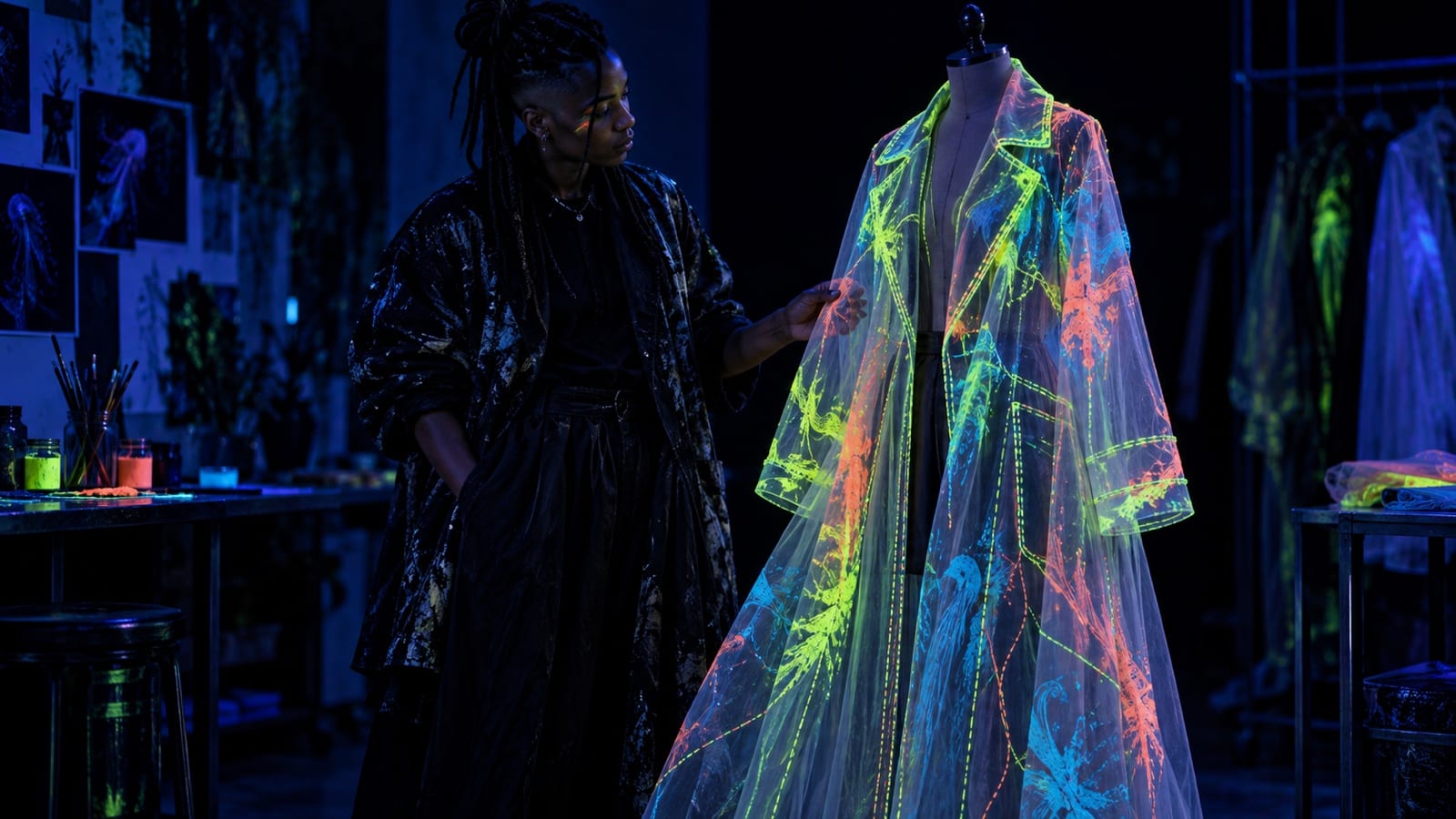
A designer in a dark studio studies a transparent coat on a dress form, its painted lines and botanical motifs glowing lime, amber and cyan under ultraviolet.
Archive plate · Fluorescence
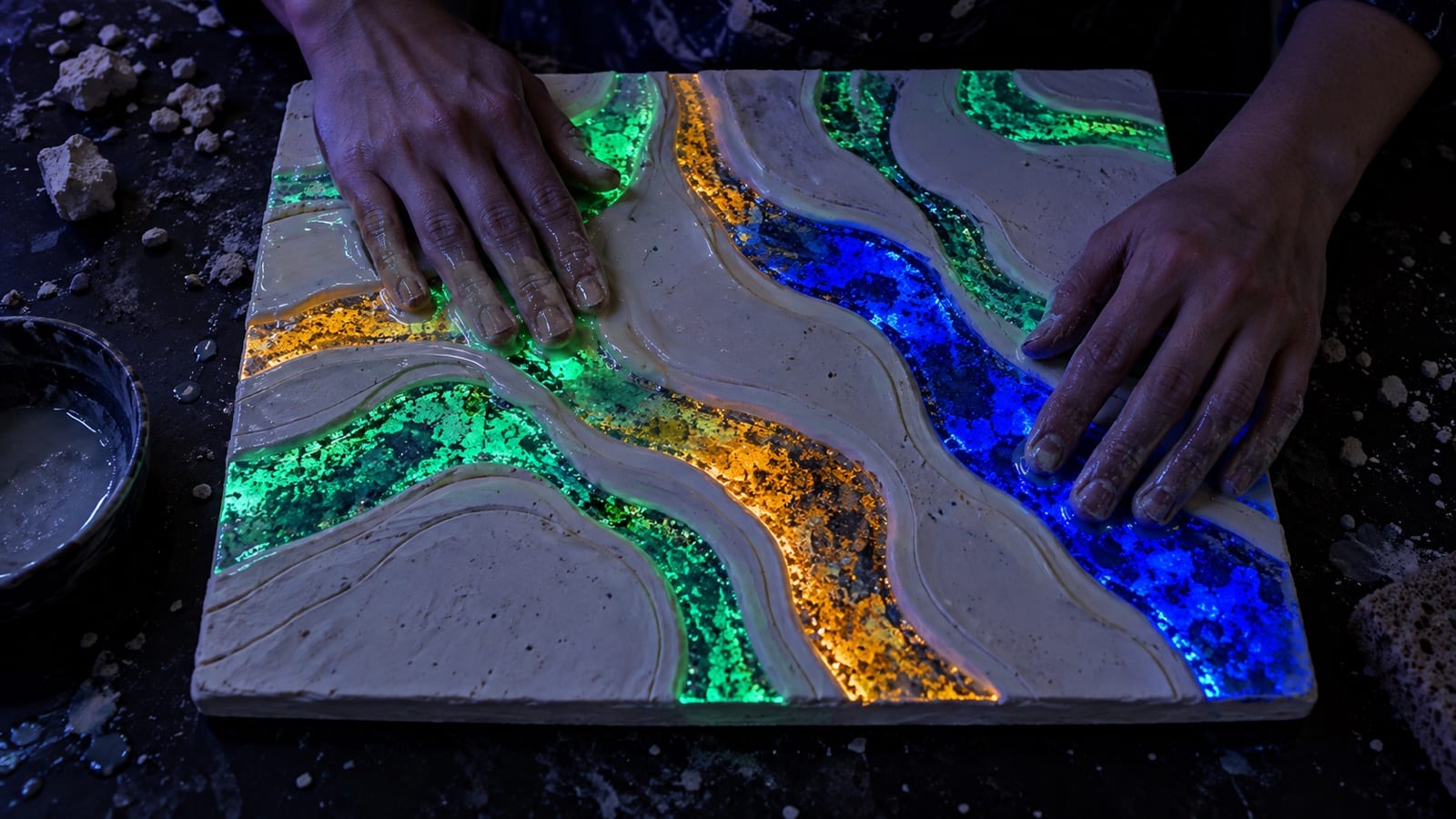
Hands press a pale plaster tile inlaid with winding channels of mineral and pigment that glow green, amber and deep blue under ultraviolet.
Dossier sceneMaterial · 1/4
01
The record

What it is, when it works, who it is for, and where it already exists.

How to use it

Record 025-FL - when it works, who it is for, what it looks like

FIELD 01

When to use it

  • Fashion and beauty campaigns where a fabric, pigment or finish should reveal a second colour
  • Material research, scientific editorial and exhibition identities about hidden properties
  • Sport photography and nightlife spaces lit with controlled ultraviolet
  • Packaging and experimental product launches built on a reactive coating or ink
FIELD 02

Perfect for

  • Fashion and beauty brands
  • Material and colour researchers
  • Science museums and exhibition designers
  • Nightlife venues and product launches
FIELD 03

What it looks like

  • George Gabriel Stokes names fluorescence, 1852
  • Robert Wood's ultraviolet filter glass, 1903
  • The Switzer brothers' blacklight paints, from 1934
  • Fluorescent minerals of Franklin, New Jersey

In the wild, Fluorescence aesthetic real-world examples

Where this aesthetic shows up in the real world · ↗ opens the source site

Omoro Style GuideEvery aesthetic, every field on this page, in one PDF.
$8Get the guide →
02
The anatomy

Where Fluorescence came from, what makes it recognisable, and the fingerprint it leaves.

History, Fluorescence aesthetic history

Named in 1852; a design language from the twentieth century to now · Optical physics, mineralogy and pigment chemistry, carried into science, fashion, sport and nightlife

Fluorescence is a material doing something it cannot help. Certain molecules and crystals absorb ultraviolet, which the eye cannot see, and give it back a moment later as visible colour. In 1852 the physicist George Gabriel Stokes described the effect and named it after fluorspar, a mineral that glows strongly under the right light. Mineralogists had long noticed the strange colours; Stokes showed that the emitted light was always of a longer wavelength than the light that caused it, which is why an invisible source can make a stone turn green, red or violet.

The twentieth century built tools around it. In 1903 Robert Wood made a glass that passes ultraviolet and blocks most visible light, the basis of the blacklight. Conservators began using ultraviolet to find retouching on paintings, and collectors turned places such as Franklin, New Jersey, into shrines for fluorescent minerals. In the 1930s the brothers Bob and Joe Switzer developed paints that glowed under blacklight and went into business in 1934; their daylight fluorescent colours later went to war as signal panels and then into packaging, safety wear and, by the 1960s, blacklight posters.

Science made it precise. Optical brighteners made laundry glow; fluorescent dyes and proteins let biologists light up single structures, and the green fluorescent protein earned a Nobel Prize in 2008. Fashion, beauty, sport and nightlife took the look, but its best work keeps the physics: a dark room, a controlled ultraviolet source, and colour appearing only where a dye, pigment, mineral, coating or living tissue responds. It is often mistaken for neon, which is light from a tube, or bioluminescence, which is light made by organisms. Fluorescence needs the ultraviolet first.

Visible light emitted after a material absorbs ultraviolet radiation.

Omoro dossier · 025-FL

Visual markers, Fluorescence aesthetic visual markers

The visual DNA: what makes it recognisable

typography

See the fonts
  • A clean technical grotesk; the image is active enough
  • Narrow monospace accents for specimen notes, wavelengths and codes
  • No glow on every word; at most one fluorescent ink printed for real

grid

  • Near-black fields with the emitting material as the only bright area
  • Tight crops on a seam, particle, vein or grain
  • Strong separation between two or three emission colours
  • Generous darkness around each subject, like a specimen case

materials

  • UV-reactive dyes and fluorescent pigments in fabric, paint and ink
  • Optical brighteners in white paper, cotton and detergent-washed cloth
  • Fluorescent minerals: fluorite, calcite and willemite under longwave UV
  • Tinted acrylic and fluorescent-doped plastics that glow at their edges
  • Blacklight tubes and UV LED lamps as the light source
  • Darkness lit only by ultraviolet: surfaces emit colour, everything else disappears

motifs

  • A garment whose painted or dyed lines appear only under ultraviolet
  • Mineral grains and pigment channels glowing in a dark matrix
  • Pollen, petal veins and tissue lit from within
  • Seams, edges and coatings on objects answering the light

Aesthetic profile

8-channel console with the fingerprint on its display. Save the card, or share the page

Aesthetic Profile
Fluorescence
Named in 1852; a design language from the twentieth century to now · Optical physics, mineralogy and pigment chemistry, carried into science, fashion, sport and nightlife
Attribute console · 025-FL
leans dark, cool, expressive
8 CH
FIG. 1
MaximalMinimalAnalogDigitalExpressiveRestrainedCoolWarmFuturisticNostalgicStructuredChaoticDarkLightOrganicGeometric
01Minimal
Maximal20%
02Analog
Digital20%
03Restrained
Expressive40%
04Cool
Warm70%
05Futuristic
Nostalgic30%
06Structured
Chaotic20%
07Dark
Light90%
08Organic
Geometric30%
DarkCoolExpressive
Omoro · Attribute console · 025-FL
omoro.io/styles/fluorescence

Color Palettes, Fluorescence color palettes and hex codes

The definitive color scheme for this aesthetic

Fluorescence
#07060D · #2A1B8F · #2EF2F0 · #B6FF2E · #FF5A7A
A near-black field lit in deep ultraviolet, where cyan, lime and coral appear only in the material that emits them
Omoro Palette Pack575 curated palettes across every aesthetic, 5 export formats.
$8Get the palettes →

Adjacent Palettes, styles related to Fluorescence

The colour of the styles sitting closest to this one

Infrared Photography
Thermal Heat
Rave
Cyberpunk
03
The direction

How to shoot it, how to prompt it, and how to board it.

Photo Direction

How to shoot this aesthetic

"Keep the room dark and let the material answer the ultraviolet"

Shot list

  • A designer in a dark studio beside a transparent coat on a dress form, fluorescent painted lines and motifs glowing lime, amber and cyan under ultraviolet while the room stays near-black
  • Hands pressing a plaster tile inlaid with fluorescent mineral and pigment channels, lime, amber and deep blue emission in the grooves, the plaster itself pale and dim
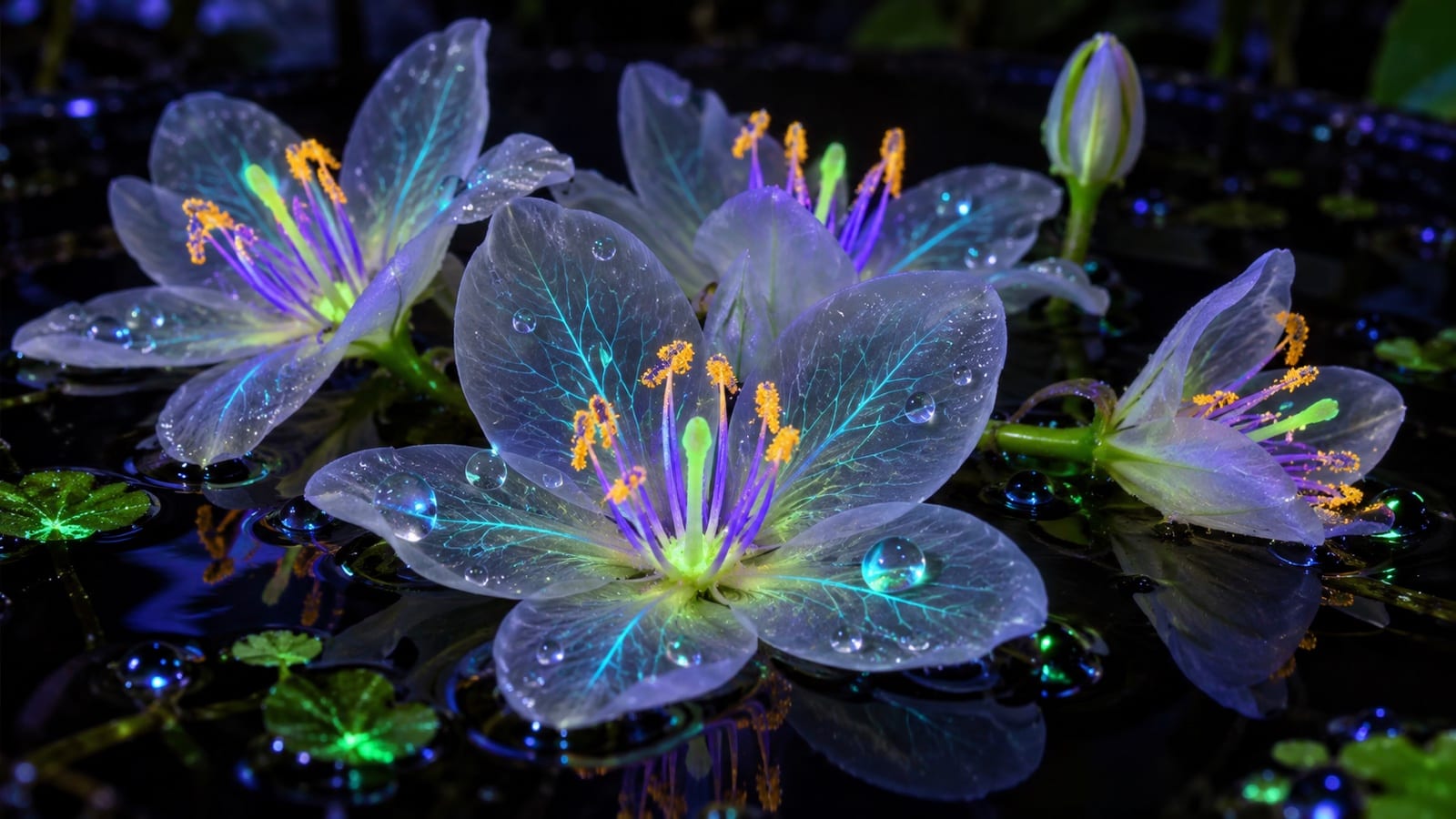
  • Translucent flowers on dark water under ultraviolet, pollen glowing amber and lime, petal veins faintly cyan, droplets catching the light

Lighting

Filtered ultraviolet (blacklight) in a dark room, placed low and to the side so emission reveals texture; no ambient fill. Expose for the brightest emission, keep reflected violet down, and use a UV-blocking filter on the lens so only visible fluorescence reaches the sensor.

Omoro Director's Briefs151 photo shot-lists like this one, ready to shoot from.
$8Get the briefs →

Prompts

Click any prompt row to edit. Copy uses your edited text.

Make
Fluorescence · image
Style

Fluorescence photography under filtered ultraviolet light in a near-black room

Visual cues

only specific materials emitting visible light: fluorescent pigment, dyed textile seams, mineral grains, pollen, coatings, glowing electric cyan, lime, amber, magenta and coral against deep ultraviolet blue and black, crisp material texture, restrained reflected glow, strong colour separation, editorial photograph, not neon signs, not bioluminescent creatures, not a cyberpunk city, not a uniformly glowing scene, no rainbow gradient, no text, no logos

Paste as-is, or add your own subject.

Variant 1 of 8Same style, a different picture each time: new subject, setting, framing and light. Add a model if you want someone in the picture.
Frame
Variant 1 · image
Shot

Photograph: a designer in a dark studio beside a transparent coat on a dress form, fluorescent painted lines and motifs glowing lime, amber and cyan under ultraviolet while the room stays near-black.

Setting

Set in a material or colour research lab. Shot wide, the whole scene with room around it, filtered ultraviolet (blacklight) in a dark room, placed low and to the side so emission reveals texture; no ambient fill.

Detail

Keep pollen, petal veins and tissue lit from within in the frame.

Style

Style: Fluorescence photography under filtered ultraviolet light in a near-black room, only specific materials emitting visible light: fluorescent pigment, dyed textile seams, mineral grains, pollen, coatings, glowing electric cyan, lime, amber, magenta and coral against deep ultraviolet blue and black, crisp material texture, restrained reflected glow, strong colour separation, editorial photograph, not neon signs, not bioluminescent creatures, not a cyberpunk city, not a uniformly glowing scene, no rainbow gradient, no text, no logos.

Palette

Colour palette #07060D #2A1B8F #2EF2F0 #B6FF2E #FF5A7A.

Wardrobe

Dark, non-reactive base clothing so only chosen elements respond: a treated textile, a painted seam, a reactive lace.

Frame

Composed for a 16:9 landscape frame.

Rules

Photographic, not an illustration. No text, no logos, no watermark.
Use as skill

The whole record as a portable skill for Claude, ChatGPT, Gemini, image and video models, or a human brief

The whole record, compiled into a skill another system can work inside: lineage, axes, palettes, type, materials, photography, verdicts and a critique checklist. Nothing is generated; it is the dossier, restructured.

Mood Board

The record applied to your project. The record's kit is free; your brand, references and plates come with membership

Mood board
The Fluorescence board
8 frames · 4 selected
FIG. 4
Dark Adaptation07060DUltraviolet Field2A1B8FEmission Cyan2EF2F0Optical LimeB6FF2ECoral ResponseFF5A7A
Brand and references
IdleBrand and references open with membership
With membership: the brand's own facts and colours in every prompt, references carried into every frame, and the plates generated.
01 · Hero application
02 · Material and finish
03 · Palette in context
04 · Photography direction
05 · Pattern plate
06 · Object
07 · Environment
08 · Digital presence
Demo kit free, the rest with membershipThe record as a demo kit, free. Name a project and it is written for that
Omoro · Mood board · 025-FL
04
The judgement

Whether to use it, what it costs to do properly, and where it stands right now.

Creative verdict, Fluorescence feasibility and strategic recommendation

Two written calls, seven meters, and when to walk away

Creative verdict
Should Fluorescence be the call?
7 meters
FIG. 2
Assessment

Light the material, not the room. Use filtered ultraviolet in deep shadow, choose subjects whose dyes, minerals, coatings or tissue actually respond, and expose for the emission so the texture survives. Keep reflected violet down and let one or two colours carry each frame. If everything glows, or the colour is painted on in post, it has become neon.

Verdict

Right when a material has a hidden colour worth revealing: a dyed textile, a pigment, a coating, a mineral, a specimen, a finish. It suits fashion, beauty, scientific editorial, sport and exhibitions. Borrow the darkness, the local emission and the strong separation of colour; never let the whole frame glow or fake it with a purple filter.

Production cost
Medium

UV lamps with good filtering, reactive materials and a dark studio are affordable, but safe, even ultraviolet over a large set costs more.

Creative difficulty
Medium

The effect is instant; choosing which material answers the light, and keeping everything else dark, is the design.

Execution difficulty
High

Cameras exaggerate violet and clip bright emissions, so exposure, filtering and colour separation need careful control to keep texture.

Risk of misuse
High

It collapses easily into generic neon, rave graphics or a purple filter with nothing actually fluorescing.

Prevalence
Emerging

Common in nightlife and sport, and newly visible in fashion, beauty and material-led campaigns shot under real ultraviolet.

Longevity
Enduring

The physics does not date; what dates is the club-poster styling that often surrounds it.

Brand investment
Medium

Lamps, filters, reactive materials and a controlled dark set; retouching must be restrained.

Avoid if
Everything in the frame glows
Fluorescence is local: it lives in one dye, seam, particle or organism against darkness. A uniformly glowing scene, a rainbow gradient or a soft purple haze has no material doing the work, and reads as generic neon or vaporwave.
You mean neon, bioluminescence or cyberpunk
Neon is a lighting and signage language; bioluminescence is light made by living organisms; cyberpunk is a narrative world. Fluorescence is an optical, material event: ultraviolet in, visible colour out. Borrowing their tubes, glowing sea creatures or rain-soaked city turns it into someone else's style.
Omoro · Creative verdict · 025-FL

Editorial Depth

A Pro feature: origins, practitioners, and pitfalls

Editorial depth
The Fluorescence file
14 sections
FIG. 3
Context02Brands02Perception04Use04Index02
01Common MisconceptionThe principle beneath the surface
02Historical ContextOrigins, cultural moment, and reaction
03Brands That Accidentally Use This StyleNatural alignment, not category claims
04Brands That Perfectly Represent This StyleExceptional execution
05Psychological EffectHow visual decisions change perception
06Visual ChecklistInclude and avoid
07Creative FormulaThe visual system reduced to essentials
08Recognition SignalsHow to recognize it in two seconds
09When To Use This StyleContexts where the language performs
10Common Creative MistakesWhere imitation weakens the signal
11Best Brand ApplicationsIndustries with a natural advantage
12Creative Application AnalysisFit, feasibility, and production reality
13Related StylesClose languages and the key distinction
14Visual DNA SummaryThe sentence to remember
The editorial depth, with membershipOpening soon
Omoro · Editorial depth · 025-FL
05
The index

Neighbours, cross-references, blends, and the questions people ask.

Related concepts

Connected across the creative knowledge graph

Cultural relevance, Fluorescence cultural relevance today

Where it stands now, and what it costs you to use it

Fluorescence fits a moment interested in materials and in what they hide. For fashion, beauty, sport, packaging and product launches, a reactive dye or coating becomes a reveal: the same object carries a second colour that appears only under the right light. For scientific editorial, museums and exhibitions, it turns specimens and minerals into images without inventing anything.

Its risk is that it looks like other glowing styles. The work that lands is photographed under real ultraviolet, with darkness doing half the work and each colour belonging to a material. The work that fails glows everywhere: a purple haze, a rainbow gradient, a lab vial from a stock library, neon tubes or a cyberpunk street. Fluorescence is an optical event, and the picture should show where it is happening.

Cross-references

Infrared PhotographyAnother way of making invisible light visible, from the other end of the spectrumThermal HeatFalse colour from heat rather than colour emitted by a materialRaveWhere blacklight became a club convention, often without the material precisionCyberpunkA narrative world it is often confused with because of shared colours

Blend

Mix Fluorescence with any style in the library, or see the pairs worth trying

Fluorescence×
50%50%
55% alike
Fluorescence referenceInfrared Photography referenceFluorescence 50%Infrared Photography 50%

Merged palette

#07060D

#E98AA0

#2A1B8F

#D9563F

#2EF2F0

Leads organic, cool, analog

Typography · from Fluorescence

IBM Plex Sans over IBM Plex Mono

Materials

  • UV-reactive dyes and fluorescent pigments in fabric, paint and ink
  • Optical brighteners in white paper, cotton and detergent-washed cloth
  • Kodak Aerochrome and Ektachrome Infrared colour film stock

The calls this blend forces

These two disagree on one thing, and a blend cannot average them: you pick a side. At this mix:

Dark or Light? Fluorescence is dark, Infrared Photography is light. This mix lands dark.

Use it

DIRECTION

Create one visual direction that synthesizes Fluorescence × Infrared Photography. Preserve a clear hierarchy; do not make a contact sheet or a collage of unrelated styles.

CHARACTER

Let it read as organic, cool, analog. Resolve the strongest tensions deliberately: dark / light.

PALETTE

Use these colors as a controlled system: #07060D (Dark Adaptation) · #E98AA0 (Blush Canopy) · #2A1B8F (Ultraviolet Field) · #D9563F (Vermilion Leaf) · #2EF2F0 (Emission Cyan).

TYPE

Use IBM Plex Sans for display type and IBM Plex Mono for supporting text.

MATERIALS

Bring in UV-reactive dyes and fluorescent pigments in fabric, paint and ink, Optical brighteners in white paper, cotton and detergent-washed cloth, Kodak Aerochrome and Ektachrome Infrared colour film stock, Infrared-converted digital sensors with a hot-mirror filter removed.

OUTPUT

Keep one subject or one clear interface state in focus. Use the visual language to guide composition, lighting, spacing and material decisions.

Open in blends, with pairs worth trying →

About this aesthetic

What is fluorescence?

Visible light emitted after a material absorbs ultraviolet radiation. The material takes in light the eye cannot see and gives it back, almost instantly, as visible colour. George Gabriel Stokes named the effect in 1852 after fluorspar, a mineral that glows under ultraviolet.

How is fluorescence different from neon and bioluminescence?

Neon is a lighting and signage language: light from gas in a tube. Bioluminescence is light produced by living organisms through a chemical reaction, with no ultraviolet needed. Fluorescence is an optical, material event: a dye, pigment, mineral or tissue absorbs ultraviolet and emits visible colour. Cyberpunk, often dressed in similar colours, is a narrative world rather than a phenomenon.

How do you photograph fluorescence?

Work in a dark room with a filtered ultraviolet (blacklight) source and no ambient light. Choose materials that genuinely fluoresce, place the lamp to reveal texture, expose for the brightest emission, and use a UV-blocking filter on the lens so only visible fluorescence is recorded. Keep reflected violet low and let two or three colours separate cleanly.

Build with the fluorescence aesthetic

Every style in the library is broken down like this one: the palette, the typography, the materials and the lineage.

Explore the style library →