Workwear

Clothes made for labour and worn for their honesty: duck canvas, riveted denim, overalls and chore coats that age with use

Collect references in this style →
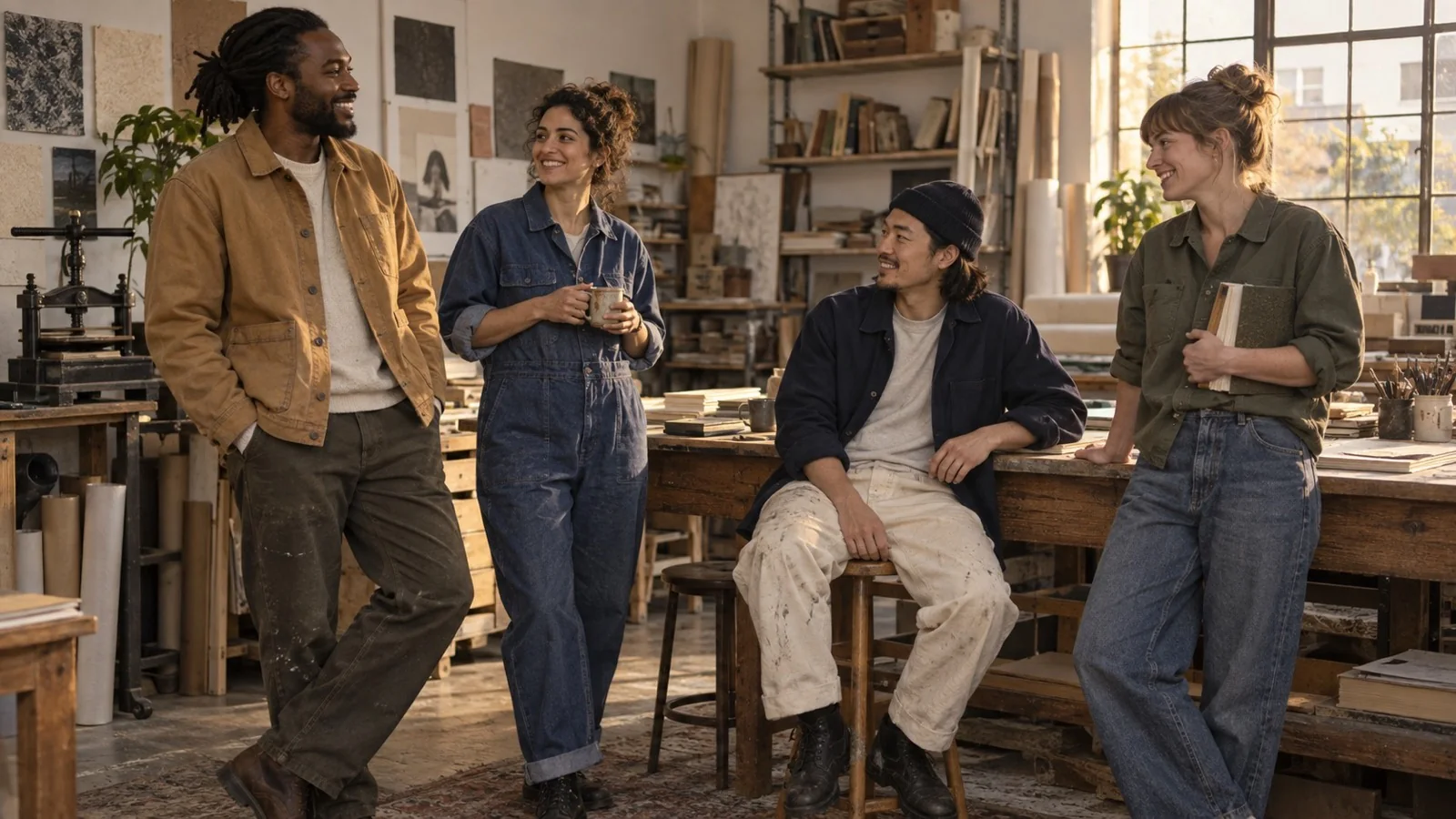
Workwear visual example
Visual language · Workwear

Clothes made for labour and worn for their honesty: duck canvas, riveted denim, overalls and chore coats that age with use

Key colors
Era
1870s to present
Origin
American mills and French workshops, then Japanese and European menswear
Typography
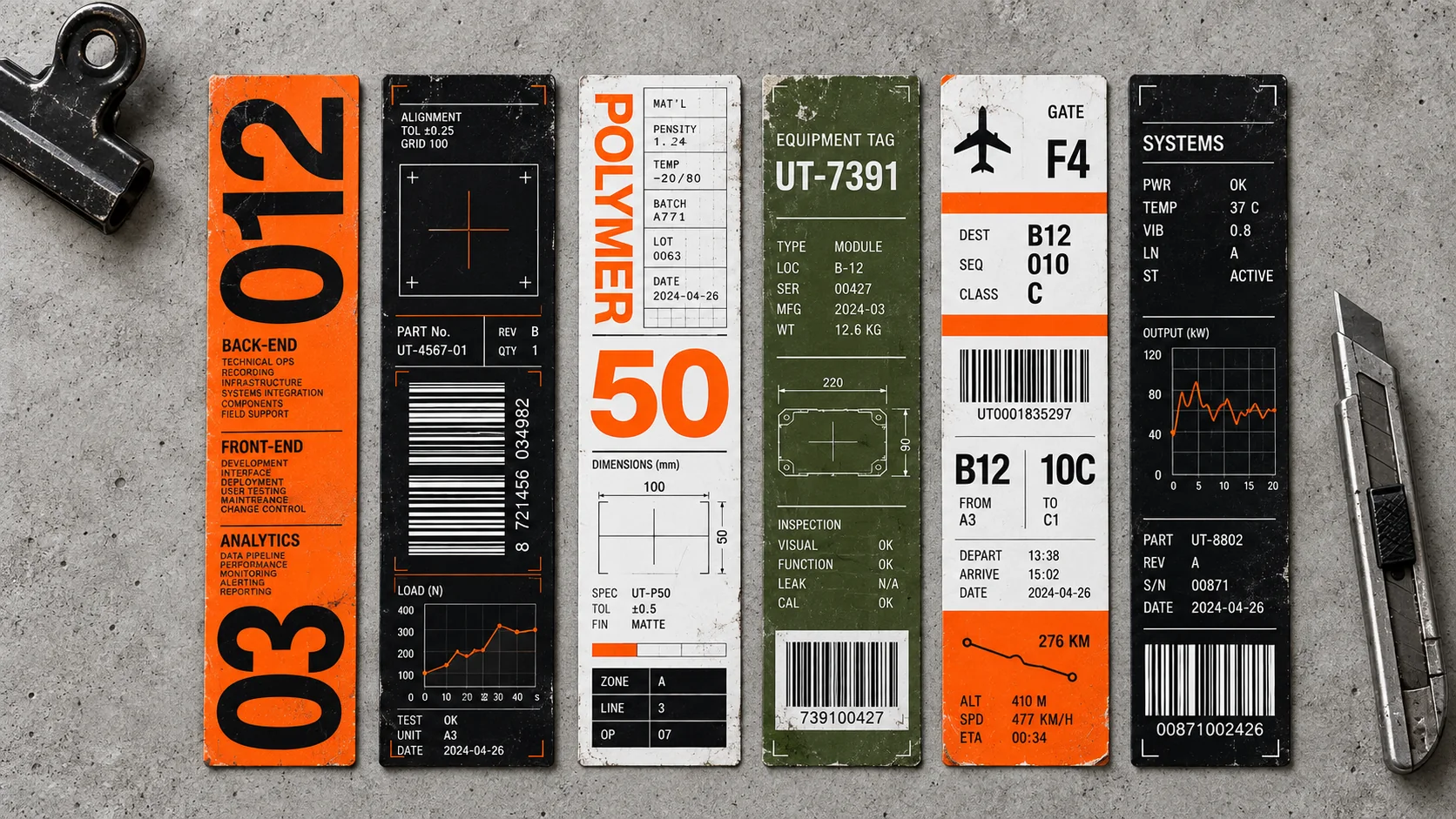
A sturdy slab serif, Stencilled and stamped labels, used sparingly
Best for
Denim and outerwear labels
Explore Utilitarian Design
Record042-WO
AestheticWorkwear
ClassAnalog / Nostalgic
StatusINGESTING
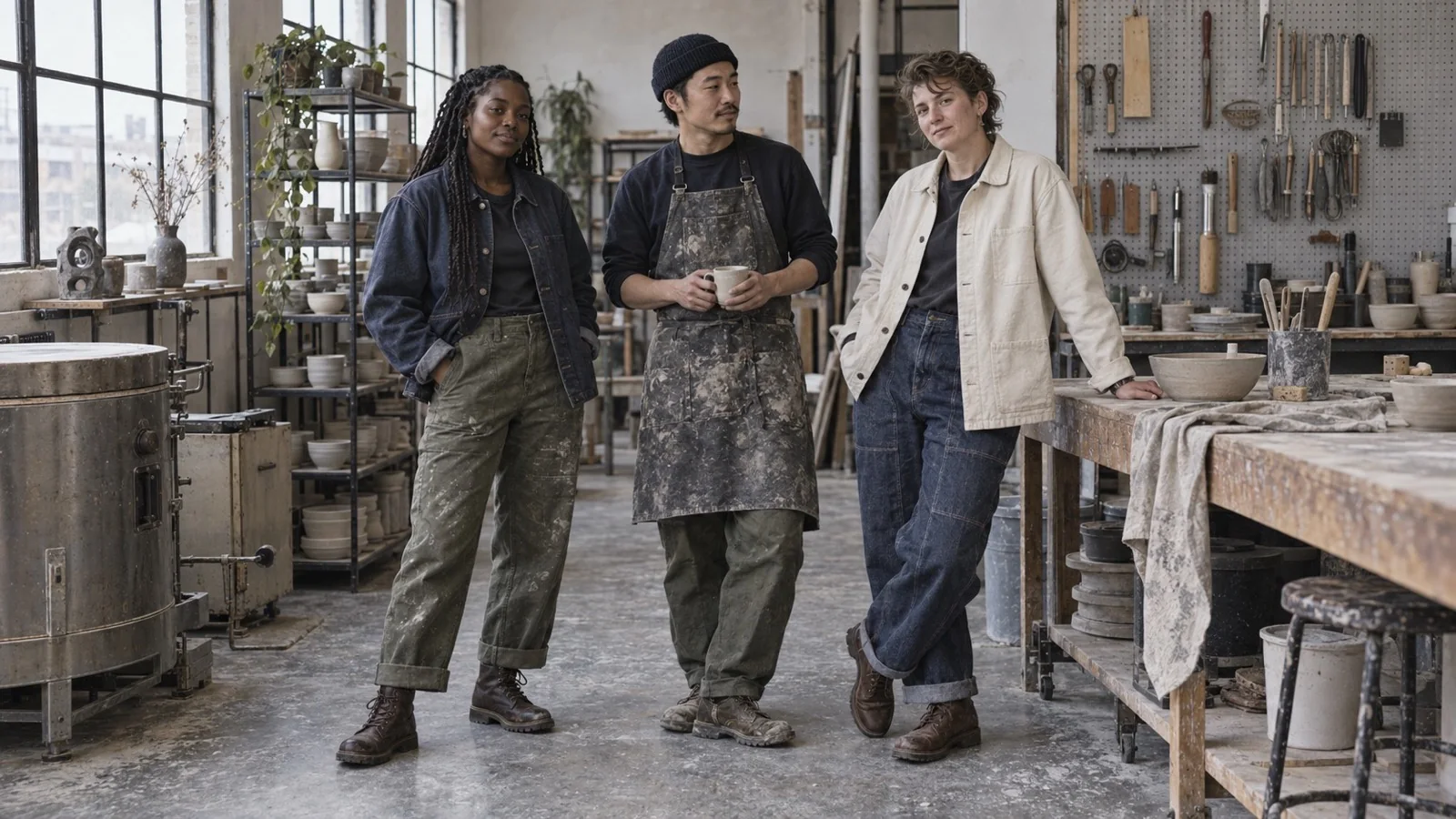
Three potters stand in a daylit ceramics studio in an indigo denim jacket, a clay-splashed canvas apron, a cream chore coat and olive work trousers.
Archive plate · Workwear
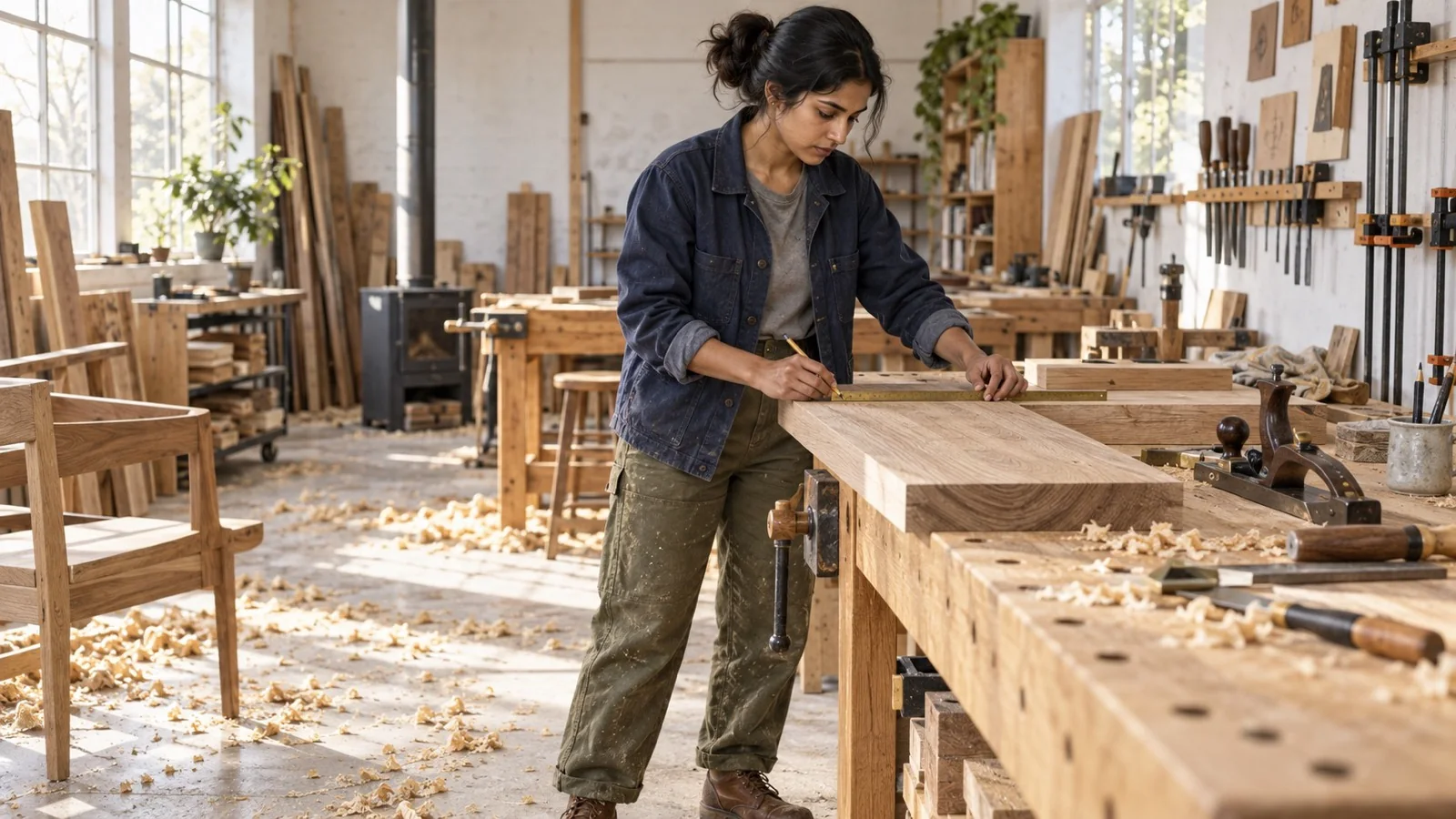
A woodworker in a navy chore jacket and olive work trousers marks a length of oak at a bench covered in shavings.
Dossier sceneWorkshop · 1/5
01
The record

What it is, when it works, who it is for, and where it already exists.

How to use it

Record 042-WO - when it works, who it is for, what it looks like

FIELD 01

When to use it

  • Heritage denim, outerwear and boot makers with real construction to show
  • Craft, trade and maker brands whose customers use their hands
  • Hospitality with a workshop mood: breweries, bakeries, coffee roasters
  • Campaigns about durability, repair and buying less
FIELD 02

Perfect for

  • Denim and outerwear labels
  • Boot and leather makers
  • Breweries, roasters and workshops
  • Tool and hardware brands
FIELD 03

What it looks like

  • Levi Strauss and Jacob Davis, riveted work trousers patent, 1873
  • Carhartt, founded in Detroit, 1889
  • Lee Union-All coverall, 1913
  • The French bleu de travail chore jacket, early twentieth century

In the wild, Workwear aesthetic real-world examples

Where this aesthetic shows up in the real world · ↗ opens the source site

Workwear maker, founded in DetroitCarhartt (opens in a new tab)1889
Workwear maker, founded in Fort WorthDickies (opens in a new tab)1922
Omoro Style GuideEvery aesthetic, every field on this page, in one PDF.
$8Get the guide →
02
The anatomy

Where Workwear came from, what makes it recognisable, and the fingerprint it leaves.

History, Workwear aesthetic history

1870s to present · American mills and French workshops, then Japanese and European menswear

Modern workwear begins with a problem of pockets. In 1873 the tailor Jacob Davis and the merchant Levi Strauss patented copper rivets at the stress points of work trousers, because miners and labourers tore them. The riveted, indigo-dyed denim trouser that followed became the most copied garment in the world. Across the next decades American makers built the rest of the uniform: Carhartt, founded in Detroit in 1889, made duck canvas overalls for railroad workers, and Lee's Union-All of 1913 put the whole body into a single coverall.

In France the same need produced a different look. The bleu de travail, a short jacket of blue cotton drill or moleskin with patch pockets, was worn by builders, mechanics and farm workers through the twentieth century, and artists and intellectuals wore it too. Fort Worth's Dickies, founded in 1922, supplied work trousers by the million. These were clothes chosen for durability and price, and their appeal lay in how they changed with use: canvas softening, indigo fading along the seams, knees and elbows wearing pale.

Fashion noticed slowly and then completely. Japanese makers from the late 1970s, beginning with Osaka's reproduction denim workshops, studied and remade vintage American workwear with obsessive accuracy. In 1989 Carhartt launched Work in Progress for European streetwear, and the heritage revival of the late 2000s made chore coats, selvedge denim and work boots a steady language of menswear. What the style depends on is still the original bargain: construction that lasts, and wear that is earned rather than applied.

Canvas and denim made for work, worn for their honesty, and marked by everything they have done.

Omoro dossier · 042-WO

Visual markers, Workwear aesthetic visual markers

The visual DNA: what makes it recognisable

typography

See the fonts
  • A sturdy slab serif
  • Stencilled and stamped labels, used sparingly
  • Numbers set like lot, size and style tags

grid

  • Full-length figures at work in real places
  • Close details of seams, rivets, bar tacks and wear
  • Daylight from doors and high windows
  • People doing things with their hands rather than posing

materials

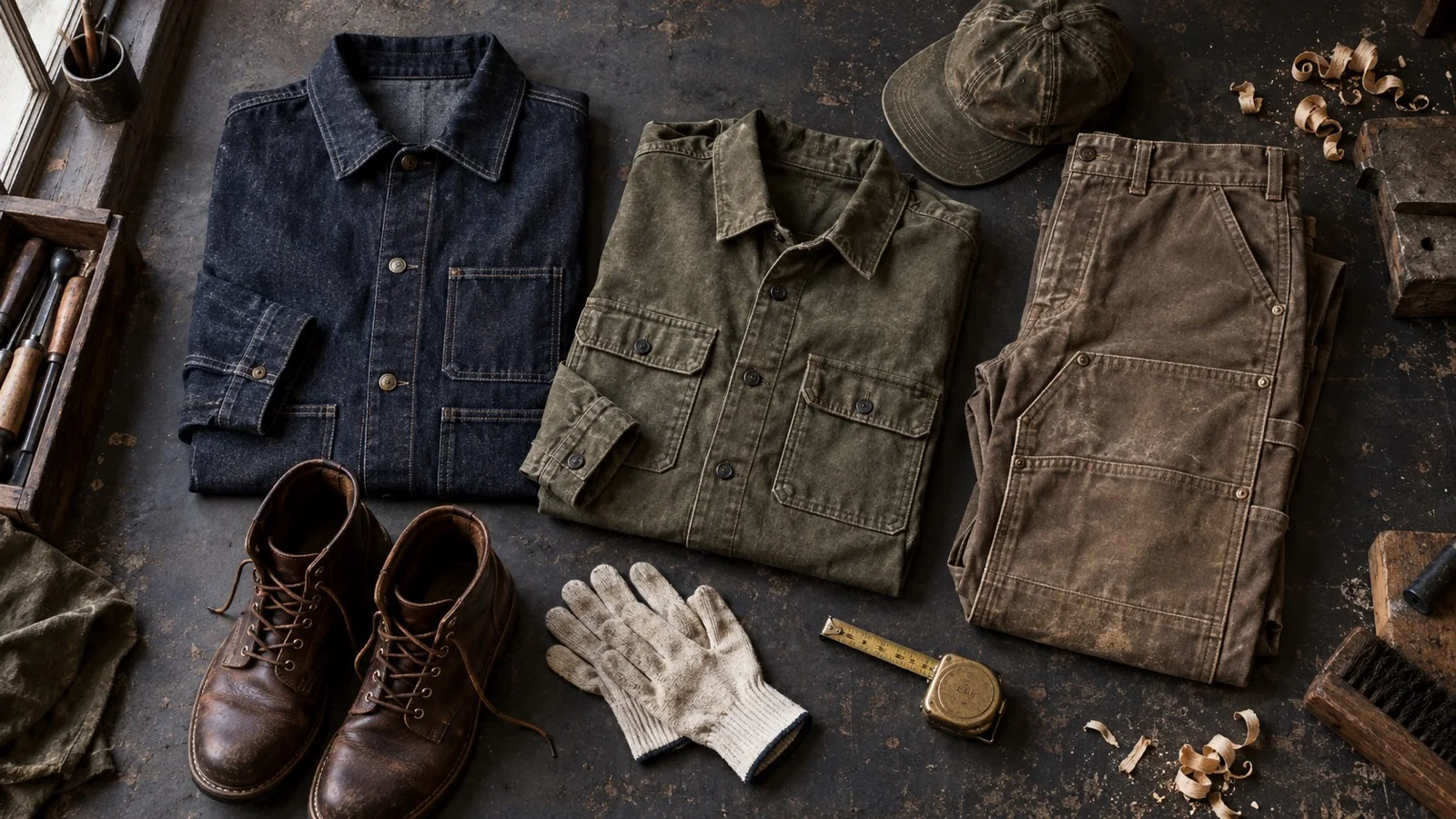
  • Heavyweight cotton duck canvas, as in Carhartt chore coats
  • Selvedge denim and hickory stripe, rinsed and faded through wear
  • Moleskin and French chore cotton in bleu de travail
  • Copper rivets, bar tacks and triple-stitched seams
  • Brass, steel and leather hardware: buckles, snaps and tool loops
  • Flat, practical daylight on scuffed canvas and worn edges

motifs

  • A chore coat with three patch pockets
  • Triple-stitched seams and copper rivets
  • Bib overalls over a plain T-shirt
  • Canvas worn pale at the elbows and knees

Aesthetic profile

8-channel console with the fingerprint on its display. Save the card, or share the page

Aesthetic Profile
Workwear
1870s to present · American mills and French workshops, then Japanese and European menswear
Attribute console · 042-WO
leans analog, nostalgic, restrained
8 CH
FIG. 1
MinimalMaximalAnalogDigitalRestrainedExpressiveWarmCoolNostalgicFuturisticStructuredChaoticDarkLightGeometricOrganic
01Minimal
Maximal30%
02Analog
Digital80%
03Restrained
Expressive50%
04Cool
Warm40%
05Futuristic
Nostalgic60%
06Structured
Chaotic30%
07Dark
Light10%
08Organic
Geometric10%
AnalogNostalgicRestrained
Omoro · Attribute console · 042-WO
omoro.io/styles/workwear

Materials

Named in this style's material notes, 4 materials the library documents

Copper (patinated)MetalDuck CanvasTextileSelvedge DenimTextileLeatherTextile

Key Pieces

The pieces the look is built from, and where the money goes

Chore coat
Boxy, with three patch pockets: the one piece that makes an outfit read as workwear.
Selvedge jeans
Raw or rinsed, worn until they fade to the owner's shape.
Bib overalls
In duck or hickory stripe, over a plain T-shirt.
Double-knee work trousers
Reinforced at the knee; the most practical piece in the look.
Leather work boots
Resoleable, and they outlast everything else here.
LeatherInvestment
Entry: affordable to get right; buy the good basic version · Mid: worth paying for better cloth and cut · Investment: where the money goes; bought once, kept for years

Color Palettes, Workwear color palettes and hex codes

The definitive color scheme for this aesthetic

Workwear
#9B6A3C · #22344F · #2F4E8C · #5E5F3A · #D9CBAE
Duck brown, indigo and chore blue with olive and raw canvas: colours made by dye, sun and wear rather than chosen from a card
Omoro Palette Pack575 curated palettes across every aesthetic, 5 export formats.
$8Get the palettes →

Adjacent Palettes, styles related to Workwear

The colour of the styles sitting closest to this one

Utilitarian Design
Technical Sportswear
Soft Utility
Deconstructed Tailoring
03
The direction

How to shoot it, how to prompt it, and how to board it.

Photo Direction

How to shoot this aesthetic

"Built for labour, worn for honesty: canvas and denim that record the work they have done"

Shot list

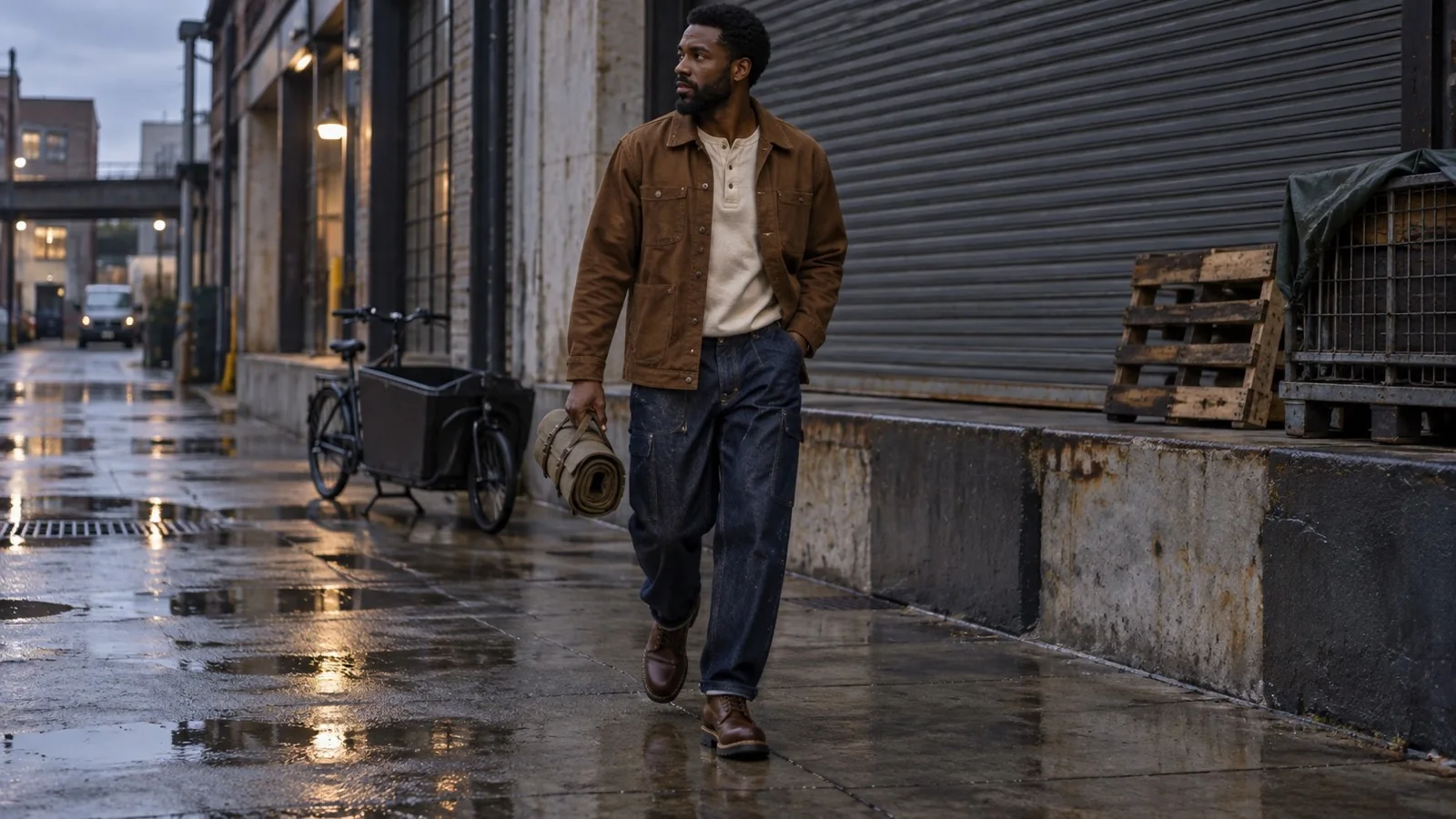
  • Full-length shot of a figure in a broken-in brown duck canvas chore coat, faded indigo selvedge jeans and leather work boots, standing in the open door of a timber workshop in morning light
  • Three-quarter shot of a figure in hickory stripe bib overalls over a white T-shirt, sleeves pushed up, leaning on a workbench covered in hand tools
  • Close detail of triple-stitched seams, a copper rivet and a bar-tacked pocket corner on heavy indigo denim, raking side light

Lighting

Natural working light: daylight through a workshop door, a high industrial window, low morning sun in a yard. Warm and direct, never glossy.

Omoro Director's Briefs151 photo shot-lists like this one, ready to shoot from.
$8Get the briefs →

Prompts

Click any prompt row to edit. Copy uses your edited text.

Make
Workwear · image
Style

Workwear fashion

Visual cues

a broken-in brown duck canvas chore coat with patch pockets, faded indigo selvedge jeans with copper rivets and triple-stitched seams, hickory stripe bib overalls, leather work boots, duck brown, indigo, chore blue, olive and raw canvas, natural daylight in a timber workshop, people at work, editorial photograph, honest wear, no logos, no labels, not a costume

Paste as-is, or add your own subject.

Variant 1 of 8Same style, a different picture each time: new subject, setting, model, pose, garment and light. Keep any of them to change only the rest, or pick or type your own. A garment you type is worn as written, colours and all.
Frame
Variant 1 · image
Shot

Photograph: full-length shot of a figure in a broken-in brown duck canvas chore coat, faded indigo selvedge jeans and leather work boots, standing in the open door of a timber workshop in morning light.

Setting

Set in a woodworking shop full of shavings. Shot wide, the whole scene with room around it, natural working light: daylight through a workshop door, a high industrial window, low morning sun in a yard.

Model

Model: a white non-binary model in their twenties with freckles and copper hair, standing square to the camera, arms loose.

Outfit

Dress the model in a completely new outfit: a fitted dress under a short cape, low heels, the main piece cut in silk organza, mainly duck brown with chore blue. It replaces any other garment or accessory in this prompt and carries the shot's one idea; no hat, bag, jewellery or prop unless it is part of this outfit.

Detail

Keep bib overalls over a plain t-shirt in the frame.

Style

Style: Workwear fashion, a broken-in brown duck canvas chore coat with patch pockets, faded indigo selvedge jeans with copper rivets and triple-stitched seams, hickory stripe bib overalls, leather work boots, natural daylight in a timber workshop, people at work, editorial photograph, honest wear, no logos, no labels, not a costume.

Palette

Colour palette #9B6A3C #22344F #2F4E8C #5E5F3A #D9CBAE.

Frame

Composed for a 16:9 landscape frame.

Rules

Photographic, not an illustration. No text, no logos, no watermark.
Use as skill

The whole record as a portable skill for Claude, ChatGPT, Gemini, image and video models, or a human brief

The whole record, compiled into a skill another system can work inside: lineage, axes, palettes, type, materials, photography, verdicts and a critique checklist. Nothing is generated; it is the dossier, restructured.

Mood Board

The record applied to your project. The record's kit is free; your brand, references and plates come with membership

Mood board
The Workwear board
8 frames · 4 selected
FIG. 4
Duck Brown9B6A3CRinsed Indigo22344FChore Blue2F4E8CWorkshop Olive5E5F3ARaw CanvasD9CBAE
Brand and references
IdleBrand and references open with membership
With membership: the brand's own facts and colours in every prompt, references carried into every frame, and the plates generated.
01 · Hero application
02 · Material and finish
03 · Palette in context
04 · Photography direction
05 · Pattern plate
06 · Object
07 · Environment
08 · Digital presence
Demo kit free, the rest with membershipThe record as a demo kit, free. Name a project and it is written for that
Omoro · Mood board · 042-WO
04
The judgement

Whether to use it, what it costs to do properly, and where it stands right now.

Creative verdict, Workwear feasibility and strategic recommendation

Two written calls, seven meters, and when to walk away

Creative verdict
Should Workwear be the call?
7 meters
FIG. 2
Assessment

Show the construction and the wear. Triple-stitched seams, bar tacks, rivets and a canvas coat that has broken in at the elbows are the whole argument; photograph them close. Shoot in real workplaces with real light, and cast people who look at home there. If the wear was made in a factory to look old, leave it out.

Verdict

Right when the brand makes things that last, or serves people who work with their hands: denim, outerwear, boots, tools, workshops and trades. Borrow the honest construction, the fading colour and the real places; never borrow the look without the durability behind it.

Production cost
Medium

Heavy duck, selvedge denim and good hardware cost more than fashion cloth, but the garments are simple to make.

Creative difficulty
Low

The codes are clear and a century old; the work is in choosing real details over costume ones.

Execution difficulty
Medium

Wear has to look earned. Pre-distressed rips and fake paint read instantly as costume.

Risk of misuse
Medium

It can look like costume, or like borrowing working-class authority, if nothing real stands behind it.

Prevalence
Common

Heritage workwear has been a steady menswear and streetwear language since the heritage revival of the late 2000s.

Longevity
Timeless

The chore coat, the five-pocket jean and the bib overall have barely changed in a hundred years.

Brand investment
Medium

Good cloth, hardware and real locations; the imagery itself is simple to make.

Avoid if
The brand has nothing to do with making or durability
Workwear borrows the authority of labour. Without real construction or use behind it, it reads as dressing up as a tradesperson.
The brief is about technical performance in weather
Workwear is canvas, denim and rivets that wear in. Membranes, taped seams and measured performance belong to technical sportswear.
Omoro · Creative verdict · 042-WO

Editorial Depth

A Pro feature: origins, practitioners, and pitfalls

Editorial depth
The Workwear file
14 sections
FIG. 3
Context02Brands02Perception04Use04Index02
01Common MisconceptionThe principle beneath the surface
02Historical ContextOrigins, cultural moment, and reaction
03Brands That Accidentally Use This StyleNatural alignment, not category claims
04Brands That Perfectly Represent This StyleExceptional execution
05Psychological EffectHow visual decisions change perception
06Visual ChecklistInclude and avoid
07Creative FormulaThe visual system reduced to essentials
08Recognition SignalsHow to recognize it in two seconds
09When To Use This StyleContexts where the language performs
10Common Creative MistakesWhere imitation weakens the signal
11Best Brand ApplicationsIndustries with a natural advantage
12Creative Application AnalysisFit, feasibility, and production reality
13Related StylesClose languages and the key distinction
14Visual DNA SummaryThe sentence to remember
The editorial depth, with membershipOpening soon
Omoro · Editorial depth · 042-WO
05
The index

Neighbours, cross-references, blends, and the questions people ask.

Related concepts

Connected across the creative knowledge graph

Cultural relevance, Workwear cultural relevance today

Where it stands now, and what it costs you to use it

Workwear is fashion's most trusted signal of durability and honesty. For denim, outerwear, boots, tools and any brand built on making things, it says that the product is meant to be used, repaired and kept, which fits a moment wary of fast fashion.

Its risk is costume. When the wear is manufactured and nothing real stands behind the look, it becomes dressing up as a tradesperson. The best work shows real construction, real places and people who are at home in them.

Cross-references

Utilitarian DesignThe same honesty of function applied to products, tools and labelsTechnical SportswearPerformance built for weather, where workwear is built for wearSoft UtilityShares the earth tones and function made friendlyDeconstructed TailoringVisible construction, taken into tailoring

Blend

Mix Workwear with any style in the library, or see the pairs worth trying

Workwear×
50%50%
82% alike
Workwear referenceUtilitarian Design referenceWorkwear 50%Utilitarian Design 50%

Merged palette

#9B6A3C

#E8E2D3

#22344F

#4A5A3C

#2F4E8C

Leads restrained, analog, structured

Typography · from Workwear

Oswald over Roboto

Materials

  • Heavyweight cotton duck canvas, as in Carhartt chore coats
  • Selvedge denim and hickory stripe, rinsed and faded through wear
  • Pressed and galvanised steel, aluminium and powder coat on tools and cabinets

Use it

DIRECTION

Create one visual direction that synthesizes Workwear × Utilitarian Design. Preserve a clear hierarchy; do not make a contact sheet or a collage of unrelated styles.

CHARACTER

Let it read as restrained, analog, structured. Resolve the strongest tensions deliberately: keep the balance coherent.

PALETTE

Use these colors as a controlled system: #9B6A3C (Duck Brown) · #E8E2D3 (Canvas) · #22344F (Rinsed Indigo) · #4A5A3C (Olive Drab) · #2F4E8C (Chore Blue).

TYPE

Use Oswald for display type and Roboto for supporting text.

MATERIALS

Bring in Heavyweight cotton duck canvas, as in Carhartt chore coats, Selvedge denim and hickory stripe, rinsed and faded through wear, Pressed and galvanised steel, aluminium and powder coat on tools and cabinets, Cotton canvas, nylon ripstop and polypropylene webbing with bar-tacked stitching.

OUTPUT

Keep one subject or one clear interface state in focus. Use the visual language to guide composition, lighting, spacing and material decisions.

Open in blends, with pairs worth trying →

About this aesthetic

What is workwear style?

A way of dressing built from clothes made for labour: duck canvas chore coats, riveted denim, bib overalls, hickory stripe and work boots, valued for their construction and for the way they age with use.

What is a chore coat?

A short, boxy work jacket in canvas, drill or moleskin with three or four patch pockets. The French bleu de travail and the American duck canvas chore coat are the two classic versions.

How is workwear different from utilitarian design?

Utilitarian design is a broader language of function on show, across products, packaging and interfaces. Workwear is specifically about clothing made for labour: canvas, denim, rivets and the wear that comes with use.

Build with the workwear aesthetic

Every style in the library is broken down like this one: the palette, the typography, the materials and the lineage.

Explore the style library →